Blog and recipes

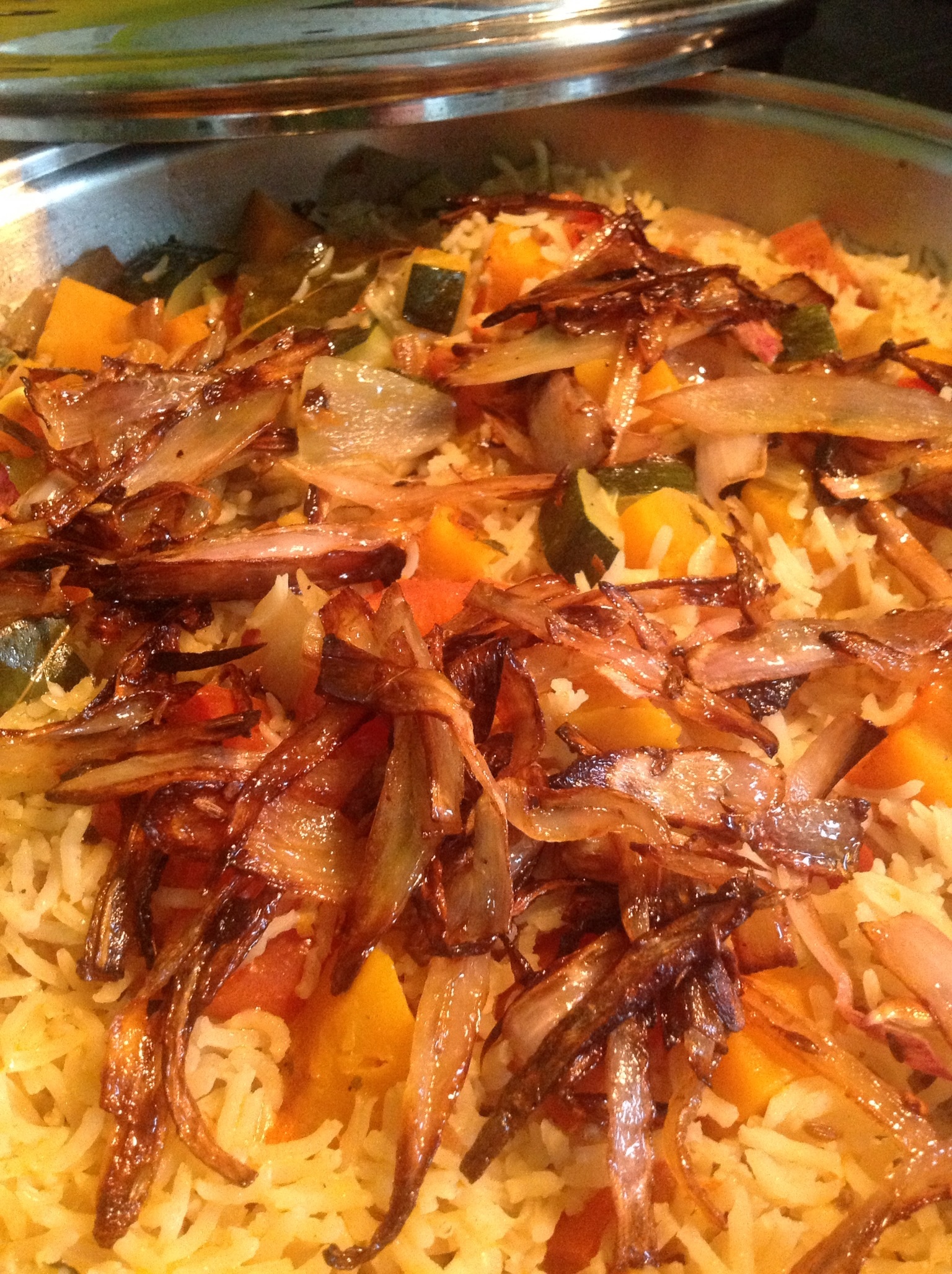
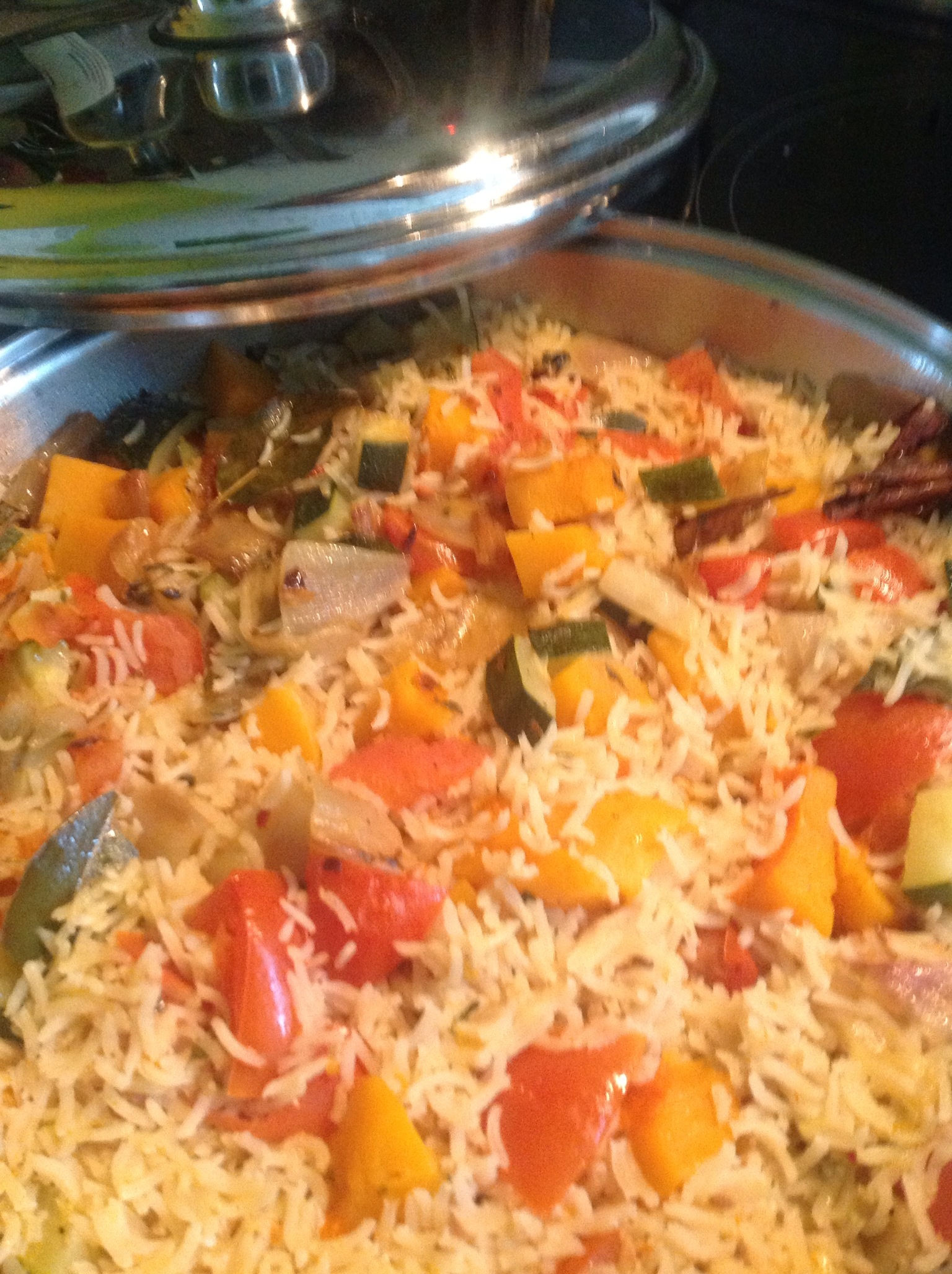
Biryani on a hot, sultry July day

It was hot. Sultry. Steaming. Oppressive.  And that was just in the garden.  I had the germ of an idea for supper but it felt incongruous. But then again, it felt right. Vegetable biryani. All the windows and doors were wide open but not a breath of cool air. I was drawn to warm sweet spices – cumin, cinnamon, chilli, cardamom this evening.

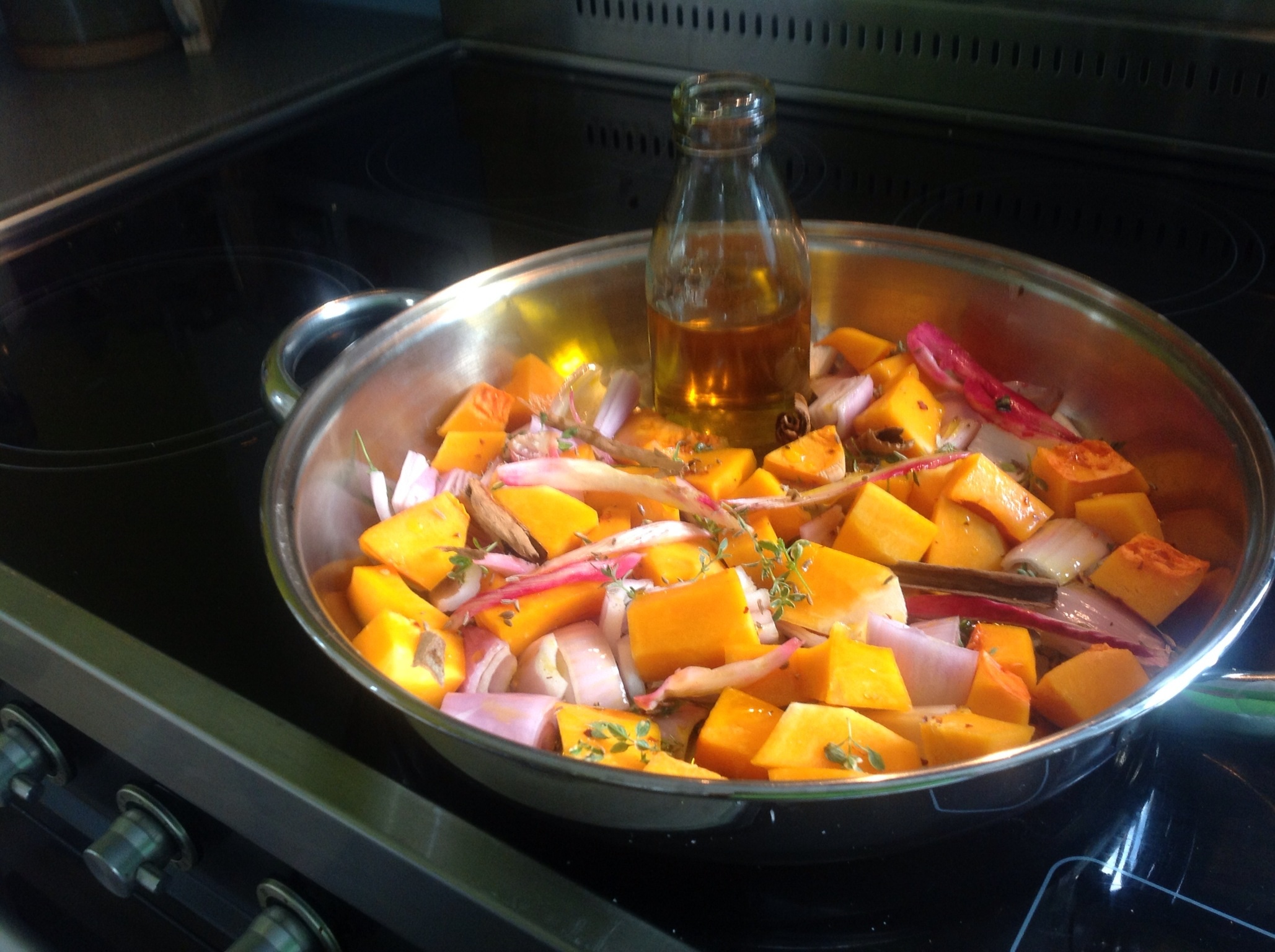
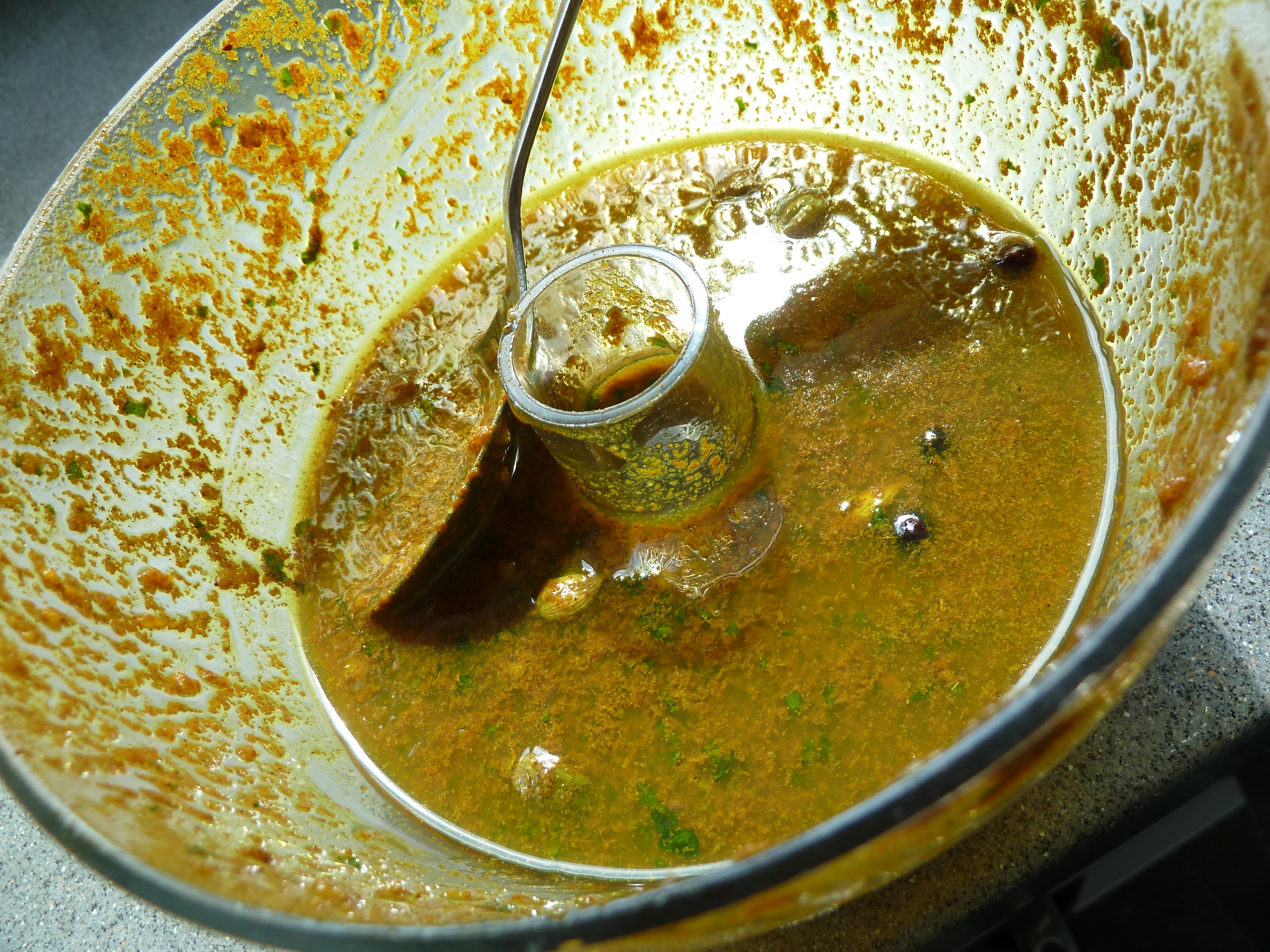
In a heavy based wide shallow pan warm plenty of (about 30ml)  gorgeous Yare Valley rapeseed oil. It is so beautiful. Almost the colour of saffron.Lightly cover the bottom of the pan with chilli flakes and cumin seed, crushed green cardomom and half a stick of cinnamon broken into pieces.  Let the spices heat very gently, then added sliced shallot, some chopped fennel, chunks of the last butternut squash from last year’s winter garden, and chopped courgette – cooking them gently for 10 minutes with the lid on.  Then turn up the heat, added a large chopped tomato (minus the pips), black pepper, a little salt and a scant dessert spoon of sugar which combined with the high heat will char the edges slightly.  By now the vegetables should be just cooked but still firm.  Add two handful’s of basmati rice quickly followed by 750ml hot vegetable stock and the lid!

When the steam is vigorously belching out from under the lid, KEEP THE LID ON and turn the head down low, letting it gently steam away.  Don’t be tempted to lift the lid. The idea is that the stock turns to steam and the steam hits the lid then drops back down on the rice. That way you get lovely fluffy rice and no mush.

Whilst it is placidly gurgling away to itself on a low heat, put more rapeseed oil into a pan and add more cumin seed and chilli flakes then fry sliced onions until golden brown.  You will have noticed that these so-called measurements are desperately imprecise.  That’s because 1) whatever is in the fridge will go in the Biryani, 2) I have no idea how hot or spicy you like your Biryani but you do! 3) The freshness of your spices will influence the over all flavour.  A gorgeous Biryani will be full of flavour and spice without it overwhelming the flavour of the vegetables. The spicing should enhance the vegetable flavours, not drown them.  Anyway, after 20  minutes  (with the lid on!) the Biryani will be ready. Resist temptation.  Just leave it there for another 10.  The flavours will develop and will offer up intense warm spicyness and aroma without too much of a fiery chilli hit. When you are ready to eat, simply remove the cinnamon sticks and discard them, and  tip the crispy onions onto the top.  In my view the Biryani is best eaten about 30  minutes after this – still warm and definitely not hot.

Me. Him. The sofa.  Beer. Wallander.  The rain and the thunderstorm came about  2 hours later.

Simon’s birthday cake

Sometimes you just happen across good people. Simon is one of them. He’s clever. He’s handsome. And he is my IT saviour. Although he lives the other side of the country and we have only met face to face twice in 10 years, he has the uncanny knack of being reassuringly there in the back of my mind. And so I know that if I meet the big blue screen of death, he can probably save me. And if I have totally messed something up in the bowels of my iPad, laptop, iPhone or PC, somehow he knows how to manage me out of a disaster. His ‘virtual’ reach is infinite. It is just magical to see him working on my computer. Him in Lancashire – me in Norfolk; the little cursor scurrying across the screen, the muttered curses (his) at the end of the phone. So this is for you old chap. I can’t bake it for you but you could bake it for yourself or maybe Paula will. Happy birthday! This is an unashamed lift from Nigella. But I know she won’t mind. And she deserves to be associated with a good man.

Nigella’s Guinness cake

250 ml guinness
250 grams unsalted butter
75 grams cocoa powder
400 grams caster sugar
142 ml sour cream
2 large eggs
1 tablespoon vanilla extract
275 grams plain flour
2 ½ teaspoons bicarbonate of soda
for the topping

300 grams cream cheese
150 grams icing sugar
125 ml double cream (or whipping cream)
Method

Preheat the oven to gas mark 4/180°C/350ºF, and butter and line a 23cm / 9 inch springform tin.
Pour the Guinness into a large wide saucepan, add the butter – in spoons or slices – and heat until the butter’s melted, at which time you should whisk in the cocoa and sugar. Beat the sour cream with the eggs and vanilla and then pour into the brown, buttery, beery pan and finally whisk in the flour and bicarb.
Pour the cake batter into the greased and lined tin and bake for 45 minutes to an hour. Leave to cool completely in the tin on a cooling rack, as it is quite a damp cake.
When the cake’s cold, sit it on a flat platter or cake stand and get on with the icing. Lightly whip the cream cheese until smooth, sieve over the icing sugar and then beat them both together. Or do this in a processor, putting the unsieved icing sugar in first and blitz to remove lumps before adding the cheese.
Add the cream and beat again until it makes a spreadable consistency. Ice the top of the black cake so that it resembles the frothy top of the famous pint.

Dinner with friends and the Antrim duck

1-photo (3)In my world there is little that can compare with an uninterrupted day in my kitchen and the prospect of good friends coming for dinner. Inexplicably, the garden is groaning with produce at the moment – I guess it is harvest festival season – but generally my produce is waining by now. But this year we still have three rows of Pink Fir Apple potatoes to lift, more beetroot than we can eat, new shoots and green leaves on chard, a couple of rows of spinach, salads. Super Marmande tomatoes and about 15 aubergine.

I intended that we should start with a carpaccio of beetroot with wild sorrel and ricotta sprinkled with gremolata. As it turned out the ricotta was replaced by feta because I failed to make the ricotta in time. For the beetroot, gently boil in 50ml balsamic vinegar, 50g sugar, grated orange rind and the juice of an orange, a cinnamon stick until the beets are only just tender. Then skin and allow to cool.

Gremolata is a magic combination of parsley, garlic and lemon rind minced finely with the mezzaluna. You can make it in advance and if you have too much, put in an airtight jar and store in the fridge. When you’re ready to serve the beetroot starter, dress the salad leaves and sorrel with a tart vinagrette, slice the beetroot very thinly either with a very sharp thin bladed knife or a mandolin. Then place a spoonful of ricotta or crumbled feta on the plate and sprinkle with the gremolata. Dot with the well reduced cooking liquour, boiled till it is thick and syrupy.

Next was the Antrim duck that managed to survive HM Customs examination at Belfast City Airport earlier in the year. She gently defrosted overnight on her haunches, so any remaining blood didn’t contaminate the flesh and was patted dry. I stuffed her with the Christmas recipe of mashed potato and apple then roasted on a high heat – 220C – uncovered and breast side down on a bed of carrot and thick bacon offcuts for about 1 hour and 15 minutes. On balance I think she was too well done for me, but then although I like my game on the pink side, others definitely do not. Out of the oven to rest for about 20 minutes, gravy made by mashing down the roasting base and deglazing with a good glug of red wine then added garlic broth (see next) and seasoned to taste. In facet the bacon had leant its own seasoning and it needed just a little black pepper.

The vegetables were flash roasted Pink Fir Apples. I am now in the habit of cooking the roast potatoes till they are 75% done then taking them out, roasting the meat and whilst the meat is resting after it is cooked, returning the potatoes to finish off. Definitely works and no hysterical juggling of shelves and last minute panics necessary. Red cabbage with apple and cider had been cooking down for about 4 hours so that just needed reheating. The greens were chopped chard, cos lettuce from the garden cut in quarters, and peas. Place on a large knob of butter in a wide shallow pan and clamp on the lid and rack up the heat. When steaming add 75ml garlic broth, lid on again for 5 minutes by which time the broth will have disappeared and created a glassy emulsion with the butter. Season with black pepper and turn into a dish.

Garlic broth is a favourite of mine instead of vegetable stock. Put 450ml water in a pan and the trimmings from two onions (tops and bottoms plus the skins), two large gloves of garlic cut into pieces, and a little salt. Bring to the boil and reduce to about 350ml. Use this for either cooking the greens (as above) or as the basis for a vegetarian gravy. Now you know it, you will probably find 1001 uses for it.

Finally the pudding. We have taken about 30 pears off our one cordon pear tree which is against a south facing wall. In spite of this the pears didn’t ripen. I tried putting them in a paper bag with a banana (which is supposed to ripen them). It doesn’t by the way. So now my freezer has foil containers full of cooked pears. Tonight I made pear and apple crumble and we used up the remaining plum icecream to serve with it.

The outcome? The beetroot was gorgeous and the gremolata lifted it into light lemony heaven. The duck was gorgeous. Deep dark meat but not too gamey. As always it confirmed that the potato and apple stuffing is the best stuffing for game birds. The greens were still brilliant green and so tasty. The hot sweet crumble with the cold and tart plum icecream made the tastebuds zing.

John, you should have eaten slower. And sneaking single potatoes dipped into the gravy boat before we had pudding is probably why you had indigestion before you left!!

Celeriac

Yummy yummy in my tummy. Celeriac is one of my favourite vegetables. Last year we fell into Josef’s vegetarian joint in Bury St Edmunds. Sadly, when I Googled it just now, it looks like it’s closed which is a shame because it was there that I experienced a celeriac burger. It was a revelation and I have been trying to replicate it ever since. Think I’m there now. And Joseph – wherever you are, hope life is good for you and that you are happier than your Google post implied.

Using a sharp knife, peel the knobbly bits and the skin off the celeriac, then slice it into 2cm rounds. This is your burger so treat it carefully. Pour some vegetable stock into a wide shallow pan. (If you are really keen you can make your own from the washed celeriac peelings, a sliced onion and the skin, a clove of garlic, a carrot, a bayleaf, some thyme and some of the the washed celeriac tops. Boil these in about 750ml water and add salt at the end of the process, not at the beginning).

Place your celeriac rounds into gently simmering stock and cook till the middle bit is only just tender. Don’t overcook. Then take out and drain on kitchen paper. Meanwhile make some fine wholemeal breadcrumbs in the food processor – maybe 25% of a loaf. Add a little salt and a grind of black pepper and half a flat teaspoon of cayenne pepper. Put these on a flat plate. Beat two eggs in a bowl. Now comes the messy bit. Line up the following – right to left. Drained celeriac. Beaten egg. Breadcrumbs. Clean plate covered in lightly oiled clingfilm. Take a burger and drop into the beaten egg and make sure it is coated all over. Then lift it into the breadcrumbs and press them into the soggy egg covered celeriac. Then move onto the plate. When you’ve done this to your celeriac rounds place the plate in the fridge. This will firm it all up. The trick to achieve is 1) don’t overcook the celeriac. 2) leave them to rest in the fridge before you cook them.
You could freeze it at this stage if you wanted to.

Now, add enough golden rapeseed oil to a frying pan so that when you add two or three burgers there is plenty of room around them and the oil comes half way up the burger. You need the oil to be hot but not smoking. But equally if the oil temperature is too low, too much will soak in. The key to frying is achieving the correct temperature. The best way to test is 1) brink it up to smoking point then take off the heat and leave it for 3 minutes before returning the pan to the ring on a lower heat and/or 2) throwing in a small piece of bread which should immediately bob up to the surface and begin to sizzle. Frying food is not bad for you – if you get the oil temperature correct then the food cooks quickly and the outside is crispy. The worst thing is frying in oil where the temperature is too low – then the oil is absorbed by the food and is greasy and won’t crisp. So fry your burgers – about 3 minutes each side – then drain and place in a bun full of salad and onion and with whatever relish you like. Sometimes I add a sprinkle of gremolata on the burger (picture above). Finely chop flatleaf parsley, garlic and lemon zest – I put this in a jamjar and it keeps fresh for about a week.

More ideas for celeriac…………..
Grate it, then add a thick vinaigrette dressing made with wholegrain mustard (one crushed garlic clove, twist of salt and pepper, half a squeezed lemon, 5ml runny honey, 10ml (two teaspoons) wholegrain mustard, 50ml good oil).
Or mash it. Peel and chop into chunks then boil it and drain it. Put back in the pan with a good knob of butter and white pepper, 15ml cream or yogurt then mash. Sometimes I add grated parmesan.
Gratin it. Slice thinly and blanch slices for two minutes then drain. Put in a dish, alternating layers of thinly sliced onion and garlic and celeriac. Pour single cream or full cream milk over and add a dusting of parmesan. Bake in the oven for about 1.5 hours.
Make soup with it. Combine with equal amounts of celeriac, chopped carrot and onion. Saute gently with the lid on then add 750ml or so of stock and simmer gently. Whiz with a stick blender until about 50% is blended (or 100% if you prefer a smooth soup).

Cavalo Nero

photo (1)

Black cabbage to you! or Tuscan kale. Either way it has long stemmed leaves and a beautiful range of colours from black to deep dark green. It has a dense flavour – lots of iron. I love it. So do the caterpillars in my garden – it attracts them like a bee to honey. My favourite way to eat it is with pasta. any pasta. Yes I know I have said on these pages that I don’t crave pasta. But with cavalo nero I make an exception. So gather your ingredients. This is done and dusted, pan to plate in less than 15 minutes. Proportions here are for two. Lay the table now, and pour the wine.

Fill your kettle and bring to the boil. Meanwhile take your cavalo nero and wash it (just checking for caterpillars here). Split the stems and cut out the bottom bit if they are a bit thick. Then pile the leaves atop one another so you have a stack – maybe eight or ten leaves depending on the length. Roll them up length ways and then starting from the top, finely slice from top to bottom. Posh chefs call this a chiffonade http://www.youtube.com/watch?v=iRLNS62ITqo
By now the water will have boiled. Pour into a large saucepan and add salt. Never, never cook pasta without salt. To do so is like cooking bread without salt. Or eating roast potatoes without salt. Yuk. Add enough pasta for two – penne, conchiglie, orchiette, or linguine, whatever takes your fancy – and cook till just underdone.

Meanwhile add plenty of excellent olive oil to a shallow pan, add the zest of half a lemon and two grated garlic cloves. Keep it moving so the garlic doesn’t frazzle. Then add the cavolo nero and 30ml water from the pasta pot. Stir it round, add a little salt, then clamp on the lid, shake it around a bit and cook on a high heat for 5 minutes until just al dente. Your pasta should be ready, so drain it and leave in the colander over the saucepan, reserving about 50ml of the cooking water. Pour 25ml olive oil over the pasta and a good grind of black pepper. Lift the lid and test the greens. They should still be bright green, but cooked, and there should only be a speck of water left in the pan. Now add a large handful of grated parmesan to the greens, about 50ml single cream or creme fraiche, then the pasta and the reserved cooking water. Toss with two large forks until all the ingredients are combined. You should have a bright green mixture of cavolo nero, garlic, parmesan and pasta coated with a creamy sauce. Sometimes I add some chopped basil at this stage. Finish off with a squeeze of lemon juice and grate more parmesan on the top and lots of black pepper. Ready to eat. You can use ordinary garden kale in this way, also.

Post script: the veggiebox has twice had those purple globed vegetables that look like purple-all-over turnips. I have to reveal that I detest turnip. They are the devil’s food. Many friends of mine love them. I do not. If they remain ubiquitous next week, I shall be forced to invent a recipe for them, as I must admit that I have none in my repertoire. If you have a favourite turnip recipe, let me know. You could write a guest blog on turnips, just for fun!

Membrillo


Dulce de membrillo or Carne de membrillo in Spanish, marmelada in Portuguese, codonyat in Catalan, cotognata in Italian. Anyway you like, membrillo is tart/sweet and made from quince. My favourite method is to add rose scented geranium leaves which add a beautiful soft rose aroma. When you cook quinces they turn from apple green to deep crimson in about 2.5 hours. The membrillo is traditionally eaten with Manchego cheese. It can also be eaten as marmalade – which is a favourite in this house. Or you can make quince jelly, or quince cheese. I’ll tell you how to make them. All start with the same ingredients.

You can also roast quince alongside a joint of lamb – or poach them in a syrup containing rose scented geranium leaves, or a vanilla pod. You can add them to poached apples or pears too. Serve them simply, with fresh cream or icecream and a crunchy tuille biscuit. You won’t be disappointed. Heaven!

I bitterly regret not planting a couple of quince trees when we moved here. Knowing we are likely to move in a couple of years is now putting me off planting them – but maybe, just maybe I will next year.

However. Back to the membrillo. This year I was searching, searching for quince and finally found some last week at the farm shop, very late in the season.

First prepare your quinces. Peel them first. This is easiest with a vegetable peeler. Stand them on end and slice off thick quarters, just clean of the core. Quince do not ripen, they are always very hard – so use a sharp knife and a good strong board. Shave off the fruit that remains on the core and add to the quarters. Don’t waste a bit. Chop each quarter in half and place in a pan containing water and the juice of half a lemon (simply to stop them turning brown). Continue preparing the quince in this way until they are all done. You will notice I haven’t given you any proportions or weights at this stage. That’s because you need to put the fruit into a clean preserving pan and cover with water, bring to the boil and cook for about half an hour until they are soft. Then strain the water off. This is the stage at which you weigh the fruit. Put the fruit back into the preserving pan and add an equal amount of preserving sugar. The amount of cooked pulp I was left with today was 1.4kg. So I added 1.4kg of preserving sugar and then 8 rose scented geranium leaves. (you can leave these out if you prefer)

Bring it slowly to the boil, stirring occasionally, then cook for up to 2 hours on a gentle boil. During this time, the fruit and its syrup will turn ruby red and the aroma will fill the house with a subtle rose scent. After two hours the pulp will be thick and syrupy and at this stage – if you want to use it as marmalade – you simply decant into hot jars and seal. If you want to make dulce de membrillo that you can slice and eat with cheese, then cook it for a further 15 minutes until even more syrupy. Remove from the heat for 15 minutes, then remove the geranium leaves and put the pulp into the food processor and whizz until it is thick and has no lumps.

Turn the oven on to 120C. Lightly oil a heavy dish or metal pan and then line it with baking parchment and scatter more geranium leaves in the bottom. Pour the pulp into the dish and cook, uncovered, for one hour. Take out of the oven, leave it in a cool place overnight to set completely. Then slice into portions (I got 12 portions from 1.4kg fruit). Lift each portion onto a piece of baking parchment and fold the paper over, securing with brown string. This makes a great Christmas present with a chunk of Manchego cheese or a bottle of Port!

However, if you prefer a quince jelly, pour the mixture into a jelly muslin and strain it for 24 hours till all the juice has run through. You might be tempted to push more through, but the more you do that, the cloudier the jelly. Return the juice to a pan with the juice of half a lemon. Bring to the boil again and rest for 15 minutes. Then pour the jelly into jars. Don’t waste the pulp. You can either make some membrillo or jar it up for more marmelade.

If you want to make quince cheese, then for every 400g cooked pulp you will need 65g lemon juice, 125g unrefined caster sugar, 4 whole eggs, 75g unsalted butter, cold cut in to small pieces. Put the pulp into a double boiler and heat it slowly. Then mix the lemon juice, sugar and eggs in a separate bowl. Slowly add the mixture to the pulp, heating it gently and stirring it till it thickens. Don’t be tempted to cook it too quickly or the eggs will cook and you will end up with quincy scrambled eggs! When it is thick, drop in the cubes of butter, stirring all the time. Let the curd cool completely and then pour into hot jars, and seal.

If you have never used quince before then I hope this has encouraged you. Look out for them next year!

Warm winter stew with herby dumplings

Well here’s Charlie’s veg box in week 4. Week 3, sadly, disappeared in a haze of paracetamol, lemon and honey. No matter – let’s get on with the show. And stop coughing!
The sight of this wonderful mixture steered me toward comfort eating. Now it’s true that the cold I’ve had makes me want to eat one handed. You know, the sort of food you can only eat with a spoon, from a warm bowl of steaming goodness which is comfortably nestled against the chest whilst curled up on the sofa….. the other hand ready with the tissues etc….. but there really is little to match the rich earthiness of root vegetables cooked in a rich broth and topped off with little dumplings, all light and herby. It just tastes so damned nourishing.

I realise of course that you might not keep home made vegetable stock in your freezer. Elsewhere on this blog you will find a recipe if you are so inclined. Thus you can always use my standby. A Knorr vegetable stock pot (those little plastic ones that come in packs of four), zhooshed up a bit with one tablespoon light soy sauce, one tablespoon of that good old standby Burgess’ mushroom ketchup and one clove of garlic (crushed) and all added to 750ml boiling water.

Prepare your vegetables. One chopped onion, one sliced leek, two chopped carrots, two chopped potatoes, and any other root vegetables you have to hand (turnip, celeriac, kohl rabi). The key is to have a mixture and to ensure a balance of flavours. Remember that vegetables such as parsnip have a strong flavour which tends to dominate whatever it is cooked with, so you will need fewer of them). Start by gently frying off the onion and leek in some butter. Then add two large mushrooms, sliced into about 8 pieces, add a bay leaf and a couple of sprigs of rosemary, and stir until coated in the butter. Then add the rest of the vegetables. Put the lid on and sweat them for about 5 minutes on a medium heat. Then add the stock, bring to the boil, turn the heat down and cook with the lid off for about 25 minutes. Check the seasoning. You are aiming for rich, deep, earthiness – not thin, watery and insipid! If it’s not quite there, continue cooking until the stock has reduced a bit more.

While this is cooking, measure 100g self raising flour, pinch of salt, a good handful of finely chopped herbs such as parsley, thyme and sage, 50g suet (vegetarian or otherwise – you can also use butter. But not margarine!). Blend the fats into the flour, then bind together with about 75ml cold water. Be gentle, just bring it together into a ball. Then divide into about 10 small balls. For the wheat intolerant, I have successfully made dumplings with a 50/50 mixture of chestnut flour and gram (chick pea) flour.

Whenee!n you think your vegetable stew is nearly ready (and you will only know by tasting it), drop the dumplings onto the vegetables and stock and let them simmer gently – probably no more than 10 minutes. The knack is to judge how much stock is left in the pan, and remember that the dumplings will absorb some of the stock. After all, you will want gravy won’t you? When done, take off the heat and leave for 5 minutes and just before serving, sprinkle some chopped parsley over the top.

Now. Prepare the following. Sofa and cushions. Maybe a blanket. Turn off the phone. Box of tissues. Radio – preferably lunch time edition of The Archers. Logs piled up beside woodburner. Kitchen towel. Large bowl. Spoon. Imagine………. a cold windy day with rain lashing on the window. You on the sofa. Artfully drape kitchen towel on chest. Bring bowl up to just under your chin and spoon the warm vegetable stew and light herby dumplings in. Comfort food, or what? Bring on the black and white matinee.

Pear and caramelised walnut tart

Turn the oven on to 180C (no fan) and preferably with heat coming from the base, if your oven will do this.

Peel, quarter and poach pears in a light sugar syrup (3tbsp unrefined caster sugar and 150ml water). Remove from syrup and cool.

Add 150 unrefined caster sugar to a shallow pan on a high heat. If you leave it, it will turn dark dark brown and probably set off the fire alarm. When it does, whack the alarm with a tea towel and take it off the heat. Pour in 150ml single cream (stand back, make sure you are wearing an apron), stir all the time until the caramel and cream are combined, then add about 50g cold butter and 150g chopped walnuts.

Now. Unfurl your ready made puff pastry.

Grease a loose bottomed flan case and line with the pastry. Place the pears on the base and pour the walnuts and caramel over them. Be careful not to over fill it.
Loosely drape the rest of the pastry over the top then press your thumb over the edges of the flan tin to release the spare pastry which is hanging over the edge.
I said ‘loosely drape’ because puff pastry shrinks. So you don’t want it taut because it will spring back into the centre when it cooks. Like it did when I tried to impress my first husband’s boss in 1975. Steak and kidney in a dish with a small (but admittedly tall) disc of pastry in the centre!

Brush with beaten egg.

Place on a baking tray which has been in the oven whilst you’ve been bringing it to temperature. (The tray will catch the drips but the heat from the tray will encourage the pastry on the base to crisp up quickly.

Bake in the oven for about 25 minutes.

I made mine about an hour ago. It will sit in a cool room till Monday night, then I will warm it slightly and drift icing sugar over it and serve with vanilla ice cream. (Jue, John, Het, Andrea – this is Monday’s pudding!)

Banana icecream

This is easy too. Use the same cream and yogurt mixture as before (150ml single cream or creme fraiche and 150ml greek yogurt). Mash up two bananas and mix well with the cream.
Put 2 tbsp muscovado sugar in a small pan and melt slowly then bring to the boil and add a small packet of flaked almonds.
Immediately turn this mixture onto baking parchment and let it spread out.
When cold it will be brittle. Crush it up and add it to the ice cream mixture.
Turn into a plastic box lined with baking parchment and freeze.
Take out of the freezer and put in the fridge an hour before you serve it.
Serve this gorgeously banana-y icecream with crunchy almond brittle with hot bitter coffee.
Marriage made in heaven.

Panetone pudding

Those Italian Panetone look so inviting. But so often it hangs around till Easter!

Here’s an easy pudding for next week.

Slice the Panetone and spread with butter (it has to be done). Cut the slices into triangles and place in a dish so they overlap.  Drizzle a little alcohol like vin Santo onto it.

Beat 3 eggs into 200ml cream or cream mixed with milk.  Pour onto the Panetone and bake in the oven for about 40 minutes.

It will smell divine and taste even better.  Really really good if you are eating (or experiencing) cold turkey for the third time next week!

Celeriac and potato roast, or gratin

Quick way to bang some carbs into the freezer and pull out over the Christmas season.

Peel potatoes and celeriac. Chop into large chunks if roasting, slice if baking or gratin.

Put a large pot of salted water to boil then throw in the potato and celeriac. Drain and cool quickly after 3 minutes.

ROASTING: Heat the oven to 200C. Heat golden rapeseed oil in a roasting pan on the hob. Toss the potatoes and celeriac gently in seasoned coarse semolina. The easiest way to do this is to put the semolina in a carrier bag with the seasoning. Carefully empty the potatoes and celeriac into the bag and gently move it around till they are all coated with the semolina.  Sounds wierd. But it works, trust me. Then drop them carefully into the hot roasting pan and oil. Keep on the heat for 5 minutes then turn them. Then put in the oven for 20 minutes only.  Take them out. let it cool, then freeze on the tray. When you  need them, remove from the freezer and put back into the pre-heated oven for 15 minutes tops until golden brown.

DAUPHINOISE:

Layer slices of potato in a buttered dish and add sufficient stock to cover them. Then season, add a bay leaf, cover with foil and cook in the oven for 1 hour. Cool and freeze. Return to the oven for another hour (when defrosted) when needed, or if you want them straight away, cook for 2 hours removing the foil at the half way point.

GRATIN:

As above but add half milk and half cream instead of stock. And grated parmesan on top for the last 20 minutes if you wish.

Citrus custard cake

Greece, Cumbria and house 147Citrus custard cake is an invention. Like any good guest I wanted to take something when Rosie and Sue suggested we meet up at Rosie’s place before we returned to the UK. In my head was a citrus and almond cake – a standard easy recipe involving boiled citrus fruit, whizzed in the food processor with eggs, sugar and ground almonds. It appears on this blog somewhere and many of you have commented on how delicious and easy it is. Which is true.

As always when cooking in Spain there are some fundamental flaws in any plan you might have in your head, to replicate what you do at home. One: it’s just not cricket to do what you do at home. Two: fundamental ingredients are not in the stock cupboard. Three: there is so stock cupboard. Four: this means you have to walk into a shop and ask for what you need – in my case “donde estan milados almondes por favor”. Five: it is rare to find a springform cake tin. Six: it isn’t your oven so its bound to burn.

So, after a fruitless search in the Dia supermarket (where, to be fair, my question was faultlessly enunciated and the helpful assistant understood what I asked but replied “No. nosotros no vendemos eso aqui”) I returned with no almonds.

This recipe is therefore sin almonds, sin boiled oranges and sin sugar because there were no ground almonds to be had in Orgiva, I had used nearly all the sugar and the lemons in the lemonade I had made the day before and we had eaten all the oranges. So far, the plan for citrus almond cake was proving to be a poor one! But. I soldiered on and necessity being the mother of invention, I invented out of necessity. So here it is….. The citrus custard cake.

Use the sweetened pulp left over (about 200ml) from yesterday’s lemonade which is sitting in the bottom of the saucepan waiting for inspiration to strike. Instead of whizzing in the food processor, leave it in the pan and chop any large pieces of flesh into smaller pieces. Add 150ml local runny honey and half a jar of excellent local marmelada de najaranja dulce (marmalade).

Beat 5 large eggs in a dessert bowl until really frothy (the dessert bowl isn’t necessary, its just that in a holiday let there are rarely full sets of mixing bowls hanging around). Measure out 8 heaped tablespoons of flour (I it was plain flour). Sift the flour through a tea-strainer (no sieve) into the saucepan containing the pulp, marmelade and running honey. Add 50ml olive oil and then the eggs. Now beat like fury with a wooden spoon until you have what looks like a thick batter.

By now you will not be surprised to hear that there was no springform cake tin or greaseproof paper so I greased the dish with more olive oil and dusted with flour. thickly sliced some lemons and placed in the bottom of the dish with a little sugar and some sliced almonds then poured in the batter. It cooked in an unreliable gas oven at what said 5 but was probably 6 as I had to turn it down and put foil on top after half an hour. In the end it was in the oven for about 45 minutes.

imageIt smelled divine. It looked pretty good. I let it cool in the dish for about an hour then turned it out onto the grill rack. Bottom side up it looked even more impressive, revealing caramelised lemons and almonds. I drifted the remaining sugar about 3 teaspoons) over the top.

The surprising thing is that it looked just like it was made with ground almonds until it was cut. What was revealed was a cooked custard spiked with lemons and oranges and it tasted pretty good. Nothing like citrus almond cake, I have to say, but pretty darned good. And I was not in the least bit ashamed to present it for consumption at Rosie’s place.

Four sheep and a woodburner

We arrived late at our Casita way up in the Sierra de Tramantana between Soller and Deia. Hell’s teeth the gradient getting up to the house was steep – strong smell of burning clutch which lasted about 10 days.

First we were greeted by three ewes and a ram, one with a bell. Their favourite trick was to run up and down the outside stairs at about 3am. When I was feeling generous I would smile and imagine the ram, helpless to resist the pull of lady-sheep pheronomes. Not to mention the inability to quell his rampant instincts. Feeling less generous at 3am, I would imagine they were charging up and down those stairs like pantomime sheep, deliberately disturbing my peace. Then I dreamed of little lamb chops, or a leg of lamb on a spit, gently dropping its rich juices into the fire.

We were also greeted by two gas rings (one didn’t work). And one woodburning oven in a pretty small room (it was between 28 and 34C outside). Of course a lesser mortal would have screeched and demanded to be taken out to dinner every night. As for me, I felt excited, challenged and my imagination was already running riot. That lamb! Aubergine. Fish. Flatbread. One pot dishes. Almonds and pears. Figs. Prawns.

David took charge of the firing-up. I took claimed custody of the woodburner, and mine it remained for the next two weeks. We experimented and it really was ok. Had to be more conscious of timing. Would I put a meal in on the rising heat or the falling heat? And what dish should I use? All of a sudden terracotta came into its own. Especially those wide terracotta dishes with convex bases – which of course sat neatly on the gas ring and then on a circular terracotta ring in the oven itself. I’ve had many a disaster cooking in these dishes at home, stupidly not using a diffuser. Stupidly not soaking them for 24 hours in water before the first use. They dont work well on electric plates. Gas is better. But woodburing ovens rule now, in my world. And I want one.

So just to give you a taster – some Tapas.

Chop and roast over a high heat half a kilo of large good ripe tomatoes with some chilli flakes, a teaspoon of sugar, hot smoked paprika, olive oil and just a little water. Mash down with a fork when they are mushy and season with sea salt, black pepper and oregano. Take off the heat. Add the sauce to previously wood-oven roasted chopped potatoes and you have instant Patatas Bravas.

Roughly chop some meaty Chorizo and either roast or fry it for no more than 5 minutes – keep it juice and sweet, don’t draw the life out of it by too much heat. Make it the last thing you cook. Chorizo done.

In a shallow terracotta dish pour in a good glug of olive oil and sliced red peppers: Oh those gorgeous peppers – huge, mis-shapen, dull red on the outside, slightly grey on the inside – sweet and juicy. Roast them in the rising oven put in at about 150C and cook at around 200C. You want them charred. When almost stuck to the dish, take out of the oven and divide the peppers into four rough ‘pockets’ in the dish, drop an egg in each pocket and cover with foil. Leave on the worksurface and the residual heat in the dish will cook the eggs in about 10 minutes.

Whilst the peppers are in the oven, put an aubergine or two on a metal tray and just a little oil. Roast and char until the skin is BURNED and the flesh is soft (about 15 minutes). Then remove and put in a plastic bag and fold it up so no air gets in. Leave for 5 minutes then carefully peel back the charred skin (hot, hot hot) and tip the roasted flesh into a bowl, stir in a little ground cumin, cinnamon, mashed garlic and a heavy glug of olive oil and seasalt.

Take last night’s left over rice out of the fridge (which you cooled quickly once you’d had enough risotto or paella). With wet hands, form it into balls the size of a golf ball. Push in a small chunk of cheese or ham into the middle. Then coat in egg and breadcrumbs and deep or shallow fry.

Slap some triangles of roughly rolled bread dough onto the base of the oven whilst you are putting all the other dishes on the table. Turn the flatbread after 2 minutes and cook for one more minute on the other side.

Hey presto – a supper before your eyes in about 45 minutes accompanied by wonderful olives, preserved baby aubergine and onions in red wine. all with a delightful hint of woodsmoke from the oven.

Eat, preferably outside, with the new moon rising over the mountains with a cold beer or a good glug of red. And good friends.

More Spanish food adventures to come – including little lamb chops, sizzling prawns, paella poisoning, Spanish Markets, olives, squid, rabbit with offal, crocquettas bacalao…………

Almond soup

During our last week on holiday we went to Teteria Baraka late one evening as the sun was setting. Baraka is lively during the day, an internet cafe, gelateria, kebabs, international newspapers. In the evening they serve simple food mostly North African but so much of the food in this area is influenced by North Africa it seems tardy to emphasise the difference. We ate salad, almond soup, vegetable couscous and beef tagine. The almond soup was divine. Cool, creamy, so much flavour, served with a swirl of spiced oil. The next day we drove to Malaga and spent ages wandering round the Picasso museum. It was cool, light, and is the main repository of the Picasso family collection. What surprised me was the tenderness of his paintings – mostly of his family – and drew the inevitable connections between the figurative paintings and his abstracts, and helped me understand them better. Late afternoon after wandering the back streets of old Malaga, experiencing the blasting heat of the sun against white buildings and the welcome cool shade of narrow streets echoing with footsteps but rarely a person seen, we searched for somewhere promising to eat. What we were looking for didn’t emerge and I wish I had re-read Arpi Shively’s Malaga blog again before leaving. However luck was on our side when we found La Consula. Again, the almond soup. I thought I’d try it again to compare with last night’s. It was divine. Better. Creamier. I vowed to make it.

Meanwhile, himself – as you know a confirmed vegetarian of 35 years – needs no persuading to consume vast amounts of Alpujarran jamon. So for him it was a fancy anchovy and tomato salad, followed by the Malagan equivalent of ham, egg and chips! Mine was oxtail – rich, dark – with chips. Mouthwatering.

Yesterday I made the soup. Why have I never made this soup before? 1. It is simple. 2. It is quick. 3. You don’t need to cook it. 4. You can prepare it well in advance. 5. It is simply delicious.


Blanche 100g almonds and then remove skins (yes, they really are tastier if you do this). Put in a blender with 3 cloves of garlic, a teaspoon of salt and about a tablespoon of olive oil. Blend using a high speed and pulse, then add a scant pint of cold water, 125ml olive oil and 25ml sherry vinegar. That’s it. Finito benito or however you might say it in Spanish. I left it in the blender and put in the fridge for about 4 hours till the lovely Su arrived for dinner. We sat in the courtyard and pretended we were still in Spain, drinking beer and Rioja – kindly provided by Su – eating jamon and olives. Then served the soup in cold dishes garnished with another swirl of olive oil. Looked impressive, tasted even better!

Lamb koftes with yogurt and warm flatbread

These little north African babies are in constant demand in our house – so easy to make and simply delicious.

This quantity should serve 8 people, with some left over… (often these are piled high on a large platter to feed 50 or more, so just ramp up the quantities as you need it but check seasoning more carefully)

Your best friend for this recipe is a food processor.

First turn on the oven to 180C. Prepare one or two flat roasting trays, very lightly oiled. (By this I mean put some oil on a kitchen towel and wipe it over the tray. You don’t want oil sitting in the tray itself).

Put into the food processor the following ingredients: two medium onions chopped in half, one little finger length red chilli (plus or minus seeds depending on how hot you like it), two fat cloves of garlic, 1.5 tablespoons of freshly roasted whole cumin seed (please don’t use old, stale ground cumin that’s been in the back of the cupboard for a year or five), one flat dessert spoon sea salt, 750g good quality minced lamb and a few grinds of black pepper. Pulse the ingredients in the food processor first till they begin to blend – remember yours might not be as large as mine so you might need to do it in two batches – and then process for about 30 seconds till it looks like the consistency of sausage-meat.

Put all the ingredients in one bowl. Have another bowl beside it filled with hand-hot water, and have some kitchen towel handy

Take walnut sized pieces of the meat mixture and form into balls or torpedoes, wetting your hands frequently to prevent the meat sticking to them. Wipe your hands on the kitchen towel occasionally if you’re getting sticky. Depending on what size you form the Koftas into, you will need one or two roasting trays. Simply lay them out side by side with just 1cm clearance then put in the oven and roast for no more than 8 minutes. They should be brown and sizzling, but soft. So be careful not to overcook – remember they will carry on cooking for a couple of minutes after you take them out of the oven, so if anything take them out when they are just underdone.

Remove from roasting trays after 5 minutes and pile onto a platter or large bowl which has been generously covered with lots of very thinly sliced tomato, very thinly sliced onion and chopped coriander, well seasoned and drizzled with olive oil. Squeeze the juice of one lemon over the koftas.

Eat the koftas with the juicy piquant salad folded into rich warm flatbread or pitta, and have a bowl of creamy natural yogurt with bright green mint chopped into it to dollop on the top.

If you are very lucky there will be three or four left over when everyone has gone home and you can eat them while you are clearing up. If there are none left over you will know its a great recipe and make more next time!

Bon appetito!

Ourzo pasta with beans, peas and prawns

image

First you will notice that I dont do lists of ingredients. I would rather you read the page and enjoyed it. It’s intuitive – the results will flow easily from your fingertips, just read it like a good book and enjoy it. Then cook it and share it.

For four people:

Shell some broadbeans, about 500g should do it (before they are shelled), take about 250g peas out of the freezer and 16 big fat tiger prawns – defrost these if they are frozen. Go into the garden and pick a large handful of fresh mint – dont go near any dried mint in this recipe! Take the zest from half a lemon with a zester and squeeze the juice from the lemon and save it. Dissolve one small pot of dehydrated fish stock in 1l of boiling water – I used to buy this in Carluccio’s but they don’t seem to stock it anymore, so now I use 3 tbsp fish sauce from the Chinese supermarket instead. Chop a handful of deep green flatleaf parsley and grate 100g of good parmesan.

Take a big handful of fresh basil leaves, a teaspoon of rock salt, 2 tbsp olive oil and one fat clove of garlic. Pound it down in the pestle and mortar till it looks like thick pesto.

Now we are ready.

Remove the broad beans from their long furry shells and blanch in boiling water for 1 minute, and transfer to a bowl of cold water. Put the prawns into a small pan with chopped garlic with the lemon zest, a knob of butter and chopped garlic. Maybe just a sprinkle of dried chilli depending on your taste. Heath the prawns gently till cooked then take off the heat immediately.

Put 300g of Ourzo pasta into a big saucepan then add all the boiling stock, bring the whole thing back to the boil. Dinner will take 15 minutes from this point. Just before the 15 minutes is up, about 75% of the liquid will have been absorbed by the pasta. Add the peas, the beans and the prawns and stir well, and add 75g of the parmesan, stir again and take off the heat.

You should have in the pan a thick soupy unctious pasta with peas, beans and prawns. There should still be liquid visible in the pan. Check for seasoning, but the combination of the fish sauce and the Parmesan should mean that you probably dont need any additional salt. Stir in the parsley and the chopped mint. Add the lemon juice.

Serve hot, with liquid in the bowl, bury a good dessert spoon of the pesto in the middle and offer extra Parmesan and eat with a spoon – because the combination of fishy stock, parmesan and pesto, combined with the sweet beans and peas and gorgeous prawns means you can get more in your mouth than with a fork! Bon appetito!Ourzo pasta

Lemon meringue icecream

Nigel Slater might be growing a bead which makes him look like a loveable lurcher, but he does a good line in quick yummy food. Somewhere on this blog is a version of this. It started as Nigel’s but I have changed it so many times I think it’s probably mine now.

150ml creme frache mixed with 150ml greek yogurt and one 375g jar of my mum’s lemon curd (or someone else’s). A handful of crushed meringues. Crushed pistachio nuts.
I had half a large tub of greek yogurt from Lidl so I mixed everything in the pot then turned it into a plastic box lined with cling film and put it in the freezer.

Yes folks. It’s that simple. Take it out of the freezer and put in the fridge an hour before you serve it. Last time this was on the menu I served it with little lemon friands (lemon buns made with icing sugar and egg white).

This is a great standby to have in the freezer. You could leave out the lemon curd and add fruit puree swirled into it instead.

Quick Quail with Oloroso


Tasty little quails with a start to finish cooking time is 35 minutes.

The day before you want to cook them, take 8 quail out of the freezer. Sounds posh doesn’t it? It’s not! My 8 quail came in boxes of 4 from Lidl. £4.99 a box. Bargain.

The evening before you want to cook them, crush 2 cloves of garlic with 8 juniper berries, a teaspoon of fennel seed, some chilli flakes, sea salt, black pepper, a teaspoon of sugar and olive oil.

Take each quail and with the breastbone uppermost, use sharp scissors, clean secateurs or a pair of poultry scissors and snip down both sides of the breast bone and take it out. Lay each quail on the work surface and press down on the breast with the heel of the hand to snap the bones at the end. Now cover with the marinade and leave overnight.

When you are ready, prepare either a wide shallow pan which has a close fitting lid, or a small roasting pan – and add golden rape seed oil. Fry each quail, probably best to do it in pairs rather than the whole flock at once, so they are browned on all sides. Remove onto a plate until they are all finished.

Then add two chopped shallots and either some chopped pancetta, bacon or chorizo. Sweat these off gently then turn up the heat and return the quail to the pan and add about 100ml Oloroso Sherry (or you could use Vermouth) – but the sherry is the best really. Now let the liquid bubble for 3 minutes then put in a pre-heated oven for no more than 15 minutes. Then take out of the oven and remove the quail to a warm plate and cover loosely.

Return the pan to the heat and scrape up all the bits. Add about 100ml chicken stock and bring to the boil, check the seasoning, then transfer to a jug and serve the birds – one per person.

You could serve them on their own with good bread, or polenta, and a green vegetable or a salad. Or with roasted little potatoes and celeriac. Which is what we are having on Christmas Eve.

Roast loin of Roe Deer

Roe Deer is probably my favourite meat. Think you like venison? Wait till you’ve tasted wild Roe Deer. The loin – or fillet – will probably be about 25cm long, maybe a bit longer. This will feed six in our house. It’s not cheap but it is a real and rare treat. In fact rare is how you should eat it.

Pat the dear deer dry.

Roll in a mixture of crushed juniper berries, black pepper and sea salt.

Have a large heavy-based roasting pan on the hob and heat golden rapeseed oil till smoking.

Immediately sear the deer on all sides till a golden crust has formed. This will take about 10 minutes if you are doing it carefully. Don’t move the meat around in the pan. You need to be brave and leave it. And leave it again! Then turn it. When it’s brown all over, put it in a hot oven – 200C for no more than 20 minutes if you like it rare. 25 for medium. 30 for well done – but please don’t go there!

Remove from the pan onto a warm plate and tent with foil. Let it rest for 15-20 minutes. At this point you can return the roasties and the carrots that you part-cooked yesterday, to the oven..

Put the pan back on the hob. Add a scant scattering of flour. De-glaze the pan with deep red wine, and some meat stock, stirring all the time. Then add a tablespoon or two of redcurrant jelly. Bring to the boil. Taste and season. Pour into a hot jug.

Carve the deer on the diagonal, not too thin. Serve on a smear of parsnip puree with roasted potato and celeriac, roasted Chantenay carrots and dark greens. And the gravy.

Merry Christmas lunch in under an hour? Yup. It’s possible.photbackup march14 933.JPG

Endless sprouts. And a joke.

At this time of year Brussels Sprouts are ubiquitous. As are leeks and all things dark green. But if you love those dark green flavours this is absolute heaven, as the greens can take all sorts of flavours.

So don’t just boil them! Try this:

Fry small pieces of smoked pancetta until the fat is rendered (translucent) then add 100g vacuum packed chestnuts. Cook for a further 5 minutes. Allow to cool then put in a blender with 250g butter and whizz.. Add a little black pepper and whizz again. Now simply put all of this in an airtight container and on Christmas day, prepare your sprouts as normal, but slather them with bacon and chestnut butter when they are drained. I could eat a plateful all on its own! The butter should keep for 4-5 days in the fridge. Try it on bread with peanut butter. Naughty but nice.

Because they have quite a bit of sugar, sprouts will char easily. Which means that if you peel and quarter them and then stir fry in a little vegetable oil with some chilli flakes, they will caramelise and taste really nutty.

Hetty has a brilliant way with sprouts. I don’t know if it’s Dutch (she is) but when we spent Christmas in North Norfolk with Het and John a few years ago I tasted this for the first time. Boil your sprouts as you would normally, drain them well and then mash them – not too mushy – then add cream, black pepper and nutmeg and turn into a dish. The sprouts that is, not you! Divine.

Finally. Is there anything better than left over cold roast potato, mashed potato and left over sprouts in bubble and squeak? Imagine this. Before you go for a long walk on Boxing Day, mash all the potato and left over sprouts together with lots and lots of black pepper. Put some good sausages in a small roasting pan with some wedges of onion and a little olive oil.

Now go for that walk to clear away the cobwebs and the hangover. When you come back put the sausages in a hot oven just as they are. Meanwhile put a good heavy frying pan on the hob and add a generous glug of golden rapeseed oil and heat till almost smoking. It is worth it – if you can bear it – to NOT use a non stick frying pan. And I’ll tell you why. You want it to stick!

Throw in the bubble and squeak and press it down. Now leave it until you can smell it charring. Don’t be scared. It adds flavour. After 10 minutes, release the edges from the edge of the frying pan and gently slide a palette knife underneath. Invert the whole thing onto a plate. Add a little more oil, then repeat, sliding it back into the pan, uncooked side down.

Now check your sausages. They should be almost done. Turn them over. Pour the rest of yesterdays gravy in with the sausage and onion and a tablespoon of wholegrain mustard. Put back into the oven until the gravy is hot. Now the bubble and squeak should be crispy on the underside too. Slide it out onto the plate. Put the pan with the sausage and onion gravy on the table, along with the B&S, HP sauce and a glass of beer. Cut the B&S into big wedges and serve with the sausages. Start as you mean to go on!

Now here’s the joke…

1) boil Brussels sprouts
2) eat Ferrero Rocher whilst sprouts are cooking
3) save wrappers
4) melt chocolate whilst sprouts are cooling
5) roll sprouts in melted chocolate
6) wrap chocolate covered sprouts in Ferrero Rocher wrappers
7) enjoy the delight on the children’s faces tonight

Tortiere

Our Katie makes this and this is her family recipe. It’s French-Canadian and a fixed part of a Canadian Christmas, generally served on Christmas Eve. She also made a festive slaw to go with it. Yummy in my tummy.

1-1/2 cups cubed peeled potatoes
2 lb (907 g) lean minced pork – some people like to do 1/3 beef and the rest pork
2 cups sliced mushrooms
3/4 cup finely chopped celery
3/4 cup (175 mL) chicken stock
2 onions, finely chopped
3 cloves garlic, minced
3/4 tsp salt
1/2 tsp pepper
1/2 tsp dried savory (or use Sage and be a bit more lavish)
1/2 tsp dried thyme
1/4 tsp ground cloves
1/4 tsp cinnamon
large batch of flaky pastry

one egg

***it will still be delicious if you use the spices, celery and mushroom quantities as a guideline but adjust them to suit your taste***

-boil the potatoes and mash them finely. season.

-Meanwhile, in a deep frying pan, saute pork over medium-high heat, until no longer pink, about 8 minutes. Drain off fat.

-Add mushrooms, celery, stock, onions, garlic, salt, pepper, savory, thyme, cloves, cinnamon and bay leaf; bring to boil. Reduce heat, cover and simmer until almost no liquid remains, about 25 minutes. Discard bay leaf. Mix in potatoes. Let cool.

-roll out part of the pastry to about 5mm thickness. lay into deep 9-inch pie plate. Spoon in filling. Roll out the rest of the pastry. Brush pie rim with water; cover with the top circle of pastry and press the edge to seal. trim your edges and flute your favourite way.

– Now the fun bit – take the pastry scraps, roll them out and cut out holiday shapes to decorate the top crust. Stick them on with a bit of water. Cut vents or an exciting holiday shape for the steam.

-lightly whisk the egg and brush the top of the pie to make it shiny and golden.

(Make-ahead: Wrap tourtiere and shapes separately; refrigerate for up to 24 hours. Or overwrap in heavy-duty foil and freeze for up to 2 weeks; thaw in refrigerator. Add 20 to 30 minutes to baking time, covering with foil after 45 minutes; remove foil for last 10 minutes.)

Mix egg yolk with 2 tsp (10 mL) water; brush three-quarters over top. Arrange cutouts on top; brush with remaining egg wash. Cut steam vents in top.

Bake in bottom third of a 200 C oven until lovely and golden. Probably about 50 minutes.

It is actually traditional to make the tourtiere well in advance and freeze it. My Mom says the flavours will develop more this way! If you do this, just follow all of the steps above (including the sticking on of festive shapes) apart from the egg wash. Freeze wrapped heavily in foil. Take it out in plenty of time to thaw (at least a day) and let it thaw in a cold room or in the fridge. Bring it to nearly room temperature before you put it in the oven. If you have frozen it, add another 10 or 15 minutes to the cooking time.

Festive slaw

This one is purely a list of crunchy ingredients to mix according to how you like the look of them in the bowl. Ditto the dressing ingredients. We have sometimes leaned more towards mustard and sometimes more towards pomegranate. (The maple syrup is nice to keep as a nod towards the land of the silver birch though.)

The slaw part:

1 cup puy lentils
1 cup broad beans (frozen are great for this)

a large double handful of Brussels sprouts
1 pomegranate – seeds of
about a third of a butternut squash- raw – grated

the dressing part:
grapeseed or other oil of choice
maple syrup
pomegranate molasses
mustard (probably Dijon)

a squeeze of lemon juice

salt and pepper to taste

-cook the lentils until tender and set aside or use Gourmet Merchant pre-cooked

-blanch the beans in boiling water for one minute and set aside in a bowl of ice water until you are ready for them

-shred the Brussels sprouts in a food processer with a shredding blade or, as there aren’t many, just slice them very finely with a knife and sort of open them up slightly with your fingers as you put them in a bowl

-peel and grate the squash and add to the bowl with the sprouts

-add the seeds of the pomegranate ( a food blogger I know taught me that you can hear the seeds rattling in the pomegranate when it is ripe….)

-drain and add the beans and the same with the lentils

-mix your dressing according to taste and dress at the last minute

I originally saw the idea for this recipe on a food blog called Golubka Kitchen and have kept the ingredients the same but tinkered with the quantities.

A fine vegeburger

OK, so it’s never going to be a fine steak burger. But in our house, a confirmed vegetarian would never eat a steakburger anyway. So the search is always on for a good, tasty veggieburger that does’t taste of dehydrated soy product. I think this might be it.

Finely grate one carrot. Microwave 4 small potatoes. Finely chop half a pack of vacuum packed chestnuts. Finely chop about 5cm from the tops of a bunch of spring onions. Finely chop a handful of flatleaf parsley. You will notice I have not used the food processor! A little gentle chopping is very soothing. And chopping in a processor does tend to bring out the juice in any of the ingredients.

Remove the potatoes from their skins and put in a bowl with all the other ingredients. Add a quarter of a teaspoon of cayenne pepper, a good grind of black pepper, salt, a teaspoon of freshly ground coriander seed. The secret ingredient is a dessert spoon of goat curd – or you could use cream cheese. This helps bind it all together without the need for an egg, which would make it too wet. Get your hands in the bowl and squeeze all the ingredients together.

Form into burgers (or sausage shapes), dip in beaten egg, then drop into coarse semolina or polenta, mixed with some cayenne (to your taste) and make sure it is all covered. Put on a plate and put in the fridge for half an hour.While the burgers are settling down and recovering, fry some onions and set aside. Make a chopped salad. In ours tonight we had cucumber, apple and dill; fresh fennel and avocado; chicory, red pepper and celery. The dressing was a thick vinaigrette, loosened with a little plain yogurt and a dash of maple syrup.

Heat some oil in a frying pan and fry the burgers gently on both sides will they are golden then stuff between tasted focaccia (left over from lunch today) with the onions. Serve with the salad and maybe sauce, or chutney or wholegrain mustard.

Banana brownies and caramel banana icecream

Well here we are after a mammoth Christmas and with new year resolutions to not waste any food produce or purchases.

I declare 4 very over-ripe bananas, half a bag of walnuts, a pot of full fat yogurt, half a jar of salt caramel sauce, a small pot of readymade custard – for these two recipes anyway.

First, the banana and walnut brownies. Cannot tell a lie – I have been forced to sample them this afternoon on the pretext that I cannot put anything on this site without having tasted it first. That’s my excuse anyway. I am now slightly woozy on a rich chocolate hit.

Brownies are probably the easiest cakes to make. Melt 250g butter with 150g soft brown sugar and 200g dark chocolate then take off the heat. Beat 3 eggs with 3 overripe bananas and one teaspoon of vanilla extract. Mix all this with the melted butter mixture. Then stir in 150g self raising flour and 2 tbsp cocoa powder and 120g chopped walnuts. Some recipes will indicate using more sugar than this but quite frankly if your bananas are as overripe as mine you won’t need it. So stick with these measures for success.

For those with a nervous disposition I suggest eating these in the morning where medical attention will be easier to access. If you eat them later you probably won’t sleep at night. Certainly I don’t expect to sleep tonight. The cardiac arrhythmia has already started and the medication is lined up on the work surface. 70% cocoa solids? Yay!

These quantities are sufficient to fill a standard sized lined baking tray. Halve the quantity if you want to about a dozen. Though why you would I cannot imagine. The whole street will be rhythmically sleepwalking to your door with noses in the air as the waft of warm chocolate and walnuts drifts out of the extractor fan and infiltrates all available open windows.

Pour the mixture into a pre-heated oven at 180C for about 35 minutes. Check after 25 minutes and place a single layer of parchment paper on top if it looks as if the edges are getting too brown.

Then remove the tray from the oven. I challenge you to not touch them till they get cold. No, that’s not fair; in fact my advice is don’t leave them till they get cold. They are mouth-wateringly delicious whilst still warm. If you want to be really decadent try them with leftovers icecream.

Leftovers icecream: Mix one medium sized (300ml in this instance) pot of full fat plain yogurt, with one small pot of readymade custard and about 30% of a jar of salted caramel sauce and a mashed banana. Pour into a container and freeze. Eat it all about 5 hours later – possibly with a warm brownie. You don’t have to eat it all. But it seems to make sense. And to eat it with a brownie or two, given that this combination is a marriage made in heaven.

Habas cocidas al horno en tostada

Another hot and sunny day in Spain. I was awake and it was unconscionably early for a holiday day. I was laying in bed reading my Hemingway biography, the sun streaming in and the mountains beyond were lit by the sun and I was aware of barely suppressed muttering and cursing in the kitchen. The cupboard was bare and the cyclist was a man on a mission. The necessary carb-loading was being delayed by insufficient food in the cupboard. I tried to ignore the unspoken invitation to rescue, but failed.

On entering the kitchen, his lovely self stood there in lycra bib-shorts, turning in an aimless circle his brain audibly seeking something slightly more substantial than an insubstantial bowl of organic natural yogurt. I peered sleepily into the fridge and found half an onion, two tomatoes, half a small tub of passata and a jar of haricot beans. Result!

Whilst he added another layer of lycra, plus socks and silly shoes I set to with a small saucepan and some olive oil. Chopped one small onion and two tomatoes and a big clove of garlic. Fried them off with some added smoked paprika. Added about 75ml passata and a teaspoon of honey, then added 3 tablespoons of the beans. All on a high heat. After all, cycling was being delayed in the process! Toasted two slices from a stale loaf, checked beans for seasoning. Piled beans on the toast.

imageNow. I have watched Huge Fearnleywhittingstallperson do this in the past. And not being a fan of baked beans, I had never been tempted. Until today. Never one to serve small portions, even two rounds of my B-O-T were too much for the king of the mountains and so I got to eat the leftovers after he had cycled off up the hill. Pretty good I’d say. And the beans on toast weren’t bad, either. Back to Hemingway….

Tortilla – it’s so not an omelette

Tortilla de Patates. A staple for dinner, packed lunch, tapa. However you want it, it never fails to please.

In Mexico a tortilla is a flatbread made from flour or cornmeal. Add a filling and its a burrito. In Italy its a Frittata. In the eastern Europe its a Latke. In Switzerland its a Rosti. In Azerbaijan it is Kuku and is mostly eggs and herbs sometimes with added cumin and turmeric.

But in Spain it is Tortilla de Patates. And it is simple. And you can make it as you like it, with whatever you have in the fridge. Or just with potatoes and eggs.

Today we ate this for lunch with a cucumber and tomato salad and a thick, garlicky yogurt dressing.

Chop as many potatoes as you like, then add a bit more. Don’t peel them, just make sure they are clean. Boil gently in water but don’t add salt. Cook until just cooked then drain and leave them to cool. I am going to describe what other ingredients I added to the pan, but believe me it is just as delicious with two ingredients – potatoes and eggs.

Into my frying pan I poured a generous 50ml olive oil. Don’t be scared…. Really! Into the hot oil, add half a big onion, sliced, plenty of roughly chopped garlic and some chopped red pepper and some chopped red chilli. Stir it around a bit till soft and then add the potatoes. Remember that a Spanish tortilla is supposed to be thick. A good 3-4cm. Don’t be tempted to press it all down like a cake (yet). Move it around in the pan and then add four eggs beaten with half a teaspoon of salt and a good grind of black pepper. Pour onto the potatoes in the pan and only then do the ‘mash and smash’ to make it into a firm cake. Cook gently on the hob until the underside easily slides across the pan (and to achieve this means you must be patient, and not probe – you want to ‘hear’ a slight crust has formed on the bottom) and the top is only just set (I often put the lid on at this stage, or cover it with a plate).

After about 5-8 minutes the fun starts. You need to turn it over! I didn’t have enough hands to photograph this bit – but a trick to remember is to choose a pan with a lid that fits tightly or use a plate slightly larger than the pan. And you must use enough oil at the beginning to prevent the tortilla from sticking – but no so much that when you invert it (as you are about to do) the boiling oil drips over your arms. This you should avoid at all costs for obvious reasons.

When you are sure the egg is just about set on top, wrap your hand in a tea towel, clamp on the lid, shake the pan gently and invert the pan – do this over the work surface and not the floor incase something slips. And if the phone rings, a child cries or someone knocks at the door – let them wait!

Now, lift the pan off the tortilla, which is now balanced on the lid and you are wondering whether you are in fact rehearsing for The Generation Game. Put the pan back on the hob. At this stage you may shout ‘Halleluliah’ and accept generous rounds of imaginary applause. If the postman appears at the window, just wave at this point. I digress.

Carefully slide the tortilla back into the pan, with the (former) topside facing the bottom of the pan. Viola! (It’s the same in Spanish as in. French, I checked). Now cook for a couple more minutes and take off the heat. You have a few choices here ………. You can eat it hot. You can leave it with a plate on top and a heavy weight on top of the plate and eat it in an hour or so whilst it is still warm. or you can weight it, cool it and put it in the fridge and cut into slices tomorrow. My bet is the best you can last is a couple of hours! As for me? I tootled off to have a swim, picked some lemons to make more candied peel, had a beer and ate a slice for lunch and I am just about to have another slice for dinner, con jamon.

The picture shows cheese on top. That’s definitely not authentic. But I like it sometimes. Just as I like to occasionally add anchovy, or peas, or baby broad beans. The choice is yours.

Don’t knock Knakerbrod


IMG_6048 IMG_6049 IMG_2342It all started the week before Christmas.  I was wandering around, mindlessly muttering the mantra that was the list inside my head. As I passed the bakery section I was muttering ‘rye flour’, ‘yeast’, ‘rye flour’, ‘yeast’.  Bob the friendly baker tapped me on the shoulder……. ‘would you like some fresh yeast?’.  I  immediately wondered what I would do with it. But gift horses came to mind and so I said yes. Please.  Bob the baker gave me a little bag of fresh spongy yeast.  It is years since I’ve used fresh yeast but it is so wonderful I think I shall never use dried yeast again.  It just springs to life with a little warm milk and a little brown sugar.  But I digress.  There is no yeast in Knakerbrod.

I treated myself to Camilla Plum’s Scandinavian kitchen just before Christmas and have been drooling over it ever since.  And conversations with Ingrid  and Mark in Norway, plus the gravlax I made before Christmas (now long gone) have all been tending toward woody , resin like flavours, rye, nuts, spruce,  herring, deer (no – not in January). Then as if by magic up sprang Annie’s version of Knakerbrod on Facebook, via her friend Inge.

David and Marion used to sell Knakerbrod in their wholefood shop (Beano’s) in the early 80s.  I used to love eating it with Jarlsberg and gherkins.

Here’s Annie’s (well, Inge’s) recipe that she helpfully advises is measured out in a measuring jug.

100 ml oats
100 ml linseed
100 ml sesame seeds
100 ml sunflower seeds
100 ml pumpkin seeds.

200 ml wholemeal flour
100 ml oil( olive or rapeseed)
150 ml water
1/2 tsp baking powder
1/2 tsp salt
1/2 tsp sugar

Mix it all together then turn out onto baking parchment. Put another piece of baking parchment on top and roll out as thin as you can.  If you want to be authentic, cut a circle out of the centre so you can hang it on a wooden stick when cooked.

Heat the oven to 200F, slightly less if you have a fan oven.  Peel off the top layer of parchment, and leaving the Knakerbrod on the lower layer, slide it onto a baking sheet. Mark it with a knife then bake in the centre of the oven for about 20 minutes until slightly brown on the outer edges.  Remove from the heat and cool on the baking tray. Then snap into wedges along your mark-lines and store in an airtight tin.

More crispbread

A few days later and recovering from the Christmas lurgy I felt inclined toward more crispbread. Along the lines of the Swedish crispbread I ate on the harbourside in Stockholm – with herring, beetroot, horseradish and cucumber. I fell into Camilla Plum’s Scandinavian Kitchen and out came this Crispbread recipe.

1/4oz fresh yeast

1.75 cups warm water

1.25 cups rye flour

1.75 cups wholewheat flour

2 teasp coarse sea salt

1..75 cups sunflower seeds

2/3 cup sesame seeds

2 tbs agave syrup (Camilla uses honey)

Preheat the oven to 190C.  Dissolve the yeast in the water, add the remaining ingredients and knead to a smooth dough. (I used the dough-hook on my Kenwood for about 5 minutes).  Place a large piece of non-stick baking parchment on the work surface and flour thoroughly. Flour the top then cover with more baking parchment then roll out as thin as possible.  Either cut into rounds or irregular shapes, remove the scraps, sprinkle the remaining shapes with more sesame seeds and slide the parchment containing the dough shapes onto a baking sheet.  Bake for 10-15 minutes until lightly brown and crisp.  Then turn the oven off, and leave them in the oven to get even crisper.  Yummy scrummy. In my tummy.


Healthy energy bars


IMG_2341Those who read this site regularly will know about the cyclist and carbohydrate consumer in the household. He with the waist-band that has only increased by 2.5cm in 30 years.  Over the past week I have been confined to the sofa with a lurgy. I got to thinking about the miles and miles of energy bars and so-called ‘health’ snack bars in supermarkets.  And on specialist cycling websites.  There must be a better way to consume calories than using whey and sugar?

Himself invited me to taste a Naked Foods chocolate and date bar. To be honest it was really nice and definitely the best of the bunch. And it was low on added everything which is a real bonus. In fact the list of ingredients was so small I wondered if I could replicate it.  So here are two takes on purchased energy/healthy bars. You might want to give them a try.

IMG_2341

Chocolate date bars (makes 8-9 bars)

100g chopped dates (no stones)

25ml boiling water

50g chopped almonds (minus skin)

30g raisins

20g coarse oatmeal

7g cocoa powder

1/2 teaspoon vanilla extract


Put dates and water in a small saucepan and heat gently, stirring occasionally, until turned to mush.  Remove from the heat.  Add all the other ingredients mix well and allow to cool. Prepare a shallow rectangular dish by lining it with cling film then brushing it very lightly with any light flavour-free oil.  I am not specifying the size here – you will have to judge what size depending on the amount you are cooking.  You are aiming for an even depth of about 1.5cm.  Turn the date and nut mixture into the lined tin and flatten with the back of a knife.  the consistency should be fairly stiff – it should hold its own shape if you drop a spoonful onto the work surface.  Now cut through with a  sharp knife into even-sized fingers so that you can easily separate the fingers when cool.  The amount given should give you about 10 fingers.  Cover with oiled cling-film. Place in the fridge overnight till solid.  Loosen each finger with a sharp knife and wrap individually.  These freeze really well too.


High energy nut bars (makes 18-20)

100g chopped dates (no stones)

Half a cup of apple puree  cooked with no sugar and reduced till there is no liquid

100g of any nut  or seed butter (peanut, almond, cashew, tahini)

75g roasted almonds (no skins)

30g cashews

30g hazelnuts

10g chia seed

30g coarse oatmeal

30g rolled oats


Heat the oven, containing an empty heavy metal baking tray,  to 180F. When the oven comes up to temperature, place the oats and oatmeal evenly on the baking tray and cook until they smell toasty and have turned a shade darker  – about 15 minutes. Then remove the tray from the oven but leave the oats on the tray (the idea is that the oats continue to toast on the tray whilst cooling – so don’t keep in the oven till they are brown)!

Place dates in a small pan and a little water, heat until mushy.  Cool.  Then add the apple puree and mix. Then add the nut butter and all the dry ingredients, including the oats and oatmeal and mix well.  The mixture will be very firm which is just how you want it to be. To be honest you can add any combination of nuts and seeds you like so long as the total weight tallies with the weight given in the recipe.

Prepare a shallow baking tray by lining it with cling film and then lightly oil the surface using a brush.  Pile in the mixture and flatten it out with a palette knife till smooth.  Then mark into square or rectangular bars with a sharp knife.  Cover with oiled clingfilm and place in fridge overnight.  These bars will be crispy yet chewy the next day.   Store in an airtight tin.


Bullets? Blenders? B++++++s?


FullSizeRenderOK. So I did it. I am a sucker for gadgets and machinery. Which for someone with my personality profile (I specialise in personality profiling) is rather odd. However, I won’t ponder on it. I purchased a Nutribullet. Apparently its an extractor; neither a blender, nor a juicer. An extractor.

Now my kitchen cupboards are full of gadgets and equipment.  Blender, flash coffee maker, Kenwood with attachments, ice-cream maker, yogurt maker, bread maker, hand mixer, little electric chopper-thing, Magimix with numerous blades and bowls, good knives, stacks of pans and baking trays, dariole moulds, madeleine tray, tepanyaki plate, mandoline, cheese moulds and dozens  of canape moulds and cutters given to me 15 years ago by my lovely Aunt She (domestic science teacher and caterer prior to training in social work – a role model there I wonder)?

Ah – I digress – the extractor!  I wasn’t exactly against it, but I did wonder, what are the benefits of juicing as opposed to simply eating? And what’s the point of ptyalin and all the other enzymes that are in saliva, if we don’t chew?  But Kathy Payne’s brilliant nutritional advice on her Facebook page won me over – oh, and that whimsical purchasing fairy who lives inside me for a few days after Christmas.

I read all the bumf in the big green box – what aspirational claims! What magic might ensue?  My extravert and sensing profile (just do it, it will be fun, think of all the things you can make) struggled with the thinker and the judge (for goodness sake where will you store it, you swore you would never buy one, you can already do everything it claims to do in your blender).  In the end the answer was simple.  I didn’t have to believe the bumf…… I could use it as I use all my kitchen equipment……. as yet another component in the experiment which is my-crazy-life-in-my-kitchen.

So. For breakfast I had a kale and half a banana in a smoothie with almonds and almond milk. It was gorgeous.  I balanced the potential for juices and smoothies to give a swift blood sugar-hike, with a thick slice of home-made rye bread toast, and the other half of the banana.

The urge for kitchen pottering has remained for the rest of the day – a sure sign that the Christmas and New Year virus is lifting – and I’ve experimented with making rye crispbread – see post later today – and Imade chunky hummus in a trice (well, 30 seconds) in Bullet (whizz one clove of garlic, a few chilli flakes, a teaspoon of cumin seed, two dessert spoons of Tahini, a little sea-salt and half a tin of boiling water).  I am, and remain

Yours sincerely,

a Bullet convert

Tortas de Aciete

These thin- flaky-lemony-aniseedy-crispy-wrapped-in- paper-and-tempting-me-on-the-plate biscuit sensations are stunning.  Best eaten on a hot Spanish night, gazing at the stars with a chilled Anis del Mono to hand. You know the sort of thing……. the sun has been hot, the evening long, the cicadas are  churring and the sheep bells still tinkling away in the darkness.  The sky is a deep velvet blue and the stars hang so low you could pluck them down with one stretch of the arm, if you could be bothered to move.  Inside somewhere, music is playing but you are outside and wondering why the hell you don’t just move here. Then someone brings you the liquer and a Tortas de Aciete, invisibly presenting it over your shoulder and you reach out wordlessly, place the glass on the table and unwrap the Torta from its waxed paper wrapping.  It’s thin, it’s crisp, it’s crumbly. It tastes of lemon and anise and it has a dusting of sugar on top.  It’s a bit like a Cadbury’s Flake moment. But far far better.

These proportions make 6-8 tortas. Heat 115ml cup virgin or extra-virgin olive oil with strips of lemon peel from one lemon and one star anise for 5 minutes then leave to cool.

Meanwhile whisk 200g plain flour with 1/2 teaspoon of instant yeast, 1 teaspoon of caster sugar and 80ml tepid water.  Strain the olive oil into the water (discard anise and lemon peel) and mix into the dough and knead in the bowl for five minutes, dusting with a bit of flour as you go.  Then cover the bowl and leave for a couple of hours till it has doubled in size.

Heat oven to 150C (fan oven) 160C (conventional)  You will do better to err on the cooler side of this temperature if your oven runs hot.  Well of course, all ovens run hot, but I know that my fan oven is about 10C too hot on every measure of the dial. You will know the foibles of your own oven.

Turn out the dough, knead again and form into 6-8 equal sized pieces, then leave for five more minutes (it will be worth it, promise) then roll out on a lightly floured board till very thin.

Cut out a piece of baking parchment to fit one or two baking trays and put the baking sheets in the oven and bring up to temperature again.  Then take out quickly, slide the parchment onto the trays and then place your Tortas on the tray, leaving plenty of space between them.

Bake for 10 – 12 minutes till gently brown, take out of the oven and drift with caster sugar into which you have grated lemon rind, or added caraway seed.  Another good wheeze is to add about 15ml Anise liquer into the olive oil.

I swear you will never taste anything more gorgeous.  Yet again this post is without a picture, for the most obvious reason – they don’t stay long on the plate –  but I’m making some more tomorrow so will add the picture then.

What to do with all that chard?

1-photo-001

1-photo (3)The garden is bursting with produce in spite of the heat. Or maybe because of it. Winter was cold. Spring was interminably wet and gloomy. Then summer bursts upon us and we are overburdened with produce.  The greenest green – broad beans and peas, chard, lettuce, mizuna, fennel, basil, mint, flat leaf parsley; the brightest reds and oranges – chard, peppers, carrots, radishes; the darkest burgundies of beetroot and black beans, aubergine.

Last night we were tired and edgy and at the last minute decided to go out to eat. The Inn on the Green was closed but its sister pub was open. At The Gamekeepers we scoffed hugely satisfying and piping hot halibut in beer batter with hand cut chips and home made minty mushy peas.  But tonight we are going green. Sometimes I yearn to eat plates brimming with green things and tonight is the night for chard. I guess this is really a take on Spanokopita. It uses Fielding Cottage goats curd, and the harder Norfolk Mardler.

Take a handful of chard – more than you think you need. First chop the stems off at the bottom of the leaf, then slice the stems lengthways and chop. The roll the leaves lengthways and slice thinly across the rolled leaf – it’s called a chiffonade apparently!

1-photo (5)

Add a glug and a half of Yare Valley rapeseed oil or olive oil and a knob of butter to a shallow pan, allow it to heat gently then add the chopped chard stalks and chopped spring onion tops and clamp on the lid.  Steam away merrily for a couple of minutes, then add the chard leaf and a cup of peas (frozen if you dont have fresh).  When the leaves are only just wilted it is time to grate in two cloves of garlic. Don’t chop it or add it too early – you want the fresh hit of garlic as opposed to the sweet roasted flavour.  Season very lightly with seasalt and black pepper.  Leave to cool.

Meanwhile, unpack your filo pastry carefully and spread in single sheets in one long line, overlapping edges by about 2.5cm having first oiled the edges with oil (I use a mixture of rape seed and walnut oil here.  The add the cooled greens along the top edge, then crumbled curd cheese (or you could use feta) and chopped parsley, basil and chives.  Oil the edges and turn them in toward the middle, then quickly and carefully, roll it up like a swiss roll, then curl it round like a pinwheel.

1-photo (7)1-photo1-photo (9)

It will feel (and is) fragile, but no matter, do the best you can.  Use a flat blade or two flat blades.  Drop into a springform, loose bottomed tin (I just dust it with semolina or polenta).

Cook toward the top of the oven at 190C for about 25 minutes.  When it’s done it looks like this

1-photo (3)-001then whilst it is still warm, grate a little Norfolk Mardler (semi curado goat’s cheese) over the top and it looks like this.

1-photo-001

!! προσχηματικός

Vegetable Biryani on a hot and humid July evening

imageimageimage

It was hot. Sultry. Steaming. Oppressive.  And that was just in the garden.  I had the germ of an idea for supper but it felt incongruous. But then again, it felt right. Vegetable biryani. All the windows and doors were wide open but not a breath of cool air. I was drawn to warm sweet spices – cumin, cinnamon, chilli, cardamom this evening.

In a heavy based wide shallow pan warm plenty of (about 30ml)  gorgeous Yare Valley rapeseed oil. It is so beautiful. Almost the colour of saffron.Lightly cover the bottom of the pan with chilli flakes and cumin seed, crushed green cardomom and half a stick of cinnamon broken into pieces.  Let the spices heat very gently, then added sliced shallot, some chopped fennel, chunks of the last butternut squash from last year’s winter garden, and chopped courgette – cooking them gently for 10 minutes with the lid on.  Then turn up the heat, added a large chopped tomato (minus the pips), black pepper, a little salt and a scant dessert spoon of sugar which combined with the high heat will char the edges slightly.  By now the vegetables should be just cooked but still firm.  Add two handful’s of basmati rice quickly followed by 750ml hot vegetable stock and the lid!

When the steam is vigorously belching out from under the lid, KEEP THE LID ON and turn the head down low, letting it gently steam away.  Don’t be tempted to lift the lid. The idea is that the stock turns to steam and the steam hits the lid then drops back down on the rice. That way you get lovely fluffy rice and no mush.

Whilst it is placidly gurgling away to itself on a low heat, put more rapeseed oil into a pan and add more cumin seed and chilli flakes then fry sliced onions until golden brown.  You will have noticed that these so-called measurements are desperately imprecise.  That’s because 1) whatever is in the fridge will go in the Biryani, 2) I have no idea how hot or spicy you like your Biryani but you do! 3) The freshness of your spices will influence the over all flavour.  A gorgeous Biryani will be full of flavour and spice without it overwhelming the flavour of the vegetables. The spicing should enhance the vegetable flavours, not drown them.  Anyway, after 20  minutes  (with the lid on!) the Biryani will be ready. Resist temptation.  Just leave it there for another 10.  The flavours will develop and will offer up intense warm spicyness and aroma without too much of a fiery chilli hit. When you are ready to eat, simply remove the cinnamon sticks and discard them, and  tip the crispy onions onto the top.  In my view the Biryani is best eaten about 30  minutes after this – still warm and definitely not hot.

Me. Him. The sofa.  Beer. Wallander.  The rain and the thunderstorm came about  2 hours later.

Spiced roast quail with giant couscous

You would not believe how easy this is – dinner for four. It is very easy, looks really impressive, and tastes divine.

6-8 quail depending on the size. I buy mine from Lidl in boxes of 4.

Turn on the oven to 180C.

Use the small bowl of your food processor, or in a pestle and mortar, pound a 2.5cm piece of fresh ginger, two whole cloves of garlic, a pinch of salt, ground pepper, two tsp of freshly ground cumin, one tsp ground cinnamon and one tsp of ground turmeric.  Then add 75ml vegetable oil.  put the quail in a deep roasting pan or dish and massage the marinade into the little aliens laying there in the pan.

Giant couscous is also called Mougrabieh.  Take one 200g pack, empty into a shallow pan with one chopped deseeded chilli and 1tbsp vegetable oil.  Heat gently until it changes colour to a light brown then take off the heat.

Finely chop one red pepper and one green or yellow courgette and one small fresh red chilli -include as many seeds as you dare or reduce them if you dont like it hot.  Chop a small handful of mint and another of flatleaf parsley and fresh coriander.

Put the Mougrabieh into a saucepan and add about a litre of cold water. Bring to the boil and stir vigorously then simmer gently.You want to get to a stage where it is just cooked but not over cooked (no more than 15 minutes)

Meanwhile put the quail into the hot oven turn them after 7 minutes. They should be cooked in 10-12 – no more or they will be stringy. Remember they are little aliens without much fat so they cant take too much heat before they frazzle. Take them out of the oven before preparing the Mougrabieh so they rest a bit.

Now comes the juggling bit.  Drain the Mougabrieh and run cold water through it.  Turn it onto a flat dish, mix in the herbs, chilli, pepper and chopped spring onion tops.  Chop up some preserved lemon and drag this through the couscous, adding lemon juice to taste then drizzle olive oil over the top and lightly sprinkle with sumac powder (this has the hit of sherbert but is lemony and zingy).  Then put the quail on top and drizzle the cooking juices over the top.

Believe me you will love it.  Cupboard to plate in 30 minutes tops – serve with a herb laden salad, garlicky green beans and some sourdough for the juice mop-up operation.

To be honest I always feel a bit sorry for the skinny legged birds when they are ready to serve. Remember dont bother trying to eat the quail with a knife and fork – its definitely a just pick-it-up-and-eat-it and eat dish.  I first found it in Ottolenghi’s iconic Plenty but I’ve changed the seasoning.  Enjoy.

Sicilian sweet and sour rabbit

Poor little bunnies.  I love’em in the pot best. Especially the ones brought to me by the postman (no he doesn’t post them through the letterbox, but he does check whether I am up for a rabbit or two occasionally. Or a brace of pigeon. Or partridge).  Although Richard is pretty handy too, one evening we were having supper at his mum’s, he came in as we happened to be talking about rabbit.  Do you want a rabbit then Dawn? said he. Always up for a rabbit Richard, say’s me.  Next minute there’s a great ‘kabooof’ outside (Richard with his shooting thingy) and five minutes later he presents me with two skinned and gutted rabbits in a Tesco carrier bag.  Can’t say fairer than that.

Hey ho. This rabbit is adapted from an old recipe by one of my favourite cooks Claudia Roden.  Take just one rabbit.  Joint it into two front and two rear legs and split the saddle in half. So by my counting you should have six pieces of rabbit. Put in a large dish with four chopped garlic cloves, one chopped onion, 6-8 chopped sage leaves and a few sprigs of rosemary.  Grind 6 juniper berries with a pestle, add salt and black pepper and about 60ml olive oil and a good slug of red wine.  Use all these ingredients to marinate the rabbit overnight -. ie mix them in with the rabbit, cover with cling film and leave it a while.

Next day, remove the rabbit from the marinade and dry off on kitchen towel.  Put 3 tbs plain flour seasoned with salt into a clean dry bowl and flour each joint individually, knock off most of the flour and put back on the kitchen towel.

Take 30ml olive oil and put in a shallow pan, heat till smoking then fry each rabbit joint on both sides till browned. If you fat is hot enough, it should take no more than two minutes each side. Remove and drain (on same kitchen towel!)

Don’t clean the pan whatever you do and in the same pan, add another chopped onion and fry till soft, then add the remaining flour  from the bowl you used to flour the rabbit joints, stir round a bit, then add the  juices you used to marinate the rabbit plus 300ml red wine and 150ml water.  Nothing wasted. Pour all these into a saucepan big enough to take the rabbit joints and the sauce.  Add the rabbit. Add 6 prunes, 6 chopped black olives. Maybe a spicy Meguez sausage or six. (my favourites are from The Paddocks Butchery – who also do great rabbit and game by the way – they will have their own special page later in the year, so watch this space)  Bring to the boil then turn down the heat and simmer for 20 minutes.  At this stage the sauce will still be quite thin but don’t despair.  At the 20 minute point, add 30ml white wine vinegar and 1 tbsp sugar and about 20g pine nuts.  Bring to the boil again and boil vigorously for one minute, then stir again and continue to cook on a gentle heat for a further hour. By the end of the cooking period, the sauce will be dark and glossy, thick and intense with juniper, herbs and rabbit.

You could serve it with bread or tiny new potatoes roasted in butter and garlic shavings.

Tonight I served it with chard and chopped tomatoes and peas from the garden, generously flavoured with chopped mint, flatleaf parsley, mixed with mougrabieh (giant couscous).

Poor little bunnies.

Quick and dirty curry

This curry is an adapted version from Nigella. It’s simple, it’s failsafe and it takes no time at all.  The version I am offering is bursting with flavour and is also a low fat version. No compromise on flavour though.

All you need to start with is a good rounded teaspoon of green thai chilli paste and a generous dessert spoon of golden yellow turmeric (slight Nigella flutter of the eyelashes there).  Put in the bottom of a saucepan with about 1tbsp of water and let it cook a little.  Then add one small can of coconut milk – if you want the full fat version then put the whole can in, and cook the curry paste and turmeric in a little oil.  Stir it round a bit and then add 3 tbsp fish sauce (mine is in a large bottle from the Kin Yip Chinese supermarket but you can also get smaller bottles in high street supermarkets). In case you are wondering, the fish sauce is fish stock made from shellfish and it has an intense flavour. Then add about 500ml boiling water.

Now, peel and chop half a butternut squash into 2.5cm squares (well to be honest I am never that precise!) and chop some french beans into three and drop into the curry stock.  You are aiming to add sufficient vegetables to that they are just covered by the stock.  I tend to use squash because it is so gorgeously orange and sweet, but you could use potatoes if you wish.  Anyway. Bring this to the boil and simmer very gently – the squash takes about 20 minutes but potatoes might take a bit longer.  Remember that you wont need extra salt because the fish sauce is the seasoning. Add one teaspoon of sugar at this stage.

5 minutes before the end, throw in about a cup of frozen peas and one large tomato (by which I mean a tomato like a Marmande), chopped into chunks.  Cook for the final 5 minutes then take off the heat, squeeze in the juice of one lime and add a small handful of chopped coriander and finely sliced spring onion tops.

Sometimes I add prawns, and sometimes I add firm white fish 10 minutes before the end.  Today I added tofu.  Whatever you add, tofu or fish, dont go stirring too vigorously or you’ll break it up. If you are using frozen prawns make sure they are defrosted as frozen fish is about 30% water by my judgement – and you dont want to dilute that gorgeous curry/coconut sauce.

Serve with rice – or sometimes I just ladle it into a bowl and eat with a spoon as if it is Tom Yum (but without the noodles)…… thinking about it, you could put noodles in.  Try it and see what you think.  In the back door after work, and dinner in a dish in 25 minutes. What more could you ask?

Lemon and lime parfait with pistachio and rose petals

This is a bit of a take on Nigel Slater’s lemon and organge Parfait. But I like it with a bit of crunch.  It is light and sharp and perfect at the end of a meal where you think you couldn’t possibly partake of pudding…………. but then you see this and you think  ‘well maybe a small bit then’.

Whip 500ml creme fraiche and 125ml natural yogurt till heavy but not too thick.  Add the grated rind of a lemon and a lime and juice of half a lemon. Then add a 300g jar of quality lemon curd and 50g chopped pistachios. Fold all this in, then crumble in 75g meringues – leave some on the large side and the rest a mixture of crumb and middling. Fold into the mixture.

Line the base of a loaf tin or a springform cake tin with parchment then pour in the mixture and freeze.  Take out 30 minutes before serving.  Using a sharp ended knife dipped in hot water, run the blade round the edge of the tin and invert the parfait onto a plate.  Sprinkle with more pistachio and rose petals.  Fragrant.  Piquant. Heaven

Lamb Koftas with flatbread and yogurt

LAMB KOFTAS with flatbread and yogurt

These little north African babies are in constant demand in our house – so easy to make and simply delicious.

This quantity should serve 8 people, with some left over… (often these are piled high on a large platter to feed 50 or more, so just ramp up the quantities as you need it but check seasoning more carefully)

Your best friend for this recipe is a food processor.

First turn on the oven to 180C.  Prepare one or two flat roasting trays, very lightly oiled. (By this I mean put some oil on a kitchen towel and wipe it over the tray. You don’t want oil sitting in the tray itself).

Put into the food processor the following ingredients:  two medium onions chopped in half, one little finger length red chilli (plus or minus seeds depending on how hot you like it), two fat cloves of garlic, 1.5 tablespoons of freshly roasted whole cumin seed (please don’t use old, stale ground cumin that’s been in the back of the cupboard for a year or five), one flat dessert spoon sea salt, 750g good quality minced lamb and a few grinds of black pepper.  Pulse the ingredients in the food processor first till they begin to blend – remember yours might not be as large as mine so you might need to do it in two batches – and then process for about 30 seconds till it looks like the consistency of sausage-meat.

Put all the ingredients in one bowl. Have another bowl beside it filled with hand-hot water, and have some kitchen towel handy

Take walnut sized pieces of the meat mixture and form into balls or torpedoes, wetting your hands frequently to prevent the meat sticking to them. Wipe your hands on the kitchen towel occasionally if you’re getting sticky.  Depending on what size you form the Koftas into, you will need one or two roasting trays.  Simply lay them out side by side with just  1cm clearance then put in the oven and roast for no more than 8 minutes.  They should be brown and sizzling, but soft.   So be careful not to overcook – remember they will carry on cooking for a couple of minutes after you take them out of the oven, so if anything take them out when they are just underdone.

Remove from roasting trays after 5 minutes and pile onto a platter or large bowl which has been generously covered with lots of  very thinly sliced tomato, very thinly sliced onion and chopped coriander, well seasoned and drizzled with olive oil.  Squeeze the juice of one lemon over the koftas.

Eat the koftas with the juicy piquant salad folded into rich warm flatbread or pitta, and have a bowl of creamy natural yogurt with bright green mint chopped into it to dollop on the top.

If you are very lucky there will be three or four left over when everyone has gone home and you can eat them while you are clearing up. If there are none left over you will know its a great recipe and make more next time!

Bon appetito!

Johansen’s surprise with smoky bacon cabbage

Johannsen’s surprise with smoky bacon cabbage

Urgent need for comfort food. Running late on everything. Need warmth, ease, flavour, just a fork. In a bowl. On the sofa.

Thinly slice 750g potatoes and a large onion (use the slicer on your food processor if you have one, it’s done in a trice). Put them in a deep saucepan with salt, chopped garlic, a tin of anchovies and the oil (yes, I know, but trust me) and enough full cream milk to just cover. The add about 2 tablespoons of dried dill. Bring slowly to the boil and simmer until the potatoes are just soft.

Turn into a wide shallow dish. Let me rephrase that.  Pour the contents of the saucepan into a wide shallow dish and without further ado put it into the oven with no further fuss – at 180C for about 40 minutes.  By then the potatoes will have absorbed the milk and the top will be crispy.  Then take out of the oven and leave for 15 minutes.

Meanwhile put some butter and oil in a good sized pan. Add chopped smoky bacon offcuts and fry gently for five minutes. Then add lots of sliced savoy cabbage and grated rind of half a lemon.  Stir round a bit.  Slap on the lid and steam away for about 5 minutes.  Depending on how crunchy you like your cabbage either leave the lid on and add no more water, or add a little water – by this I mean probably 100ml tops – and steam away for another couple of minutes.  Add some black pepper and you are done.

Now, take a bowl.  Serve yourself some potatoes, cabbage and bacon and enjoy some simple culinary heaven.

Gazpacho

Gazpacho is the most refreshing of soups on a hot summer day.  It has a delightful crispness and lightness and looks so beautiful.  Flavours are enhanced by making it in advance and I think it iss best served on the cool side of room temperature. I have been known to put ice cubes in the middle just before serving.  Great with home made focaccia studded with rosemary and sprinkled with sea-salt.

If you know you are going to make this, then put a jug of water and a bowl in the fridge the night before. It really helps!

When you are ready, de-seed half a large cucumber, a red pepper and half a green pepper and dice them into small dice. By small I mean about the size of a pea – yes I know a pea is round but you know what I mean! Some people also use chopped fresh onion but because it is so hard to estimate how strong the onion will be I tend to use  a mixture of chives and spring onion tops, so for the onion bit you will need 8-10 spring onion tops (the green bit cut off just before the spring onion gets firm) and a good handful of chives. Chop these finely.  Chop about 6 large sprigs of flat leaf parsley too.

Put 5 large red ripe tomatoes in a jug or bowl and completely cover with boiling water and leave for 5 minutes.  Then immediately transfer into a bowl of very cold water and you should find it easy to peel them.  Peel the tomatoes on a clean board, then cut in half and remove the centre core and all the pips and juice. Then chop the tomatoes too.  You are aiming for all the solid elements of the Gazpacho to be the roughly same size – makes no difference to the flavour, but it looks nice.  Put the tomatoes in a bowl with the other ingredients and season well with salt and black pepper and a little drizzle of olive oil.

Now, take your bowl out of the fridge (best to use the bowl you will be serving the Gazpacho in).  Put two tbsp white wine vinegar in the bottom with one tsp salt and whisk till the salt has dissolved.  Then whisk in three tbsp of olive oil followed, slowly, by the 1litre of water you put in the fridge the night before. Keep whisking!  Add a generous 3 tbsp of breadcrumbs then all the chopped vegetables.  Check the seasoning.  At this stage, you might think it tastes under-salted but be careful as the flavours develop over a few hours.  More seasoning will follow at the end.

Cover the dish and put it in the fridge for at least 4-5 hours before you eat it.

Take out of the fridge half an hour before you serve it, and make a light pesto. Put 1 tsp sea salt, one clove of garlic and a good handful of basil – by which I mean at least 10 stalks with big leaves – in a pestle and mortar and pound it down to a  gorgeous green slurry, then add 3 tbsp olive oil.

To serve, ladle the Gazpacho into a bowl, put a spoonful of pesto in the middle and eat with good bread and good friends.

By the way, don’t waste those tomato bits you left behind.  Chop them up and put them in the freezer and add to another soup on another day.

Gloomy November afternoon

November gloom outside but soothed inside by R3, Beethoven and the gentle rhythm of rolling out flatbread. A few gems gently simmering on the stove – gorgeous orange squash with garlic, red peppers, chick peas, fennel seed and a base mix of spices (roast Urud dhal, cumin, black cardamom, clove and a hint of chilli). Later I will flash roast aubergine in strips and lace with pomegranate jewels (can you hear Nigella?) and a little spritz (again?) of pomegranate molasses. And then maybe a crisp herb salad full of spinach, pine nuts or walnuts (can’t decide), parsley and mint.  What better for a November evening?

Punchy Noodles

1-photo (3)1-photo

There is no doubt in my mind, that this noodle dish is a combination that gets me salivating every time.  It is hot, fragrant, smoky and crispy.  You could add a small handful of crushed unsalted peanuts if you wanted. Or prawns. Or chicken.  Tonight it is sans everything with the exception of marinated smoked tofu, which is rapidly becoming one of my favourite ingredients.

Chop the tofu into chunks and marinade in dark soy sauce (about 25 ml) and a good squeeze of agave nectar.  Then chop and slice your favourite stirfry ingredients – tonight it is spring onions, long red peppers, carrot, fennel, little slivers of spring green.  Pound together two large cloves of garlic and a stick of lemongrass (if you look closely you can see mine has ice on it – it freezes really well) and a couple of red or green chillies and a thumb-sized piece of fresh ginger (this also freezes well) and mix these ingredients with about 25ml rapeseed oil. Put 50ml fish sauce and 50ml tamarind concentrate in a saucepan with a couple of dessert spoons of agave nectar or brown sugar, bring to the boil and then take off the heat.

When you are ready to eat, pour boiling water over as many rice noodles as you want, leave them for just a couple of minutes and then drain and cool by running them under the tap.  Whack the wok on the burner with a little oil in the bottom.  When it is smoking, add the garlic/lemongrass/chilli and ginger. Stir it round for a couple of minutes then add all the vegetables.  Keep them moving round in the wok all the time for just a couple of minutes then throw in the tofu with its marinade (or chicken or prawns and.or peanuts). Stir round again till hot, then add the fish sauce mixture or, as an alternative, 100ml coconut milk.  Add the noodles last, mix gently whilst still on the heat.  Pour into bowls, squeeze over some lime juice and chopped coriander leaf.

Head for the sofa with this steaming fragrant bowl of loveliness, a glass of beer and a good book.  Bliss.

via Facebook.

Winter fruits

1-photo-006Winter fruits are what I love to eat.  Warm and syrupy, fragrant with spices. And in non-vegan months, with a large dollop of thick cream. Quince are my favourite – with hints of rose petal and dense apple and geranium.  Who needs air freshener (yes – who does need air freshener?) when there’s a bowl of quince in the kitchen.

Mine came from Bungay, spotted by Shirley, handed over to Su who delivered them to me round about Su’s birthday in November. The friendships along the Waveney valley are hard to beat – and 35 years on, the way hawk-eye Shirl can conjour up a quince when my cries de couer goes out on Facebook, and is testament to that consistent friendship and regard. It is important to me. As is the deliciousness of warm mellow winter fruits.

Things to do with winter fruit………….  roast quince alongside lamb. You won’t believe the magic they can add.  Add one quince to a few bramley apples stewed in a little water with light brown sugar and just one star anise and then make a crumble or a pie.  Or roast sweet potatoes and quince in soft golden rapeseed oil and a drizzle of maple syrup and a sprinkling of nigella seed at the end.  Or make quince marmelade – just chop the quinces into chunks. I don’t bother peeling them and coring them – they are as hard as bullets and it kills your hands! –  and put in a preserving pan with a vanilla pod and a couple of strips of lemon peel.

Or keep back some cooked quince and apple and have it for breakfast with nutty home-made granola.

Who needs summer strawberries?

If only we had scratch-and-sniff blogs!

Then bring gently to the boil until very soft.  You will notice the colour changes to a dusky pink. Heavenly in silk! When soft, remove the vanilla pod and push all the pulp through a seive, removing all the rough husks and skin.  Return to the pan.  For every cup of pulp, add half a cup of preserving sugar. Then bring back to the boil stirring all the time and keep on a gentle boil for about an hour until the whole thing becomes deep pink/orange.  Then pour carefully into clean hot jars. Add a rose scented geranium leaf if you wish!

Seitan pot pie

I am not going to post a picture because quite frankly, Seitan looks disgusting. But in the spirit of enquiry I steeled myself to make this. The recipe is adapted from one in Veganomican which has become my bible this month. I’ve learned a lot in the process.

So. Seitan? It is wheat gluten – obviously no good for wheat intolerants – separated from the rest of the wheat. You can make it yourself and I haven’t tried that yet, Instead I bought some ready-made in a jar from Rainbow Wholefoods. It looks distressingly faecal. Sorry!

Drain the liquid and marinaded the seitan chunks in dark soy sauce, a squeeze of agave nectar, a crushed clove of garlic and a little cayenne for a couple of hours. Meanwhile, sauté a cup of finely diced onion, another of carrot, another of celery and celeriac, plus some garlic, in about 75ml olive or rapeseed oil till soft and then add 3 tablespoons of gram (chickpea) flour which is really soft and a beautiful creamy yellow. Turn the heat down and keep stirring, you are aiming for the colour to deepen. After 4-5 minutes, add 1 teaspoon of mustard powder and gently pour in 100ml white wine, stirring all the time till the sauce thickens. Then add the seitan and its marinade, about 100ml vegetable stock and some frozen peas. Because i have become obsessed with Freekah this month, I also added a tablespoon of that too. Cook it gently for about 15 minutes till all the flavours have combined and the vegetables are soft.

When I tasted it I was so surprised, and delighted, to find the flavour deeply savoury and with no need for further seasoning. Pour into a deep pie dish (cute little porcelain blackbird in the middle) and let it cool.

Meanwhile make pastry! 50g wholewheat flour, 50g plain flour and 50g gram flour, a spoon-end of baking powder with some salt and 75g margarine (yes, in the old days, it would have been butter!) roughly rubbed in and bound with unsweetened almond milk till it comes together in the bowl. Cover and leave till you are ready and the seitan and vegetables are cooled. Then roll out the pastry between two sheets if parchment paper, make a little running strip of pastry around the edge of the dish, moisten the top and then lay on the pastry lid and crimp up the edges. Make a milk wash by mixing one teaspoon of mustard powder with 25ml almond milk and brush it all over the top and the edges of the pastry. Place in the centre of the oven at 190c for about 30 minutes or until the juices are bubbling up around the blackbird and the pastry is golden.

Served with peppery potato and leek mash let down with olive oil, and dark savoy cabbage it makes a hearty supper. I cannot tell a lie. So long as you do not have to look at seitan, in this dish it tasted delicious! I would be interested to hear from you if you use seitan regularly- tell me what you cook!

Veganuary Day 27 black lentils with burnt aubergine

2015/01/img_1624.jpg

Easypeasy supper thanks to Yotam. Roast an aubergine rubbed in oil either under the grill, on a gas ring or with a blow torch. Roast deep and hard till the skin is charred and the insides are soft. Put aubergine in a sealable sandwich bag. Yes, really!

Chop equal proportions of celery, onion and carrot. Sweat in rapeseed or olive oil till soft with half a chopped chilli plus seeds then squeeze on a clove of garlic and sprinkle on half a teaspoon of ground cumin. Pour 25ml red wine vinegar on the sautéed vegetables and boil till almost gone then add a packet if Merchant Gourmet black beluga lentils, chopped fresh parsley and 150 ml vegetable stock. Cook gently till most if the stock has been absorbed then season with a little salt and lots of black pepper. Keep warm.

Rub the aubergine around in the bag till the charred skin is loosened then remove from the bag and pick out most if the black bits. Put the squishy – and it must be squishy – aubergine in a bowl and mix till roughly puree’d. Season with black pepper, add a bit more oil, a little smoked paprika and some chopped almonds.

Pile the lentils into a dish, top with aubergine and dairy or soya yogurt sprinkled with chopped coriander and nigella seeds.

Yum yum with flatbread.

Sweet little cigars – baclava

1-photo (9)

These are easy peasy and so impressive. Ask John and Het, they loved them!

Mix 100g ground almonds with 2 teaspoons of golden caster sugar and two teaspoons of cinnamon.  Unwrap one pack of filo pastry.  Dampen a clean tea towel, fold it in half and sandwich the filo pastry between to stop it drying out.  Melt 100g sugar in a pan with 150ml water and the juice of a lemon.  Bring to the boil and boil for 5 minutes then let it cool. Add 2 teaspoons of rosewater.  Prepare a baking sheet by laying a sheet of baking parchment on it (simples!).

Work with 2 sheets of filo at a time but keep the rest covered with the damp cloth. Take 2 sheets of filo but dont separate them. Cut in half then each half into four or eight depending on the size you want.

Dampen all the edges with a little water. Put a dessert spoon full of the almond and pistachio onto the pastry then fold one long side inwards (to stop the filling falling out), then roll up from the bottom. Pinch the other end together or fold over, whichever you prefer. Keep doing this till you run out!  Brush with melted butter or oil and bake in the oven for 10 minutes tops.  Allow to cool a little, then transfer to a shallow bowl and pour the syrup over them.  Now, the trick is to resist eating ‘just a little one to test it’s ok!’

This is the sequence….

1-photo (13)1-photo (11)

1-photo (5)1-photo (3)1-photo1-photo (7)

#Veganuary Day 7 Freekeh with pumpkin and Collejas

1-photo (15)

This is a quick and easy one.  After a busy day (reading, gardening) I just want something quick and easy.  Freekeh, like quinoa, is stacked with protein and doesn’t need to be combined with legumes to complete the protein chain (unlike, for example, brown rice).  Simply boil it in a little stock or water. It only takes 10 minutes.  I combined mine with chunks of roasted pumpkin and shallot and the sweetest, smokiest black garlic sent by Fran from the Isle of Wight. For which many thanks. My own experiment with black garlic has yet to produce anything remotely like the Isle of Wight black garlic.

Now to the main act.  Collejas.  Greens with almonds to you! It’s one of David’s favourite dishes and he is in charge of cooking it in case you think I’ve had a sex change.

Chop any sort of greens (David used Savoy here, but spring greens are just as lovely).  Saute chopped carrot and onion in olive oil or Yare Valley rapeseed oil till soft and then season. Remove from the pan, then add a good handful of whole almonds (preferably with skins on) and saute them for a couple of minutes. Remove from the pan. Whilst cooling, quickly blanch the greens in about 100ml of water with a lid on tight till slightly underdone, then drain – keep the cooking water.  Crush the almonds, but keep some chunky bits. Put the carrot and shallot back in the pan with the oil, add the greens then throw in the almonds.  Season.  Add a small amount of the reserved cooking water, clamp on the lid and cook for one more minute.  Voila!

Pile on the carbs for the cyclist

onion squash with leek and quinoiaThe fact is of course, that this post would have been visible last night had I not tried to be clever.

Sanity Warning. Remember to hit ‘save’ before using the back key next time. I stomped off to bed in frustration and a flurry of fury last night; abandoning the ipad and leaving a trail of dangling power leads, adaptors and photo files having failed to do so and losing the plot in the process. It has taken me a good 15 hours, a swim, a walk, a 2 hour meditation on the beauty of the mountain on the opposite side of the valley and a little afternoon snooze to regain my equilibrium.

imageWhat I had been writing about was my lycra-clad lungs-on-legs husband, who left the house yesterday all togged up in his lucky orange Bic strip, his Oakleys, special chamois padded shorts and perky little fingerless gloves, on     his favourite Orbea road bike that travelled all the way here in its special box for his trip up the Sierra de la Contraviesa, Taha, Lujar (not all on the same day, I might add).  And what I had been describing was the manner of his return. First, the sound of the clanging gate, then the crunch of the wheels on the gravel, then the dog in the cortijo below us, then the tippy-tappy of the special shoes that look like they originated in The Smurfs; closely followed by gasping. And then he appears on the terrace all pink and dripping and infinitely satisfied. This time, he has (verified by the god which is the cycle computer) cycled 50k – mainly uphill – at an average speed of 15kph, expended 1200 calories, with a maximum speed of 65kph downhill in two and a bit hours.

Meanwhile all I had done was wander down into Orgiva, buy some bread, drink a coffee and consume a pan con tomate. Which is why his waist is only 2.5cm bigger than it was 30 years ago. And mine is not. And why he can consume vast quantities of carbohydrate and I should not.

Post-cycling eating always involves lots of carbs. Tonight it was roasted squash with quinoa. And other carbs.

imageDry roast 4 tablespoons of quinoa in a frying pan till it turns and smells toasty. Then carefully add 300ml boiling water and cook for just under 10 minutes till just tender. Then drain it and run cold water through it to prevent further cooking.

De-seed, peel and then slice any sort of squash into decent sized pieces and drop into a plastic bag.  Add leeks chopped into 5cm pieces and lots of chopped garlic, a whole red chilli sliced lengthways, and chopped rosemary. Add 30ml of good olive oil, a generous tablespoon of honey and season with black pepper. No salt yet. Rub all the vegetables around in the bag and then turn out into a heavy based frying pan or roasting pan on a medium heat. Cook for 15 minutes without disturbing anything in the pan and then carefully turn the vegetables. They should be sticky and caramelised. Now chop two large tomatoes and add to the pan, season with a little sea salt. Then add some chopped halloumi and about 15ml sherry vinegar. Turn up the heat and cook for 5 minutes more. Sprinkle of the quinoa and serve with smoked paprika roasted potatoes and squeaky green beans.

imageThat should satisfy any carbohydrate craving you might have, and the quinoa adds protein. – being the only whole grain that is a complete source of protein, unlike pulses that need to be combined with whole grains to offer their full nutritional protein loading.

Onion squash with leek and Quinoa

onion squash with leek and quinoiaHis loveliness the vegetarian rode off over the Sierra de la Contraviesa about 08.30 this morning. All legs, lungs and lycra. Being an expert in these matters – feeding the fit person in my life (not me) – the small matter of lunch and dinner was preoccupying me. When he returns the pattern is predicatable.  Prancing beside me, dripping with exertion, tip-tapping in those funny shoes that look like Smurf feet. Gulp down a pint of water or two. Detach cycle computer and relate all the fascinating (sic) statistics – number of kilometers, average speed, top speed, altitude gained, calories consumed, route taken, how fast he pedalled, heart rate. Enough already!  Todays stats were: total journey 50k, average speed 23kph (up a mountain), 2,600m of climbing, 1056 calories consumed, top speed 62kph. Incase you are interested!

Feeding a very slim, fit man with a mania for cycling is a heartbreaking task for a generously covered middle aged woman. Especially in relation to protein and carbs. The ideal meal for my build would be a small amount of protein, small amount of carbs and loads of greens. Mr lungs-on-legs of course, thrives on protein and carbs. And in the nearly 30 years we have been together he is just 3kg heavier and his waist 2.5cm bigger. Wish I could say the same for me!

Lunch was fresh rye bread with home made cheese, babaganoush, a large salad, followed by fresh cherries. And water. Big mistake to offer a carbohydrate feast immediately after a big ride. But dinner….. That’s a different matter altogether, and the matter was already in hand!

Whilst he was cycling I had been meandering in Orgiva. I found some beautiful onion squash in the wholefood shop, along with freshly dug leeks and soft wet garlic.  So here is the recipe for dinner………  Roast squash with garlic, leek, quinoa and halloumi.

Pour about four tablespoons of quinoa into a heavy based frying pan and dry roast it till it turns a light toasty brown. Then carefully  add about 300ml boiling water and cook it gently until al dente (about 6 minutes). Drain and run cold water through it to prevent it cooking in its residual heat. Quinoa has a very high protein content and is a complete protein – meaning, unlike pulses that must be combined with whole grains to complete the protein chain – quinoa does not need to be eaten in combination with other foods to be totally nutritious.

imageNutrition lesson over! Chop a small squash (about the size of a grapefruit) in half, scoop out the seeds, peel it and then chop into wedges. Wash one large leek, and chop it into 6 or 8 pieces. Slice one red chilli and chop half a dozen cloves of garlic.    Put them all in a shallow pan with a very generous glug of olive oil and half a lemon sliced into 4 pieces.  Season with salt and black pepper and throw in some chopped fresh rosemary. Finally, drizzle with about a tablespoon of runny honey. Then turn on the gas to a medium heat and cook without stirring it, for about 20 minutes. Then turn the squash and leeks over, turn up the heat and add one large chopped tomato and some chunks of halloumi cheese and about 20ml sherry vinegar. The oil, tomato, vinegar and honey combine to make the mist delicious reduction.

Serve with potatoes roasted with smoked paprika and green beans.

This is a pretty perfect combination of protein and carbs for the cyclist. However, it is a pretty catastrophic combination for my waistline. But there we are – the cyclist must be fed!

By the way- for the cyclists amongst you – the squash seeds make wonderful snacks if you wash them and then roast them in equal quantities of oil, honey and good quality soy sauce. A perfect pick-you-up for when you are half way up a mountain!

Candied citrus peel


Candied Peel image imageOne of the first things you notice in rural Spain is the number of fallen oranges and lemons splattered on the roads, squashed by vehicles. Spain is the leading exporter of citrus fruits to the world. Andalucia exports only 8% of the total Spanish market, whilst Valencia exports 81%. Most of the fallen oranges around here are not grown on commercial farms, but in and around the grounds of small fincas, casas and casitas. They combine with lemons, pomegranates, almonds, olives, custard apples and the ubiquitous fig. The shape of the trees characterise the landscape. That, and the mountains.

As an English woman in love with Spain, the citrus fruit entrances me. Walking out into the garden and reaching up to pick a fruit that is twice as big as my hand, with thick skin and warm fragrant flesh and to peel its thick skin and dive into the juicy innards is a simple yet memorable pleasure. One to be drawn on in the dark winter months.

This visit I have made litres of lemonade. And loads of candied citrus peel. The oils in the flesh are so pungent that eating just one candied stick is sufficient to leave the flavour lingering in the mouth for half a day.

If you are in the UK, try and buy thick skinned fruit. Nothing will match the fruit picked from the tree, however! Peel the skin of your oranges and lemons with a sharp knife, leaving some of the pith on the back of the peel. If you prefer your candied peel more crispy, don’t include as much pith.  Peel downwards, not around and then slice the peel lengthways.  Make a syrup from 750ml water and 200g sugar then add all the peel you have. Simmer for about 15 minutes until the peel is soft.  Remove the poached peel from the syrup and lay out to drain on a cake rack placed over a baking tray.  Leave somewhere cool and airy (over here that is impossible, so I turned on the floor-standing fan and placed it near them). When they are dry to the touch, coat with caster sugar and then put in an oven set to 50C and leave them in there for about 8 hours.  By then they should be crisp and stiff. If not, leave in for longer.

Store in an airtight tin. Coat the ends in chocolate if you like. Gorgeous with a strong coffee. Share with a friend if you must. Impossible to resist if you are in the house on your own!

And don’t discard the syrup – poach orange slices in it and eat with thick yogurt for breakfast. or use as a base for lemon/orangeade, or soak an almond and orange cake with it. Or add to brandy and zoozh up with soda… The possibilities are endless.

If you are making this in Spain you will know for sure, that clearing up after you is essential. Last night after a little too much San Miguel I failed to do so. Consequently, bleary eyed and in need to coffee, my first task was to massacre all the ants in Christendom this morning that were lapping up spilled syrup on the floor. Bad, bad Karma.

Making ricotta cheese

I woke early, eager to get on with the ricotta, after yesterday’s cheesemaking adventures! Waylaid rather, by lack of bread, beer, tomatoes – and, it transpires, a whole rucksack of provisions that then had to be yomped uphill in a rucksack – and then further waylaid by the good coffee at Galindo’s and toasted bread soaked in olive oil and rubbed with large juicy garlics and tomato – we didn’t get back to the casita till nearly mid day.   Then we had to round up the dogs, which knew instinctively that Kalyani had returned to the UK this morning, and thus had gone walkabout. Except the mastiff. He knew that squirming through the hole in the fence and prancing around in the street looking happy and making an exhibition of himself, sniffing everything that moved was beneath himimage imageSo he stayed asleep under the trees, barely lifting an eyebrow. 

And so, to the 4 litres of whey left over from yesterday. Into a large cauldron, bring slowly to the boil and then boil for 10 minutes, stirring all the time.  The whey has a very pleasant slightly acetic tang. And it looks so unpromising. How can solids come from liquid?

My propensity for hoarding came into its own when I found myself, before we left home,  unearthing a nappy muslin from the depths of the airing cupboard without a second thought. It last saw the light of day when it was wrapped  around Anna’s bottom 34 years ago. Amazing what memories lurk in the depths of this brain of mine. Now, bleached and sheer, and white as the driven snow, and draped over an arcane lime green plastic colander in a casita way up a mountain in Spain, it receives the liquid whey. With a sigh, I find myself muttering with pleasure at the simplicity of it all.  WTF? What is that splashing noise? Why are my legs dripping? Ah yes. Forgot to put a container under the colander. Spot the deliberate mistake….. Having mopped the floor, and washed my hands,  decided that probably a shower was a better idea, so I didn’t walk round for the rest of the day with an aroma of baby sick about my person.

Whilst for the draining process to conclude, I started to think about how I would use the ricotta. So I sliced and fried some aubergine in olive oil and chopped chilli’s then drained them.  In fact, I had previously poached some citrus peel in the pan (see another post for this) and a scant amount of the syrup was still in the pan when I added the oil. Not only did this help caramelise the aubergines, it also sorely tested the smoke alarm. Many times. Enough! Finally the ricotta stopped dripping, and there was about 250g of ricotta nesting in the muslin. And about 3 litres of whey to be used tomorrow to make hallumi.

The final dish will be warm caramelised (!) aubergine on a bed of herby black and red tomatoes, topped with ricotta dotted with more herbs, lemon zest and drizzled with olive oil. And fresh bread. And lettuce and chicory salad.

image