Jars of quince marmalade ready to eat

Fruit gluts!

Last week it was courgettes. This week it’s quince. And pears!

QUINCE

have been waiting for well over a decade for my quince tree (planted 2010) to finally yield more than three or four fruits. This year – as with most fruit – it has been abundant.

There is no doubt that quince marmalade is my favourite. And it is so versatile. You can have it on toast, mixed with apple in an apple pie or crumble. Of course, you can also make membrillo and eat it with Manchego cheese. But, if I make it – I eat it – and that’s not always a good thing! So quince marmalade it is.

For every 2kg of prepared fruit you will need 1kg of sugar (I like my quince marmalade tart so add a bit more if you wish. It’s not a precise science!) and either 6g powdered pectin or the juice of two lemons. I use pectin.

Cut the quince in half, lengthways, and use a teaspoon to carve out the core and the seeds. Keep these. Then peel, chop the flesh into 1cm dice and put in a large bowl with about 20mllemon juice in it and this will prevent the fruit going brown.

Put the core and seeds in a muslin bag (or use a re-usable mesh vegetable bag often found in supermarkets to save using plastic bags). The seeds in particular are full of pectin. Put the muslin bag in a heavy based saucepan with the string looped round the handle. Add the water, bring to the boil and let it bubble away for about 2 hours. I often do this the night before, leaving the mesh bag in the saucepan overnight. The following morning, squeeze the bag firmly to extract as much juice/pectin as you can and then discard. Keep the liquid.

Add the chopped fruit. Bring slowly to the boil then bubble away for about 20 minutes. If you have a jam thermometer – you are aiming to reach about 105C. If you are a seasoned jam maker you will probably have a couple of saucers in the fridge and after about 20 minutes boiling, you can check the ‘setting point’ by

– observing the marmalade as it cooks and noticing it becoming less liquid
– observing when the bubbling mixture changes consistency and ‘rolls’ rather than ‘bubbles’
– Lifting your wooden spoon out of the pan and noticing when the mixture attached to it ‘drops’ as opposed to ‘pours’ off the spoon
– putting a teaspoon of the hot marmalade on a cold saucer, waiting a couple of minutes and pushing it with your fingers. It should resist and wrinkle.

If none of these methods are indicating it is ready (ie reached or is close to reaching setting point), boil it for another 5 minutes and repeat.

Warm the jars you intend to use. Take the marmalade off the heat. Decant into the warm jars. Put wax circles on top when cool, and lids on when cold.

PEARS

I have a beautiful ‘Robin pear’ tree which is prolific every year. I have to fence it off because Ted the dog is partial to snaffling them!

Apart from poaching pears, I love to smoke them. I had a smoker as a gift a good few years ago and it is wonderful for smoking fish, cheese, chicken, and pears!

I harvested about 15kg this year and half of them went into the de-humidifier (Who knew there was a de-humidifying function on the air fryer? I only discovered it two years ago). I wash and dry the pears. Halve or quarter them length-ways depending on size then dehumidify them for about 18 hours till they are just soft but not crisp. Then I light up the smoker and smoke about 400g at a time for about 30 minutes. They come out looking like leather but they are wonderful on a cheese-board with nuts, gorgeous in a venison casserole, and absolutely splendid chopped on top of caramel icecream!

autumn vegetable overproduction

Hedgerow gleaning and garden overproduction

This month has seen an unseasonable amount of blackberries, wild plums, sloes and blackcurrants. Not to mention runner beans, beets, onions, squash, garlic, lettuce, peppers and chilli.

Not only do we have to manage our own over-production, we also try to resist (and in my case, fail) the produce at the end of other peoples’ drives and tracks. It’s all too much! This is why my shelves are groaning with jams and chutneys and the freezer is full of berries and vegetables! Here are a few ideas of what to do with the glut (and it frequently strikes me as obscene, compared with what we are watching in Gaza and other parts of the world).

I’ve picked loads of sloes and wild damsons. Later in the year (when I have accumulated a few large bottles) I will make sloe gin and damson vodka. Putting the fruit in the freezer now really helps to break down the fruit when macerated with sugar and spirits, which I usually do in late October.

Apple and Blackberry Muffins

Heat oven to 210C
300g plain flour
1 tsp baking powder 1 tsp bicarbonate of soda, 1 tsp salt
130g butter
100g sugar of your choice
50g honey or maple syrup
2 eggs – beaten
130g plain live yogurt
80ml milk of your choice
chopped fruit – I used apples and blackberries – about 210g

Beat the butter till soft and creamy then add the sugar and maple syrup, then the beaten eggs then the yogurt and milk. Then fold in all the dry ingredients. Finally, add the chopped fruit and mix till evenly distributed. Then add a dessert-spoon full into muffin cases. Sprinkle a mixture of brown sugar, oats and flaked almonds on top if you wish. Put in the hot oven and bake for 7 minutes to help them rise beautifully, then turn oven down to 190 and bake for another 10 minutes or so. Use your discretion when you take them out.

This is the best recipe I’ve found for muffins – it uses a ‘batter’ base which makes them incredibly light and gorgeous.

Picalilli

Chop whatever vegetables you like into small-ish dice. I used courgette, onion, carrot, runner beans, corn-on-the-cob, apple, chilli pepper, green tomatoes
For every 500g of vegetables, combine 2tbsp dry English mustard, 30g ground turmeric, 750ml vinegar (preferably not the brown malted stuff), 100g sugar. Then to your own taste, add mustard seed, onion seed, cumin seed, chilli flakes.
Put the vegetables in a large deep saucepan, add the dry ingredients that are mixed with the vinegar then add the sugar. Mix thoroughly then bring to a slow boil and cook for 10 minutes stirring regularly. Take off the heat and allow to cool before bottling and securing with waxed paper circles and a lid when cold. (do it before and condensation will form inside the lid and the tops are more likely to go mouldy when storing).
There really is no exact measurement required, just ensure you have vegetables that are mixed in colour but chopped in a uniform size. Then mix the spices, sugar and liquid together – sufficient to just cover the vegetables once they are in the saucepan. Remember more juice will form as the vegetables cook so don’t put in too much liquid at the start. You can always add more later.

Aubergine pickle (Brinjal)

You can find my recipe for Brinjal via this link to another page on this blog

You can find other recipes for preserving, fermenting etc here

Pickles

The crowds have gone and we are left with leftovers in the veg basket. Most of them are still edible.

Here’s a quick fix before they go too soft and manky round the edges.

With the merest hint of a nod to Olia Hercules……

Veg and salad drawer basket offerings today included

  • spring onions, dry skin and root removed
  • shallots – banana and pickling onion shaped
  • red cabbage, sliced thin
  • radishes cut in half top to bottom
  • courgette cut into chunks
  • garlic cloves for good measure
  • half a jar of medium sized  pickled gherkins
  • Carrot, peeled and chunked
  • crisp apples, cored and quartered

Put all the vegetables in a large bowl and season with sea salt.

In a saucepan bring 750ml organic cider vinegar to the boil. Add a handful of coriander seed, a couple of star anise, black mustard seed and green cardamom seed plus two heaped tablespoons of raw cane sugar. Boil again. Then cool.

Sterilise a 2litre jar with boiling water or blast it in your microwave with a little water in the jar.  Make sure it is scrupulously clean.

Put a couple of fresh bay leaves and a couple of whole dried chillis in the jar.  Pack the veg in nice and tight then pour in the vinegar making sure to cover the veg. Bang the container firmly on the worktop to bring any air bubbles to the surface. Allow to cool and start eating in a couple of weeks, then store in the fridge once opened.

Horseradish

I bought some horseradish root, meaning to make horseradish cream for presents. I failed. I fished it out of the salad drawer today, it was a bit wrinkly.  The last time I made horseradish we had to evacuate the house as the fumes were breath-stopping. This time I was more careful! WARNING! Do not put your face over freshly grated horseradish and then breathe in.

Peel a 15cm length of horseradish root and wipe it clean. Put it in a MicroBullet or food processor to chop it finely. Add a teaspoon of mustard powder, half a teaspoon of salt, a teaspoon of sugar, a teaspoon of lemon juice and mix again. Remove contents and place in a bowl (remember to keep your head out of the bowl)  and mix in 200ml thick cream or mayonnaise. Stir to combine.  Place in sterilised jars and seal. Give to friends for leftover beef, or hot mackerel, or tuna sandwiches this week!


#12Days Spinach, pine nut and sweet potato b’stilla Day 10

img_3138

In Morocco b’stilla is just ‘pie’.  You can fill it with whatever you like, and I have made a chicken and a pheasant version. But this one is for vegans and vegetarians.  It’s one of those dishes that people eat, look quizzical and ask “oo, what’s in it”?  It’s flavoured with a little cinnamon and spices. It’s rich and the flavour goes on and on. It looks impressive too. Especially if you drift just a little icing sugar over it.  Yes! It is a classic combination of North African flavours that include sweet and savoury. The proportions are entirely up to you, however. This recipe feeds 8. Just make two if you have more guests!

First the filling.  Sweat a large chopped onion with three chopped garlic cloves, a small de-seeded red or green chilli, a grated thumb of fresh ginger. Then add a large peeled and chopped sweet potato and some chopped carrot.  Sweat these till they are soft too.  Add a good grating of nutmeg and a teaspoon of ground cinnamon, four large deseeded and chopped tomatoes, salt and black pepper. Stir these in and sweat for a further 10 minutes. Add a little more oil if necessary.  Now you have a choice.  If you have chard in the garden or can lay your hands on some, then chop about 5 large leaves and stalks and lay on top of the mixture in the pan. Alternatively you can use spinach or kale or broccoli. Add about 30ml water put the lid on the pan and cook again for 5 minutes to just cook the greens. Check the seasoning again.  Add a good helping of chopped flatleaf parsley and coriander leaf. At this point you can, if you wish, add about 100g pine nuts and 100g Lexia raisins if you wish.

Now, take a packet of Filo pastry you purchased earlier.  Either use individual tins (see picture) or a large springform cake tin, or just a baking tray on which you can make a parcel. Grease and shake some coarse semolina around the tins. Regular readers of this blog will know that semolina is my favourite ingredient when it comes to greasing and lining tins. It adds a bit of crunch and is better than dusting with flour in my opinion.

Lay squares of overlapping filo over the tins with lots of pastry hanging over the edge. Grease the filo sheets with a little oil as you go. Rotate the tin clockwise with every sheet of filo so the points of the pastry are in different places. Add the filling and push to the edges, sift a little icing sugar over the filling, then fold the pastry sheets over the top, scrunching them up a bit in a haphazard sort of way.  Brush with oil and bake in the oven at 190C for about 35 minutes.  If you are making a big pie, you can do this on a lined baking tray. Use the same method re the pastry except use whole sheets. Pile all the filling in the middle, flatten it out, then fold the pastry over the top. This one will take about 50 minutes to cook. Lining the tray makes it a) stop sticking and b) you can drag the whole thing off the baking tray and onto a flat plate!

If you like the idea of a sweet edge then very lightly dust with icing sugar when ready to serve.  You could even, if you’re feeling fancy, scorch lines on the top with a hot skewer. Or not, if you have a life!

Garlic chutney

imageGill has a glut of garlic. So have I.  There is no easy answer in terms of preserving garlic. Garlic enhanced chutney is the closest you will get – or a fridge relish can be pungent. Just don’t let it get within breathing distance of cream, yogurt of milk. Lids firmly on chaps!!

Preserving in oil or in vinegar only goes so far, and garlic is so pungent that it’s a shame to lose its potency. But then some things are just meant to be be eaten fresh.  Anyway, here are two recipes, one for an apple and tomato based garlic chutney, and one for a fridge relish.

GARLIC FRIDGE RELISH

Two heads of garlic, separated into cloves and peeled. 3 large tomatoes, skinned, and de seeded so you are left with the flesh, 2 chopped green chillis – retain as many seeds as you wish depending on how hot you want it. 1 tablespoon each ground cumin and coriander. Half a teaspoon of turmeric and salt. 1.5 tablespoons soft brown sugar.

Put about 30ml vegetable oil in a skillet, heat to smoking, then add the tomatoes and chopped chillis. Cook for 2 minutes then add the finely chopped or grated garlic, spice powders. Turn down the heat and cook for another 5 minutes. Then taste and add salt and sugar. Stir thoroughly then and cook for a minute more.  Wait five minutes. Taste again to check seasoning.  Spoon into small sterilised jars and put the lids on  store in the fridge only when the jars are at room temperature. This means that no condensation will form on the inside of the jars and thus reduce the likelihood of mould growth.  Eat within two weeks. (The beauty of fridge relish is you can simply store your garlic as normal in a cool dark place to prevent it going green, and then make some more when you are ready.


APPLE, TOMATO AND GARLIC CHUTNEY

First, take two or more whole heads of garlic, clean off any dirt and trim back the roots. Slice across the top so you’ve taken the pointy bits off. Rub all over with olive oil then place in a terracotta bowl or on a tray and bake in the oven  (190C) for about 40 minutes. This will depend on the size of your heads of garlic so keep an eye on it. You want the garlic inside to go sticky and gooey.

Our apples
Our apples

Meanwhile, peel core and chop 1k of sharp apples, 3 large onions, finely chopped, and 5 large skinned, de seeded and chopped tomatoes. Put these in a preserving pan with 400ml apple cider vinegar, 400g soft brown sugar and 1 teaspoon each of salt, ground coriander, cumin, paprika and a tablespoon or so of fennel seed depending on how much you like it!  Stir it up, bring slowly to the boil and then let it simmer away.  When your garlic is ready (It should be soft and squishy) and it has cooled down a bit, squeeze from the bottom of each clove and let each roasted sugar laden clove drop into the chutney.   You can see that if you want it really garlicy you simply add more roasted garlic!  Let it simmer away for another hour then check the consistency… The aim is for it to have reduced to a gloopy consistency.  Try not to stir it too vigorously as its good to keep some of the apple in chunks. Otherwise you end up with garlicky applesauce!

Once it is done, pour into sterilised jars then cool and store for a couple of months if you have that much patience!


Winter bake with goats curd


Rain slashing down, wind howling. But the woodburner’s burbling away to itself and the warmth is seeping into the kitchen.  In the basket I have potatoes, parsnip, carrot, beetroot, onion, squash, spinach.  And in the fridge I have some wonderful goat’s curd from our friends at Fielding Cottage which I bought at Wymondham Farmers Market on Saturday.  Although I noticed today that a gorgeous new deli has opened in Wymondham and they sell Fielding Cottage Cheese too. And other wonderful cheeses like Mrs Lambert’s, Chorizo all the way from Spain, hand raised pork pies, preserves and apparently some gorgeous Serrano ham coming in next week. I also bought some chilli oil whilst I was in there and some golden rapeseed oil.  It’s so good to see a proper artisan shop like Disney’s open in Wymondham.  Good luck to them – I’ll be a regular for sure.

Anyway, back to the winter warmer.   Chop the vegetables into chunks, season and then steam them till just done. Wilt a medium sized pan full of spinach in a little butter with the lid on but no water.  Remove from the pan before totally wilted and leave the lid on. Put about 25g butter in the bottom of a dish (I use a terracotta one) and grate some garlic into it.  Put in  microwave for about 30 seconds to melt the butter and just sizzle the garlic.  The add the vegetables and mix round a bit. Add the drained spinach.  Season again  but only with black pepper and stir in a handful of chopped flatleaf parsley and dill.

Pour 200ml sour cream (or  I’ve used natural yogurt before now) into a bowl. Stir in 100g goat’s curd, 1 heaped teaspoon of Dijon mustard and 50g grated gruyere cheese and two eggs.  You won’t need any more salt because the curd is salty enough, but you could add a twist of black pepper and a litte grating of nutmeg.  Then pour over the vegetables and put into a hot oven.  Five minutes before it’s cooked and bubbling  – about 40 minutes – sprinkle some more parmesan on the top and return to the oven for another five minutes till golden brown.

I suggest taking it out of the oven and leaving it to stand for a good ten minutes. You need to eat this hot but not so hot as to lose the wonderful savoury edge which the topping gives to the sweet vegetables.

Johanssen’s surprise with smoked bacon

Urgent need for comfort food. Running late on everything. Need warmth, ease, flavour, just a fork. In a bowl. On the sofa.

Thinly slice 750g potatoes and a large onion (use the slicer on your food processor if you have one, it’s done in a trice). Put them in a deep saucepan with salt, chopped garlic, a tin of anchovies and the oil (yes, I know, but trust me) and enough full cream milk to just cover. The add about 2 tablespoons of dried dill. Bring slowly to the boil and simmer until the potatoes are just soft.

Turn into a wide shallow dish. Let me rephrase that.  Pour the contents of the saucepan into a wide shallow dish and without further ado put it into the oven with no further fuss – at 180C for about 40 minutes.  By then the potatoes will have absorbed the milk and the top will be crispy.  Then take out of the oven and leave for 15 minutes.

Meanwhile put some butter and oil in a good sized pan. Add chopped smoky bacon offcuts and fry gently for five minutes. Then add lots of sliced savoy cabbage and grated rind of half a lemon.  Stir round a bit.  Slap on the lid and steam away for about 5 minutes.  Depending on how crunchy you like your cabbage either leave the lid on and add no more water, or add a little water – by this I mean probably 100ml tops – and steam away for another couple of minutes.  Add some black pepper and you are done.

Now, take a bowl.  Serve yourself some potatoes, cabbage and bacon and enjoy some simple culinary heaven.

Membrillo


Dulce de membrillo or Carne de membrillo in Spanish, marmelada in Portuguese, codonyat in Catalan, cotognata in Italian. Anyway you like, membrillo is tart/sweet and made from quince. My favourite method is to add rose scented geranium leaves which add a beautiful soft rose aroma. When you cook quinces they turn from apple green to deep crimson in about 2.5 hours. The membrillo is traditionally eaten with Manchego cheese. It can also be eaten as marmalade – which is a favourite in this house. Or you can make quince jelly, or quince cheese. I’ll tell you how to make them. All start with the same ingredients.

You can also roast quince alongside a joint of lamb – or poach them in a syrup containing rose scented geranium leaves, or a vanilla pod. You can add them to poached apples or pears too. Serve them simply, with fresh cream or icecream and a crunchy tuille biscuit. You won’t be disappointed. Heaven!

I bitterly regret not planting a couple of quince trees when we moved here. Knowing we are likely to move in a couple of years is now putting me off planting them – but maybe, just maybe I will next year.

However. Back to the membrillo. This year I was searching, searching for quince and finally found some last week at the farm shop, very late in the season.

First prepare your quinces. Peel them first. This is easiest with a vegetable peeler. Stand them on end and slice off thick quarters, just clean of the core. Quince do not ripen, they are always very hard – so use a sharp knife and a good strong board. Shave off the fruit that remains on the core and add to the quarters. Don’t waste a bit. Chop each quarter in half and place in a pan containing water and the juice of half a lemon (simply to stop them turning brown). Continue preparing the quince in this way until they are all done. You will notice I haven’t given you any proportions or weights at this stage. That’s because you need to put the fruit into a clean preserving pan and cover with water, bring to the boil and cook for about half an hour until they are soft. Then strain the water off. This is the stage at which you weigh the fruit. Put the fruit back into the preserving pan and add an equal amount of preserving sugar. The amount of cooked pulp I was left with today was 1.4kg. So I added 1.4kg of preserving sugar and then 8 rose scented geranium leaves. (you can leave these out if you prefer)

Bring it slowly to the boil, stirring occasionally, then cook for up to 2 hours on a gentle boil. During this time, the fruit and its syrup will turn ruby red and the aroma will fill the house with a subtle rose scent. After two hours the pulp will be thick and syrupy and at this stage – if you want to use it as marmalade – you simply decant into hot jars and seal. If you want to make dulce de membrillo that you can slice and eat with cheese, then cook it for a further 15 minutes until even more syrupy. Remove from the heat for 15 minutes, then remove the geranium leaves and put the pulp into the food processor and whizz until it is thick and has no lumps.

Turn the oven on to 120C. Lightly oil a heavy dish or metal pan and then line it with baking parchment and scatter more geranium leaves in the bottom. Pour the pulp into the dish and cook, uncovered, for one hour. Take out of the oven, leave it in a cool place overnight to set completely. Then slice into portions (I got 12 portions from 1.4kg fruit). Lift each portion onto a piece of baking parchment and fold the paper over, securing with brown string. This makes a great Christmas present with a chunk of Manchego cheese or a bottle of Port!

However, if you prefer a quince jelly, pour the mixture into a jelly muslin and strain it for 24 hours till all the juice has run through. You might be tempted to push more through, but the more you do that, the cloudier the jelly. Return the juice to a pan with the juice of half a lemon. Bring to the boil again and rest for 15 minutes. Then pour the jelly into jars. Don’t waste the pulp. You can either make some membrillo or jar it up for more marmelade.

If you want to make quince cheese, then for every 400g cooked pulp you will need 65g lemon juice, 125g unrefined caster sugar, 4 whole eggs, 75g unsalted butter, cold cut in to small pieces. Put the pulp into a double boiler and heat it slowly. Then mix the lemon juice, sugar and eggs in a separate bowl. Slowly add the mixture to the pulp, heating it gently and stirring it till it thickens. Don’t be tempted to cook it too quickly or the eggs will cook and you will end up with quincy scrambled eggs! When it is thick, drop in the cubes of butter, stirring all the time. Let the curd cool completely and then pour into hot jars, and seal.

If you have never used quince before then I hope this has encouraged you. Look out for them next year!

The Changing of the Seasons

I love this song by Ane Brun – listen to it here on  Youtube

“He falls asleep on her chest, The best sleep he’d ever met. Nevertheless he dreams of some stranger’s caress. He awakes and he knows maybe someone else is supposed to meet his hazy anticipating  eyes. He draws the curtains aside unfolding the first morning light. He glances at his disenchanted life. Restlessness is me, you see, it’s hard to be safe, it’s difficult to be happy. It’s the changing of the seasons he says ‘I need them’ –  I guess I’m too Scandinavian. The relief of spring, intoxication of summer rain. The clearness of fall.  How winter makes me reconsider it all. Restlessness is me, you see, it’s hard to be safe It’s difficult to be happy. And then she awakes, reaches for the embrace he decides not to worry about seasons again”.

1-photo-003 1-photo (3)-002 1-photo (7)-001

I can feel the season changing and although I am a summer bird, I welcome the change in the air. I love the deep red/gold of the fields of stubble in the dusk. I love the smell of big dark raindrops on dry earth. I regret and yet I love the dark furrows of the plough on the fields and the long purple shadows of oak trees stretching across grass. It entices me to get in the kitchen with piles of produce – beans, onions, peppers and apples, sweetcorn and beetroot, pots of spices and jars of vinegar.  Out with the preserving pan, dust off the mobile gas ring (much more efficient for this job than my ceramic hob) and off we go.
Pickles and chutneys are the very essence of alchemy.  Making them is not, in my house, a precise science.  Like most of my cooking it is achieved  through the senses rather than the weighing scale.  It depends how spicy, how tart, how hot, how deep, how fresh you want your preserves to taste. And the only way of knowing is to keep making them. Forget. Then remember again a couple of years later.
Piccalilli (thanks to my personal lexicographers Sue and Shirl), this year, was a wonderful blend of runner beans sold at someone’s gateway, cauliflower from my garden – slightly ‘gone over’ as we say in Norfolk – opened up and the edges just about to turn purple, onion and black podded beans.  I made some brine (3tbsp salt in a cup of hot water then mixed with about 1 litre of cold) then sliced all my vegetables into the brine and left them overnight.  In the morning I drained and rinsed them, then put a mixture of spices in the preserving pan.
This is where the alchemy comes in – and you are going to have to choose how to replicate the flavour you prefer.  For me, it was about 3tbsp coriander seed, a large sprinkle of dried chilli flakes. 3 tbsp black mustard seed, 2 tbsp English mustard powder, 2 tbsp ground turmeric, mixed with 750ml white distilled vinegar (absolutely not brown fish-and-chip vinegar) and 175g light raw cane muscovado sugar.  Bring all this to the boil, stirring gently and let it boil away for a couple of minutes. This simply lets some of the rawness of the vinegar calm down a bit.  Then take off the heat and carefully add all your prepared vegetables. Bring gently to the boil again and cook for about 15 minutes.  Lots of recipes tell you to cook for longer, but I think it completely boils the character out of the vegetables.  I prefer my piccalilli hot, yellow, crunchy and tasty, not mushy and pale green. Take off the heat and let it settle and then judge for yourself how thick is the sauce.  The idea is that the sauce is thick but not gloopy. But definitely not runny.  Remember that the vegetables will rise to the surface whilst cooking so there might be more liquid in the bottom than you think there is. So stir it around and see.
In my alchemy rule book I will always put slightly less liquid in at the beginning than I think I need – because not only will the vegetables will rise to the surface but they will also reduce in size).  If you think you have too much liquid you can remove some with a large spoon. Then, mix some of it with a couple of tablespoons of cornflour and return to the pan, bring slowly to the boil for the final time until the sauce thickens. When that happens, cook for one more minute then allow  to stand for a good 15 minutes without disturbing it.
My habit with glass jars, whether for pickles or jam, is to wash them in very hot water, rinse and dry them then put in the microwave and give them a blast on ‘high’ for a couple of minutes.
After 15 minutes you can decant the piccalilli into the jars. When they are full, give each one a sharp tap on the work surface to bring any air bubbles to the surface, then add a lid and you are done.
Green Tomato Chutney. For years – and particularly in the ’80s – my heart used to sink when I heard those words. For I was reluctantly, rather than gratefully, about to receive yet another pale annual offering in a jar from a neighbour who laboured under the illusion that her green tomato chutney was divine.  I could not refuse.  But I did not agree!
Last year, unlike this, I had a glut of tomatoes, many of which I ended up putting into carrier bags and freezing them whole. The red ones have subsequently been turned into passata, tomato soup, tomatoes braised in butter, garlic and basil etc etc. Today it poured with rain all day – a perfect day for green tomato chutney making.
Into  the preserving pan went about 1.5kg frozen green tomatoes, 2kg frozen red tomatoes, 500g frozen green plums, one chopped onion, 6 windfall cooking apples (on the small side, shaken off too soon by last night’s storm), a good sprinkle of chilli flakes, 2 tbsp fennel seed, 1 tbsp cumin seed, 1 tbsp ground cumin,  three fat cloves of smoked garlic from the Isle of Wight, 1 cinnamon stick and two knobbly bits of peeled fresh ginger (don’t chop it up – more on that later), 1litre white distilled vinegar, 1tbsp salt and 175g light raw cane muscovado sugar. Mix it all together and off we go.  Yes. The fruits were whole and frozen. No the ginger wasn’t chopped.
I brought it all to the boil and then settled it down to a gentle simmer for 2-3 hours. Chutney such as this (unlike the fresh Indian chutneys) should be dark and full of flavour.  Cooking these proportions of vinegar and sugar over a long period makes something quite magical happen to the liquid. It deepens and darkens, becomes unctious and glossy.  But – I hear you ask – what happens to the frozen fruit?  It simply reduces itself to a mush, including the skins surprisingly enough. So you don’t need to defreeze and chop. And what of the large knobbly bits of ginger, you retort?  Fish them out carefully and chop them up at the end of the cooking process, then return to the pan. That way you get a hot fresh gingery hit occasionally, rather than simply having ginger in the mix. They will be easy to identify because as everything reduces, the ginger doesn’t – in fact it plumps up in the liquid.    The plum stones also rise to the surface so simply pick them out. By the way, don’t be tempted to use powdered ginger – do you want your chutney to taste like a cake?
The same rule applies as for the piccalilli ie the solids will rise to the surface. so make sure you know how much liquid is really in that pan before you decide to pot it up. Leave it to stand for 15 minutes before you do so.
Remember – everyone’s preserves are different. You can make your mark by using the ingredients you have available and adjusting the spices and seasonings to your own taste. The key is understanding how much liquid to use, and how long to cook.   In my unwritten rulebook the answers to those two conundrums are less than you think for the first, and longer than you dare for the second.
 

Marsh Pig Salami

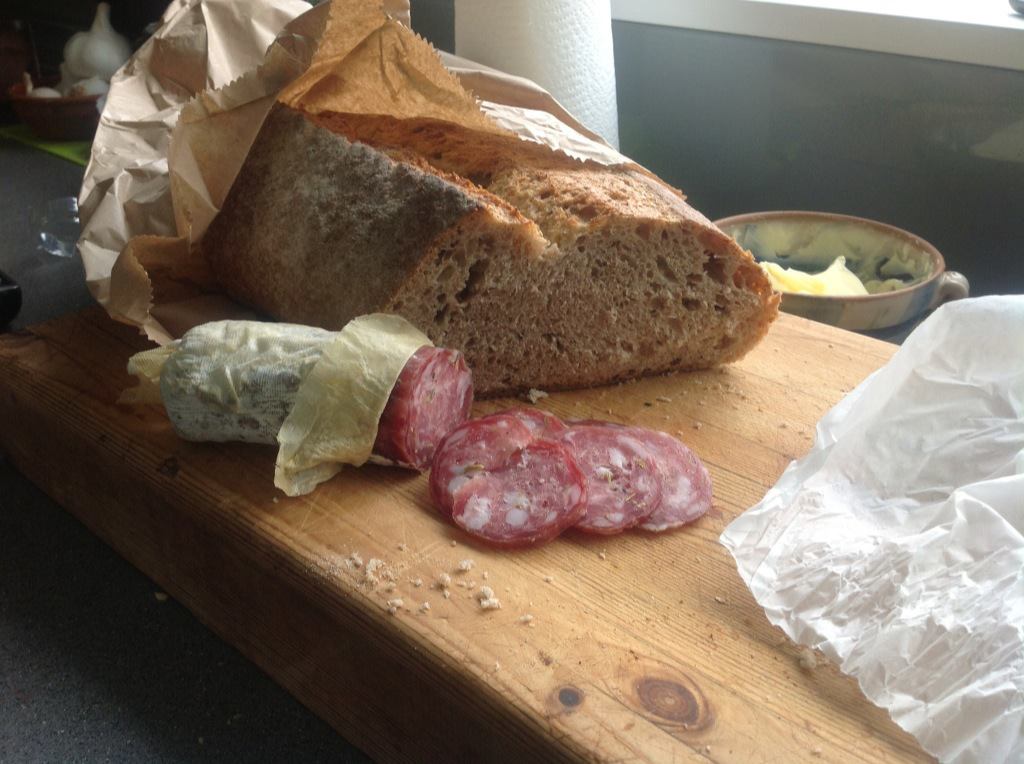
Heavenly produce from Wymondham Farmer’s Market. Everything a Farmer’s Market should be – small, great range of food, plants, meat, bread,chutneys, eggs, fish, charcuterie.  Here’s my favourite combination. Sourdough and salamiMarshPig salami with fennel, a glass of cold beer on a hot day and Tour de France on the TV.

Autumn leaf kicking

This slideshow requires JavaScript.

Well our holiday went in a flash, the tan is fading, the skin’s memory of sliding into still warm water in scorching sun is but a distant memory.

My poor chickens are flooded out and have muddy feet and produce muddy eggs as they kick them around the coop trying to settle. So the eggs always need a good wash when i bring them in. But they are so beautiful. How do chickens produce a perfect egg every day?  It’s a miracle.

The colours of the trees is just turning, gold, deep red, brown, and the leaves are beginning to fall.  And the rain is lashing down.  But a long walk in the rain has produced tons of blackberries, wild apples and bullace.  And I haven’t used up the last of 2011’s yet.  Delving in the freezer I unearthed a pot of blackberries, some ready made apple sauce and a number of escapee blueberries. See the results on ‘Dish of the Day’, along with Canadian Thanksgiving recipes from Katie and her Aunt Sue in Ontario.

This week I am going to be working with Keith Charlish from Paddocks Butchery, cooking up a storm of festive season recipe cards, especially for  game – really looking forward to it.