Blog and recipes

#12Days Felafel and Hummus Day 7

P1020125
Accompaniments for felafel and hummus

The request was for a failsafe felafel and hummus recipe.  Fortunately these are quick and easy as today is Sistema curry night and I have curry for nearly 70 to make. So here goes!

Felafel and hummus are staples in our house. We love them, the boys love them. Everyone loves them. And they are simplicity itself to prepare. What makes these different is they have a little grated carrot in them that keeps them moist inside.

Felafel

Toast two teaspoons of cumin seed , one of black nigella seed and one of coriander in a dry pan for a couple of minutes till they start popping then remove from the heat. Then grind them in a pestle and mortar.  Put two cans of drained chick peas in the food processor with the following ingredients: a teaspoon of baking powder, a gently rounded tablespoon of plain flour, 3oz grated carrot that you’ve squeezed the water out of by wrapping in a tea towel and twisting; one teaspoon of smoked paprika, one small red chilli (whole) or a sprinkle of dried chilli flakes, one clove of garlic, about 12 stalks of parsley and the zest of a lemon. Oh, and a good sprinkling of seasalt (taste it at the end to see if you need more). Whizz all these ingredients in the processor until they are just on the chunky side of smooth – by which I mean don’t process it down to a paste!  Cover and leave for 20 minutes for the flavours to combine, then form into walnut sized balls and put them all on a plate in the freezer for 5 minutes till you heat your oil till it is almost smoking.  I prefer to shallow fry mine – if the oil is hot enough they will be done in a couple of minutes. Remember you will only have greasy felafel if your oil isn’t hot enough.  Fry in batches of half a dozen at a time and remove, draining on crumpled kitchen paper.  Done!

Hummus

This is unashamedly filched from my favourite chefs Sam and Sam Clark at Moro with one slight change. Put one tin of drained chickpeas (keep the juice), the juice of one lemon, 1 large garlic clove, crushed to a paste with seasalt, two teaspoons of cumin powder, 75ml olive oil, two tablespoons of tahini into a blender and pulse until smooth.  Then add a bit more of the juice if it is too claggy and two tablespoons of boiling water. Blitz again.  Taste and adjust the seasoning. Best served in a shallow bowl sprinkled with smoked paprika and more olive oil and warm flatbread. When we are in Spain we like to  accompany the felafel and hummus with bowls of olives, small onions pickled in red wine and wine vinegar, pickled chillis and baby artichokes from the market. Of course that’s not quite as easy in the UK in December, but you can improvise!

Simples!


#12Days Prawn Curry Day 8

img_3199Fran asked for a Christmas prawn curry recipe.  This one will do for any season. It’s a stunner.

Today has been a lovely day – first attending 6 year old Monty’s carol service –   a church full of 4-11 year olds singing their hearts out. And then taking Monty and his 3 year old brother Otto to see Santa in his grotto.  Magical.

So what better way to end the day than to share prawn curry recipes with you?

Sandip gave me a pot of this Tadka after our last pop-up supper, instinctively knowing that the following night we would be completely flakers and want to cook something simple. It was a life-saver of intense yet soothing flavours. And such a generous thought, typical of such a sweet guy.

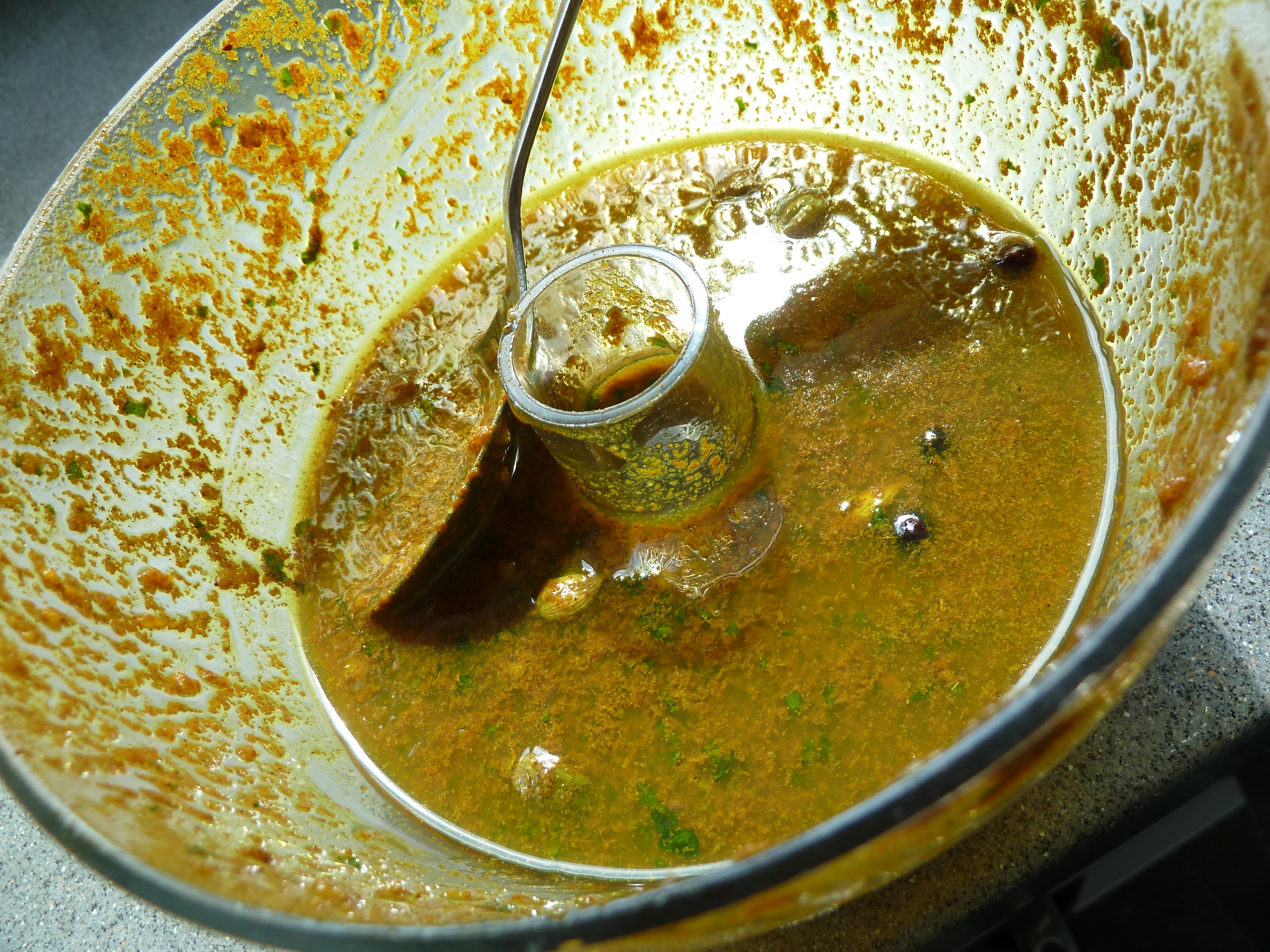
Tadka, roughly translated, means tempering spices in hot oil to release their flavours.  To make this deeply flavoured paste that you can use with chicken, chick peas, prawns – practically anything  in fact – chop 3 medium sized onions into fine dice and fry them gently till soft. Then add 5 cloves of minced garlic (use a Microplane and grate it over the pan) and cook for a further two minutes, stirring all the time. Add a little more oil. Then add  a dessert spoon of cumin seed, half a desert spoon of coriander seed and 2 black cardamom pods and a small cup of water.  Stir quickly to combine the ingredients then cook with the lid on for about an hour, stirring occasionally to prevent it sticking.  Then add tomato puree and cook again with the lid off until the mixture ‘splits’. Then add half a tin of chopped tomatoes, 2 inches of grated fresh ginger and six finely chopped green chillis and cook for a further 30 minutes.  Add salt to taste, and half a desert spoon of garam masala and the same of ground coriander seed.

This forms the basis of a fulsome curry paste that you can add to any meat or fish you like, adding fresh plain yogurt to lighten it.  Use to marinade the meat or fish (equivalent of 1kg in weight – so use half of the Tadka for smaller quantities) overnight, then cook in the usual way – in a saucepan or wok for about 15 minutes.  Then you can add some coconut milk and chopped fresh coriander if you wish.  If you are using frozen prawns, make sure they are completely defrosted and dried before you mix with the marinade.

Believe me this curry is divine.  Serve with freshly made flatbreads.  Thank you Sandip for sharing the recipe with me.

An alternative is to use a quick and easy Rick Stein recipe adapted by Lynne and eaten more times than we can count at Lynne and Andy’s house whilst putting the world to rights over a couple of bottles of wine. Thanks to Lynne for sharing the recipe again by text and from memory whilst collecting her dad from Dorset.

Fry garlic paste and freshly grated ginger in some oil then add a good tablespoon of Fern’s Green Masala paste and when it splits in the pan, add 500g prawns, frying until they are pink. Then add a tin of coconut milk and cook for a couple more minutes. Then add a big handful of chopped coriander leaf, spring onions and a couple of chopped red chillis. Cook with the lid off for a further two minutes.

To be honest, both these curries are simply delicious.  Making the Tadka means you will probably have some left over to use another night. In fact if you made double the quantity you could store it in an airtight jar for at least a week. It takes more time, but it completely authentic.  The Rick Stein version is quick and very delicious too.  It’s for you to use.

There are recipes for flatbreads on this blog if you want to make some.


#12Days Salmon en croutes ideas Day 9(a)

Photo From Lavender and LovageGill asked for some ideas for a zhoozed up Salmon en croute for their Christmas lunch. The best celebratory s-e-c I’ve ever eaten was in in the Irkutsk School of Medicine at the end of an academic visit there in February 2002 in temperatures rarely rising above -35C. And that is very cold, I can assure you! It is a traditional dish offered to guests – salmon  with chopped onion and chopped egg, capers, sometimes cooked rice,  and herbs, all wrapped in golden pastry decorated with pastry fish scales, gills, fins, the lot.

A tip for a crispy bottom is first to put a heavy baking tray in the oven then heat the oven to 190C.  More tips….. Make sure you have all your ingredients ready.  Roll out the ready made puff pastry on non-stick baking parchment the same dimensions as the tray. Then you can simply slide it all onto the hot baking tray. The reason for pre heating the tray is to prevent the scourge of any en-croute dish – a soggy bottom.

Now. Ideas for zhoosing up the dish….

You could make a duxelles of shallot and mushrooms – frying finely chopped shallot, garlic and mushrooms in oil and butter and seasoning with salt (after cooking and ridding the mushrooms of most of their water) and pepper, a little shake of chilli flakes and chopped fresh dill. Then you can either sandwich the cold duxelles between two salmon fillets and enclose in pastry, or spread it along the top.

Or you could make a deeply flavoured rough pesto with chopped pine nuts, loads of fresh basil, grated parmesan and lemon zest all mixed with some olive oil to wet it slightly and finely chopped kale.

Or you could sweat down a big bag of spinach in a pan with a knob of butter and NO water. Let it get cold. Squeeze out more water then mix the spinach with fresh parsley and fresh thyme, spread on the salmon and stuff with halves of hard boiled egg sprinkled with the merest hint of paprika.

Or you could cook some rice, season it with salt afterwards, then run some pomegranate syrup through it add a handful of golden sultanas, chopped walnuts and salty capers.  Pile it along the length of the salmon before you wrap it in pastry.


So what’s to go with it?  Well you could just have a green salad but that would be a bit boring.

How about parmentier potatoes? Chops potatoes into 2.5cm squares – as many as you want. Throw them into a plastic carrier bag and add chopped garlic, black pepper and chopped rosemary. Don’t add salt at this stage.  Add about 30ml olive oil.  Tie a knot in the bag and you can prepare them and leave overnight if you wish.  Preheat a heavy baking tray containing another 30ml olive oil and 25g butter. Get it really hot then throw in the potatoes and turn them till they are all coated. Put into the oven (190C) and roast for about 35 minutes, turning a couple of times.

Serve with something green – crispy kale, or savoy finished with almonds, or with slivers of raw courgette doused in a lemony dressing. Or watercress.  And always with a garlicky aioli.

There you are Gill…. some ideas to play around with as you lounge on the sofa!

#12Days Appetisers – a little cheesey/pineapple one Tone? Day 9

images-3Whilst reading this blog you should be listening to Demis Roussos.  Treat yourself and click the link for a blast from the past.  This one’s for Barbara who inexplicably asked for suggestions for appetisers.

Now I’m not a great appetiser cook to be honest. It’s all too fiddly for me. However when we were in New York I spent many hours in Kitchen Arts and Letters determined not to buy. However the proprietor reminded me that I could save excess baggage charges if he mailed them to me at home and they would also be tax free. It took me about three months to realise of course that I still spent the money and the postage, just saved on the tax.  But it is a gorgeous shop and I recommend it if you are in New York. It has coffee and chairs and I stayed there five hours.  One of the books I purchased (before having the best pedicure ever on 5th Avenue, watching well coiffed women in spiky heels, whose clothes cost more than my house, marching past for their ‘quick wax darling’) was Martha Stewart’s Appetisers. So, Barbara, you are in luck.

Before we delve into Martha, I will just recommend a couple of things. One is to make it easy on yourself.  Please don’t use piping bags and dots of caviar.  Don’t butter bread  carved into tiny squares.  Don’t make swans out of radishes. Keep it simple.

Another is to keep charcuterie in mind. Think lots of plates of proscuitto or Iberico jamon, sharp little olives, salami or french saucisson, cornichon, quail eggs halved and spiced with a sprinkling of smoked paprika, hot radishes accompanied by bowls of salt, dotted around the room.

Another is toasted bruschetta topped with chopped tomato, olives and fresh basil, seasoned with seasalt and a grind of black pepper.  Or little toasts spread with smoked mackerel pate perked up with horseradish.

Consider offering tiny shots of gazpacho (you can buy it ready made) served ice cold with a splash of vodka and a little sprinkle of celery salt and a little celery stick to stir (you got it – it’s a Bloody Mary)! Or you can do the Virgin Mary option minus the vodka. You can buy little plastic shot glasses in Makro or Poundland for practically nothing.  This is what I did img_3444for Paul’s private view a couple of years ago, which just proves the point that I can do appetisers on a grand scale if needed – I just prefer the easy life!

When we were in Le Puget earlier in the year the charcuterie was served with tiny, buttery, parmesan biscuits. About the thickness of a one pound coin I have since replicated them at home.

Use your food processor for this.  Pulse 100g cold butter with 100g plain flour with a pinch of cayenne pepper and a teaspoon of mustard powder. Then grate in 50g each of strong cheddar and parmesan. Mix together then add a tiny splash of one beaten egg and pulse again till it almost comes together. Turn out  knead it slightly and wrap in clingfilm and put in fridge for half an hour while you have a coffee. Then roll out to about 1.5cm thick and use a small cutter.  Brush the biscuits with remaining egg and sprinkle with a little more parmesan. Place the rounds on parchment paper on a baking tray and bake at 180C for 10 minutes then remove from the oven and allow to cool on the tray. Guaranteed to be gone in 10 seconds flat!

img_3261

Now, consulting Martha,  if you really must mess around with fiddly things, she suggests the following:

  • Mini empanadas, which are just circles of pastry filled with something tasty. Little two-bite Spanish pies that look like Cornish pasties to you and me.
  • Prawns on sticks – what could be simpler?
  • Puree’d vegetable dips – colourful but oh so boring
  • bacon wrapped bites – bacon wrapped round things like shrimp, figs, dates, chillis. Really, isn’t life to short?
  • Crudites with dips – do you really want a dip that someone else has dipped their celery stick in for the third time?
  • proscuitto wrapped round asparagus or breadsticks – pur-lease

Believe me. Keep it simple.  Plates of charcuterie, good bread, some shots, little triangles of watermelon with feta, olives, cornichon, good tomato salsa on buschetta, home made grissini maybe should be the limit of your cooking. Make them with bread dough, roll  into thin sticks, cover with fennel or poppy seed or parmesan and bake for 5 minutes.

Shirley Conran said “Life’s too short to stuff a mushroom”.  She was right!

And here’s the link to Abigail’s Party  …… Now. Where’s my Demis Roussos? And my cocktail sticks?

cheese-and-pineapple1-2

#12Days Spinach, pine nut and sweet potato b’stilla Day 10

img_3138

In Morocco b’stilla is just ‘pie’.  You can fill it with whatever you like, and I have made a chicken and a pheasant version. But this one is for vegans and vegetarians.  It’s one of those dishes that people eat, look quizzical and ask “oo, what’s in it”?  It’s flavoured with a little cinnamon and spices. It’s rich and the flavour goes on and on. It looks impressive too. Especially if you drift just a little icing sugar over it.  Yes! It is a classic combination of North African flavours that include sweet and savoury. The proportions are entirely up to you, however. This recipe feeds 8. Just make two if you have more guests!

First the filling.  Sweat a large chopped onion with three chopped garlic cloves, a small de-seeded red or green chilli, a grated thumb of fresh ginger. Then add a large peeled and chopped sweet potato and some chopped carrot.  Sweat these till they are soft too.  Add a good grating of nutmeg and a teaspoon of ground cinnamon, four large deseeded and chopped tomatoes, salt and black pepper. Stir these in and sweat for a further 10 minutes. Add a little more oil if necessary.  Now you have a choice.  If you have chard in the garden or can lay your hands on some, then chop about 5 large leaves and stalks and lay on top of the mixture in the pan. Alternatively you can use spinach or kale or broccoli. Add about 30ml water put the lid on the pan and cook again for 5 minutes to just cook the greens. Check the seasoning again.  Add a good helping of chopped flatleaf parsley and coriander leaf. At this point you can, if you wish, add about 100g pine nuts and 100g Lexia raisins if you wish.

Now, take a packet of Filo pastry you purchased earlier.  Either use individual tins (see picture) or a large springform cake tin, or just a baking tray on which you can make a parcel. Grease and shake some coarse semolina around the tins. Regular readers of this blog will know that semolina is my favourite ingredient when it comes to greasing and lining tins. It adds a bit of crunch and is better than dusting with flour in my opinion.

Lay squares of overlapping filo over the tins with lots of pastry hanging over the edge. Grease the filo sheets with a little oil as you go. Rotate the tin clockwise with every sheet of filo so the points of the pastry are in different places. Add the filling and push to the edges, sift a little icing sugar over the filling, then fold the pastry sheets over the top, scrunching them up a bit in a haphazard sort of way.  Brush with oil and bake in the oven at 190C for about 35 minutes.  If you are making a big pie, you can do this on a lined baking tray. Use the same method re the pastry except use whole sheets. Pile all the filling in the middle, flatten it out, then fold the pastry over the top. This one will take about 50 minutes to cook. Lining the tray makes it a) stop sticking and b) you can drag the whole thing off the baking tray and onto a flat plate!

If you like the idea of a sweet edge then very lightly dust with icing sugar when ready to serve.  You could even, if you’re feeling fancy, scorch lines on the top with a hot skewer. Or not, if you have a life!

#12Days Vegan Chestnut and Celeriac raised pie Day 11

img_3463

OK so this one is for Shaila who asked for a vegan recipe for Christmas day.  She will pass it on to Gav to work his magic! This is a take on a pork pie of course, except it is nothing of the sort.  Instead it is a pie suitable for vegans and vegetarians. And carnivores come to that.  I’ve made it three times now, each with different fillings. I’ll offer the alternatives later.

This is what David has ordered for Christmas lunch.

The pastry is of the hot water crust variety and is as easy as wink to make. The knack is to mould it whilst it is still warm, which rather goes against all the rules – unless you are making hot water crust pastry. The clue is in the title! You don’t need a hi-falootin’ pie tin with springform sides, so if you don’t possess one (I don’t) then this shouldn’t put you off. I’ve used a jam jar (too slippery), a mug (handle got in the way) but found in the end that a stainless steel ring-form worked perfectly.  More of this later.

The filling is easy too, wintery and warming, fragrant with garlic and sage wafting out the steam hole!  It is rare for me to give precise ingredients and proportions on this blog but to get it right, this time it’s necessary. Let’s get started.

First make the filling. You can make this in advance so that it is cold when you fill the pies. For four pies you will need:

180g vacuum packed chestnuts

50ml olive oil

1 banana shallot or onion finely chopped

2 cloves garlic, grated

1 small celeriac peeled and chopped into 1cm dice

1 medium sized carrot chopped into 1cm dice

1 stick celery chopped into 1cm dice

2 tomatoes, skinned and chopped (remove wet centre)

Vegetable stock – about 200ml

Chopped fresh sage (about 8 leaves  – if you  use dried sage, then use sparingly)

1 flat tablespoon of Miso

Cornflour

pinch of chilli flakes (optional)


Gently sweat all the vegetables in the oil until soft, then turn up the heat and add the chopped tomatoes and chilli, allow to bubble furiously, then add the herbs and the chestnuts. Mix well. Add the stock and the miso, bring to the boil then turn the heat down to medium and let it gently simmer away with the lid off for about half an hour. Half way through, check for seasoning and adjust. You should now have a lovely thick ‘stew’ and not too much liquid.  At this stage if the ingredients are swimming in liquid, take some out so that when in the pan, the liquid only just reaches the top of the vegetables etc. Taste again and adjust seasoning. Then slake some cornflour with the juice in the pan, return to the pan to thicken the ‘gravy’.  Now let it cool thoroughly.  Practice showed me that the colder the filling, the better the pie. So you could make this the day before. Or freeze it till you need it.

Now for the hot water crust pastry. Be not afraid!

175g wholewheat plain flour

75g white plain flour

50g fine oatmeal

75ml olive oil or rapeseed oil

1 tsp salt

130ml boiling water

Let me first say that it will help if you have your filling ready, the oven warmed up to 190C, some extra flour for rolling out and four stainless steel rings that have been well greased and powdered with fine semolina.

Sift all the flour into a bowl, add the salt and the oatmeal and mix well.  Add the oil and rub it in  (as if it were butter – or lard!) then add the water and mix swiftly with a wooden spoon till all the ingredients come together. Turn the dough out onto a floured board and knead for a minute then leave it for 5 minutes.  Place your rings on a baking tray on which you have placed a sheet of baking parchment or greaseproof paper.

Cut the dough into four pieces and each piece into two – a larger piece of the pie and a smaller piece for the top. The dough will be warm and you need to work fairly quickly.  Roll out the larger piece so it will fit into the ring mould and come up the sides and beyond. It is easy to mould at this stage.  The idea is to tease the pastry as high as you can above the mould – the mould is only there to secure the base.  Don’t think mince pie thickness – think thicker. This is a robust pie! So now you have the first pie in its mould and the pastry standing well above the top of the mould.  Now fill the pastry with the chestnut and celeriac filling.  One tip is to take some out and mash it first and put the mashed contents at the bottom and the chunkier bits on top.  Then fill up with the gravy.  Roll out a top that fits.  Use some of the gravy to wet the edges. Place the top on the pie and crimp together. Pierce a hole in the top to let the steam escape.  Now do it again three times.

Marion told me that she ‘raised’ her pies around a jam jar, and Sue said she did the same but used a baked bean can.  Jo said she couldn’t be bothered with any of that old business and simply made individual ‘pork pie’ sized ones in deep muffin trays. I tried these aswell and they worked really well . Remember that as the pastry cools it becomes firmer and I found the ring moulds worked well and contained the base – reducing the risk of the pie collapsing as it cooks.

Place the baking tray in the centre of the oven and cook the pies for about 40 minutes until golden brown and the gravy is bubbling out the top.  When you remove them from the oven, keep them on the tray and in the moulds.  I suggest you leave for about 30 minutes then you should be able to upend and run a very sharp pointed knife round the inside of the mould to release it.

If you have left over juice, then use it to make the gravy.

#12days

images-2

I’m going to publish 12 recipes to make your life easier in the run up to Christmas. Tell me what you’d like to see.  Consider it a gift! #12days

Banana and Ginger ice-cream and ginger nobs

IMG_2664
Lemons are the only fruit

If you are looking for a quick dessert for Christmas this is my take on a Nigella recipe for soft-scoop, no churn ice-cream. It’s so easy it’s criminal and is laced with stem ginger and syrup and served with ginger biscuits. Sorry, no picture of icecream. We ate it all too quickly for an arty shot. This recipe is for Su, because she requested it.

Ice-cream

Take one can of Fussell’s condensed milk and open it. (Dare you not to stick your finger in!) Whip 500ml double cream. Whip two very ripe bananas to a froth. Finely grate the zest from half lemon.Take about six golden sticky nuggets (that’s me being Nigella) of stem ginger out of the jar. Chop into pieces, maybe six to eight pieces. Combine the condensed milk, the whipped cream, the bananas, the zest  and the stem ginger with a spoon or a hand-held mixer. Stir till thoroughly mixed. Pour into a litre container and freeze. That’s it. Take out of the freezer and put in the fridge about 1.5 hours before you want to serve it.  Pour ginger syrup that’s in the jar, over each serving and have a ginger nob or two on the side.

Ginger nobs

60g  melted butter melted in a saucepan with 60g golden syrup. Add 30g golden caster sugar. Set aside to cool for a couple of minutes.  Sift in 120g plain flour, 40g fine oatmeal, a teaspoon of ground ginger, one flat teaspoon of bicarbonate of soda and a pinch of salt.  Gather all the ingredients together till they combine into a soft ball.  Pre-heat the oven to 180C. Put a sheet of baking parchment on a baking tray.  Break off walnut sized pieces of the dough and flatten them into circles on the baking parchment and about 1cm thick.  Place the tray with all the biscuits (should do 12-14) in the centre of the oven for 10 minutes then cool so they go crunchy. Remember to leave a bit of space around the biscuits because they will spread. If necessary use two trays.


Celebrating in Le Puget

img_7665

“And I shall have some peace there, for peace comes dropping slow” W.B. Yeats”

Many months planning by my dearest brother-by-proxy in Sydney, Australia in advance of celebrating his 60th, resulted in an enormous treat for those of us that travelled to Le Domaine de Puget.  Hosted with ease, grace and endless generosity by John and Janie in their magnificent home and retreat in the Aude, 11 of us descended from London, Lymington and Australia for a long week-end and with only the glimmer of a clue as to what would ensue.  It was a triumph delivered in the most modest and understated way. One of those ‘spotlight on my life’ moments that will always be treasured. One of those week ends where there was a heady mixture of good conversation, challenging ideas, kindness, peace – along with magnificent wines.  And the setting was beyond perfection.

As you will know, I am known for my hyperbole. But believe me, it was perfection.

Imagine this……..  25 acres of rolling French countryside, a large farmhouse perched on top of the hill; ripe figs hanging from the trees, endless quiet places to sit and stare, a candle-lit courtyard, a kitchen large enough to cope with twice the number we had.  A dining room with half-trees burning in the grate. A sheltered pool that was still warm enough for frequent swims even though it was early October. Quince trees weighed down with bulbous fruit.  Soft autumnal light and long shadows.  Breakfast in the meadow looking back toward Fanjeaux. The last of the sunflowers drooping their heads in serried ranks, set in dusty green clay earth. And then there was the food………

John’s food is legendary (see Le Puget) and I was intrigued and mesmerised by the delights that emerged from the kitchen.  Charcuterie on well-worn wooden boards, little black olives sharp and juicy, buttery parmesan biscuits, stuffed guinea fowl, double-baked cheese souffle, lentil and vegetable melange, slow roast pork, fig and feta salad, local bread, artisanal cheeses made only a kilometre away, a secret recipe hazlenut cake, more croissants than you could shake a stick at, and cloudy creamy yellow butter. #heavenishere!

So here’s a selection of recipes, my take on those culinary memories.

Roast guinea fowl, boned and stuffed

img_3306

This guinea fowl recipe is on my list for Boxing Day.  I get a lot of my game and fowl from the Wild Meat Company and they do really high quality mail order too. They supplied the quail for our popup suppers earlier in the year, and venison, wild rabbit, pheasant and pigeon for my freezer.

Ask your butcher to bone out the guinea fowl but make sure you ask for the innards and the bones in a separate bag and the legs removed!  To serve 6 generously you will need one guinea fowl.  Pat it dry and leave uncovered for a few hours in a cool place.  To make the forcemeat first, roast the legs in a small pan with some onion then remove the flesh and chop it finely.  Gently fry an onion in rapeseed or olive oil with a couple of cloves of garlic and the tiniest smidgeon of crushed juniper berries and some fresh thyme. Then turn up the heat and add the chopped livers and heart from the bag of innards. Season with seasalt and black pepper. Add a wineglass full of red wine on a high heat then reduce the liquid to practically nothing. Allow the leg meat and the innards to cool completely – you could do all of this the night before.  Next day add all this to some herby coarse sausagemeat – probably about 500g, it depends on the size of your bird – and then add more salt (the best way to know how much you need is not to guess!!  Fry a dessert-spoon full in a little oil then taste it).  Then add a good scraping of nutmeg.  You get the idea don’t you – you are looking for a deep, well seasoned, warmly spiced and fragrant forcemeat, not a sharp salty one.

As you can see already. It will help to have prepared some things in advance of cooking this dish but believe me it will be worth it.  So the night before, do the stuff with the livers and the legs! And peel and poach some pears and/or quince in a light syrup, whilst roasting some shallot very gently so that the natural sugars start to caramelise but not burn.  Now you can start the consttuction!

Turn your oven on to 200C. Make sure your work surface is scrupulously clean. Not to mention your hands.  Have a long ball of butchers string and some sharp scissors to hand. Lay the bird  skin side down on a a large piece of greaseproof paper that has been rubbed with olive oil. Stretch out its various appendages. You will notice that some parts of the bird are thicker than others. You’ll soon see to that with your rolling pin! Lay another piece of greaseproof on top then beat the thicker pieces till the whole bird has stretched out and the thickness is relatively even. The only thing to avoid is making it too thin. about 2.5 cm thick will do it.  Then dry off your pears/quince and slice into even thickness then lay slices across the bird, leaving a good 3cm clear all around the edges. Then to the same with some of the roasted shallot. Finally, spread the forcemeat across the pears and onions – about 2.5cm thick.

Now you need to imagine an envelope.  You are going to fold both sides to the middle followed by the meat at the top and bottom edges.  Truss the bird up with the string, (you are aiming for a neat cylinder shape with all the ends tucked underneath). Give it a good olive oil or rapeseed oil massage and sprinkle with a little seasalt.

Place in a hot roasting tin on a bed of carrot, celery and leek. and rosemary stalks along with more olive oil and a litre of boiling water. Cover with foil and roast at 180C for an hour, then turn the heat up to 200C, remove the foil and cook for a further 15-20 minutes until lovely and brown. Test with a skewer, if the juices are clear, then it’s done.  Remove the bird from the pan and let it rest, boil up and thicken the gravy in the pan.

Dauphinoise potatoes

img_3297

This has to be the most forgiving potato dish in the world.  You can prepare it in advance and reheat it. You can freeze it. You can try an resist it but you won’t win. You can eat it in solitary confinement in the kitchen at 2am and no-one will know. Seriously. I’ve done it!

Peel and slice 8 large potatoes. Mix 500ml double cream (yes!) with 500ml full cream milk (yes, again!) a couple of peeled garlic cloves and half a teaspoon of salt.  Put the potatoes in a big pan with the milk/cream, bring slowly to just under the boil and let them cook for about 5 minutes.  Then remove potatoes with a slotted spoon and place in a shallow well buttered (oh God, the cholesterol!) dish then pour over the milk/cream and bake at 190C for about 50 minutes until the whole is creamy and thick and brown on top. Dare you to eat it!

Fig and salt cheese salad

img_7665

Sometimes with rich food, just a simple salad on the side is sufficient.  Try this.  Fresh, ripe figs are a must though.  Keep an eye out in Lidl, I have frequently purchased trays of fresh figs from there in late summer.  Slice and chop fresh ripe tomatoes and cucumber and remove most of the wet middle.   Sprinkle with gremolata (chopped rosemary, garlic, lemon zest and seasalt) to season.  Add chopped feta or salty goat’s cheese and quartered fresh figs. Mix together with a gentle vinaigrette warmed with a little dash of honey.

Charcuterie with olives and warm cheesy biscuits

img_3261

The easiest of appetisers.  Go get some great charcuterie from Marshpig or your nearest deli, or from the fantastic market in Mirepoix!  Slice it, pile it on a plate with hot, crisp radishes, some salt, some juicy olives, some of Janie’s warm cheesy biscuits and a glass of something cold and fizzy, such as a Blanquette de Limoux. Irresistible.

Mix 100g plain flour with a pinch of cayenne, a teaspoon of mustard powder and a little salt.  Rub in 100g butter then gently mix in 50g hard cheese and 50g parmesan. Bind together with half the egg (beaten).  Cover and leave in the fridge to rest for half an hour, then roll out to about 1.5cm thick and use a cutter, placing each biscuit on the tray lined with greaseproof paper.  Brush lightly with the remaining egg and sprinkle with more parmesan. Bake at 80C for about 10 minutes. I challenge you to eat only one.

Twice-baked cheese souffle

img_7693

Never be frightened by a souffle – especially if you make individual ones.  You can make and bake, allow to cool, leave overnight, have a party, go out for the day – then come back and put them back in the oven and voila! A souffle resurrects itself as if by magic.

I bow to Delia Smith on this one.   Heat 225 full cream milk in a pan with half an onion, a few black peppercorns, a grating of fresh nutmeg and a bay leaf.  Bring to simmering point then pour into a jug through a sieve, thus removing the onion etc. Essentially you are flavouring the milk. Rinse out the pan then put back on a low heat and melt 25g butter, then add 25g plain flour to make a roux and cook very gently for a couple of minutes.  Gently pour in the milk, bit by bit, stirring all the time until you have a thick sauce. Beat two egg yolks.  Pour the sauce into a mixing bowl when it is cool then add the egg yolks and mix thoroughly.  Fold in 110g good quality goat’s cheese, cubed if hard and gently broken up if soft.  Mix thoroughly. Season with black pepper.

Whisk the two egg whites until stiff and almost ‘dry’ then gently fold into the sauce with a large metal spoon and a cutting and folding motion.

Generously butter the inside of 6 ramekin dishes and coat with a little coarse semolina flour.  Divide the mixture between the dishes.  Heat the oven to 200C with a baking tray already in the oven.  When up to heat, remove the baking tray, place the ramekins on the tray and fill the tray with about 2cm of boiling water.  Put back in the centre of the oven and cook until they are risen, firm and just a tiny bit wobbly in the middle (about 15 minutes).  Now you can take them out of the oven to cool and they will sink like a stone. Don’t worry.  Put in a cool place and when you are ready then slide a very sharp knife round the edge of the ramekin to release the souffle, invert it onto the palm of your hand then place on a buttered baking tray and sprinkle each one with a little parmesan. Later in the day, or tomorrow, crank up the oven again to 200C and put back in the oven for 30 minutes. Miraculously they will puff up again and are ready to eat.

The mysterious Hazelnut cakeimg_3324

Marie helps out John and Janie at Le Puget sometimes and makes the most amazing hazelnut cake using a recipe from when she lived in Switzerland.  A recipe that was never divulged to me.  I’ve experimented a bit this week whilst nursing the Le Puget chest infection.  This is the closest I can get to the exquisite cake made by Marie last week. somewhere on my various devices I have a photograph of her cake and I will post it when I find it.

Toast 100g hazelnuts in the oven then rub place them in a tea towel and rub them till the skins flake off.  Sieve 125g rice flour, 50g golden caster sugar, half a teaspoon of baking powder and a little salt into a bowl.  Grind the hazelnuts in a food processor or blender, until fine.  Add to the flour and mix thoroughly.Whisk together 75ml vegetable oil and 75ml agave syrup (or honey), 3 egg yolks , a teaspoon of vanilla extract and a pinch of cream of tartar. Then add the flour mixture to the wet mixture and beat till it is a thick (ish) batter.  Now whisk 5 egg whites till they are stiff.Fold into the hazelnut batter with a cut and fold motion.

Pour into one or two pre-prepared springform sponge tins that have been lined with greaseproof paper.  Bake in the centre of the oven at 180C for about 25 minutes.  Then remove from the oven and keep in the tin until cold.

This  version is not the exact cake made by Marie – but it is close enough. I suspect hers had little or no flour, which is why I used very fine rice flour.  I recommend eating on the terrace of Le Puget with good friends and pots of tea.

Au revoir!

Bon chance!

img_3323


Black Garlic

The first question is why?  Why spend 40 days cooking garlic slowly?  Answer: Why not?

Garlic in all its forms is a staple in our kitchen. img_3258Our neighbours Jaz and Dick don’t eat garlic at all. Or onions. It’s a bit embarrassing because our extractor fan belches out onion and garlic fumes across our shared drive every evening.  Fortunately they are very tolerant. And very nice. Sometimes – frequently – we hear a rumble in the night and David will mumble “that will be Jaz taking our bin out then”. The problem is, we often forget which day the bin man is due. But Jaz is a stickler for routine.  Sometimes we haven’t even filled the bin so we have to trundle it back in the morning, very quietly, to fill it and then deposit it at the end of the drive again.  If we remember what day it is, but not what colour bin, we simply peer between the blinds about midnight to see what colour bin is required…….  sure enough, Jaz and Dick’s bin is already standing serene and proud at the end of the drive. Sometimes we find sticky notes on the back door, reminding us it’s ‘green bin day’ or ‘brown bin day’. Jaz is a great pudding cook, and often we will find slices of cheesecake or mounds of souffle in the lobby – oh the saturated fat!

I first encountered black garlic when visiting Fran and Jonathan on the Isle of Wight, which is famous for its garlic crop. The largest head of garlic I have grown came from elephant garlic bulbs from there.  As big round as a teacup – I swear.  The ones in the picture here are img_2951a mixture of Early Purple Wight and Iberian Wight, both purchased mail-order from Isle of Wight Garlic Farm  and planted in earth enriched with lots of muck in early November and with a top dressing of seaweed.  Then just leave it – ready to harvest in June when the tops fall over and start to go rusty.  This year I had a bumper crop of 60 bulbs. The best ever.

I digress.  Black garlic.

Black garlic is simply a matter of fermenting fresh clean heads of garlic by heating very slowy and leaving on a low heat for about 30 days.  Each clove changes character and becomes a black sticky goo, full of molasses-like juice.  Wonderful in pasta, baked potatoes, risotto, pies…….. I feel some more posts coming on.

Being a ‘bit’ of a gadget freak (I often think I could do with an extension just for all the kitchen gadgets acquired over the years) – I searched online for special equipment and found a fermenter that was about £120.  No way Jose.  More research and a handy tip from Eleanor whilst we were wandering round East Ruston Vicarage Gardens a few weeks ago, revealed that the same results can be achieved with a rice cooker or a slow cooker.  I possessed neither.  Onto Freecycle in a trice, I found a slow cooker for £5.  That’s more like it.

So now, my heads of garlic have commenced their first day in the slow cooker.  Before they are ready I shall have had 5 days in Le Puget celebrating Anthony’s 60th, followed by a mad scurry of work,  prior to heading to Seahouses for a week of walking the bare blustery and beautiful beaches of Northumberland with David, Lynne and Andy, returning for number one grandson’s birthday and a trip to Dinosaur World.  My only concession to the garlic will be to remove the slow cooker attached to extension lead to the little shed outside so the house is not filled with garlic fumes on our return.   I shall offer a progress report later………………….

All things pear shaped.

img_3228

Pears, along  with raspberries, are my favourite fruit.  Our pear trees are heavy with fruit this year.

Here are a few of my favourite sweet and savoury pear concoctions.

Savoury

Mostardo di frutti

Mostardo di frutti is a unctuous sticky preserv of fruit laced with mustard  and is usually served with cold meats in Italy.  It is great during the festive season when there is often a glut of cold meats and the mind goes blank when thinking what to do with them.  I suggest a plate full of cold meats, leftover stuffing, hot roast potatoes and mostardo di fruitti

Peel and chop  fruit such as pears, hard apples, quince. Place in the preserving pan with 500g caster sugar and just enough water to cover. Bring slowly to the boil then turn up the heat and let it bubble vvigorously until the bubbles blob and plop which should be at about 104Cif you use a jam thermometer.  Take off the heat and skim off any white foam.

In a separate pan put 2 tbsp of strong yellow mustard seed and warm them till they begin to pop, then remove and grind them in a pestle and mortar. Then mix with 1 tbsp of strong mustard powder, add the ground mustard to the mustard powder then pour on 250ml white wine and the juice of an orange.  Place pan on a medium heat and bring to the boil then reduce in volume by  one third.  Then pour over the fruit, mix well and place in sterilised jars.  Once cool place in the fridge  and i will keep for a month, or if you put in Kilner  jars or similar,  seal then place jars in a roasting pan of boiling water and  put in the oven at  170C for 30 minutes. Then they will keep for a few weeks.

If you make this you won’t be disappointed.

Pickled pears

This recipe is adapted from one of my favourite books by Darina Allen  Forgotten Skills of Cooking. It is really easy and I recommend it  with game – venison, wild duck or pigeon.

Use any pears you like, but make sure they are not too ripe.  About 2kg will make about 8 large jars.   Peel, core and quarter the pears and add the juice of one lemon. Mix well.  Cook on a low to medium heat until just done but the pears are still firm.  Then peel and slice about 4cm of fresh ginger, and add to 600ml apple cider vinegar, 30ml sherry vinegar, 600g sugar, a stick of cinnamon (dont add powder!), 2 star anis and 4 whole cloves and the peel pared off the lemon you squeezed earlier.Bring this to boil in a separate pan, stirring all the time then add the pears and continue to cook  until completely soft. This could take a further 20 minutes or so depending on the pear.

Sterilise the jars and fill with pears first, while continuing to boil the liquid. Then carefully, and using a funnel, pour the boiling liquid over the pears and make sure they are completely covered.  Seal and leave for at least 3- weeks before eating. If you can hold out that long.

Pear and chestnut jam

10169441_10151766928067395_1874372122_nThis is one of my favourites, too.  Wonderful served with brioche or croissant. Even better spooned over Greek yogurt in my opinion.

Peel and core 1kg pears an 500g sour apples and cut into small pieces then mix with the juice of 2 lemons 240ml water and the seeds from one  vanilla pod.  Bring to the boil and simmer for about 5 minutes.  Then add 750g jam sugar, bring back to the boil slowly, stirring till all the sugar has dissolved. Then turn off the heat and leave overnight.

Meanwhile, empty one 200g vacuum pack of chestnuts into a pan, add juice of one lemon and zest of two lemons. Bring to the boil them simmer for 5 minutes. Leave this to rest overnight too.

In the morning, cut the chestnuts into small pieces in the pan then pour ithe contents of the chestnut pan into the pear pan and cook to the setting point (where the consistency of the liquid becomes viscous and the bubbles pop and bloop)  or use a jam thermometer till the mixture reaches 104C. Pour into sterilised jars.

Smoky apple and pear relish

img_0871What’s the difference between a relish and a chutney anyway?  The short answer is that in general, relishes are cooked for a shorter time than chutneys, are are often vegetable based.  This one, obviously, is not, but it is not as thick as a chutney and retains a lot of what I would call its ‘bright’ flavours.

This recipe is one I adapted last year from Anna Rigg’s Summer berries, Autumn fruits.  A book I really recommend having on your shelf.  As I was researching for this post, piles of books beside me, I became aware of 1) how many books I have in my cookery library and 2) how some are much more well thumbed than others.  Anna Rigg’s is spattered with cooking liquour and some of the pages glued together!

Anyway, back to the relish. Take a couple of large dried smoked chipotle chillies and a dried red pepper.  I used to source these from Brindisa (they do mail order) but I can get them in Tesco now. Soak them in a bowl of hot water while you get the other ingredients ready.  Peel and chop 4 crisp eating apples and 4 hard pears, tip into a preserving pan and add 400ml cider vinegar, 325 light muscovado sugar, 3 large chopped shallots, 2 grated cloves of garlic along with a 4cm piece of root ginger, 1 tsp fellel seed, 1 tsp smoked paprika and a good grind of black pepper. Lastly 1 teaspoon of sea salt.

Drain the chillis and pepper.  Remove the stalks and then finely chop the flesh – seeds an all.  Add to the pan and stir around.  Bring to the boil very slowly then turn down the head to medium and cook for 40-45 minutes stirring occasionally until the mixture is thick and syrupy.  Leave to settle for 5 minutes then pour into hot jars and seal.  It will keep for about 6 months but once opened, eat it up! It won’t be difficult.  Think creamy Lancashire with oatcakes, chunks of gherkin and this relish.

Pear and chocolate pan Charlotte

Ok the preserving bit is over.  Now for some sweet things.  When I was in New York last year I spent a delightful 5 hours – yes, 5 hours – in Kitchen Art and Letters.  It was a bit of a pilgrimage for me, and one now ticked off my bucket list.  If you can imagine a wonderful bookshop one block east of 5th Avenue, way up in the north east corner of Central Park; a small and perfectly formed shop, with armchairs and coffee and tables on which to rest piles of books; and an owner who positively encouraged people to stay and read and browse.  My idea of heaven. Anyway – I was there in heaven but perversely had told myself I would not buy because it would take me into excess baggage. Until the owner cannily reminded me that as a visitor, the prices were minus tax and anyway he could ship them to me for less than the tax anyway.  SOLD!  The New Sugar and Spice by Samantha Seneviratne was one of my six purchases.

You will need a Tarte Tartin tin or similar (she uses a skillet – I dont have a skillet).  Place the  tartin tin on a hotplate and add 100g butter on a high heat. As soon as it is melted add 3 tablespoons of muscovado sugar, 1/4 teaspoon each of ground clove and allspice and a little salt; stir to combine.  Then add 5 peeled, cored and chopped firm pears, turn down the heat and cook until the pears are soft and mixture is lightly caramelised. This will take about 10 minutes. Then pour this mixture onto a plate to cool. Clean the pan.

Spread some butter onto 8-10 slices of brioche loaf (or use those long brioche finger rolls you can buy in Lidl). Line the tin with the buttered bread (butter side down) and sprinkle with 75g plain chocolate chopped in small pieces. Top with the pear mixture then the remaining buttered brioche.

Bake at 180C until the bread is golden brown – about 40-50 minutes and cover with foil if it looks like its burning.  Take out of the oven and allow to cool, then dust with icing sugar and serve with cream. Or allow to cool and then double wrap with foil and freeze. You could make two – one for now and one for later!

Spiced ginger and chocolate cake with salted caramel pears

This is another favourite from Anna Rigg.  First make your gingerbread.

Heat 150g butter with 100g golden syrup 75g treacle, 150g soft brown sugar and 150ml stout.  Quite honestly those ingredients are enough to make you stop right there!  Courage! Onward!  Melt in a large-ish pan then add 50g dark chocolate, 2 pieces of chopped stem ginger and half a teasp on bicarbonate of soda.  Mix it all together then let it cool.

Drive 200g plain flour with 1 teap baking powder and 4 teaspoons of ground ginger together with one teaspoon ground cinnamon, 1/4 teaspoon mixed spice, 1/4 teaspoon black pepper a pinch of chilli powder, a pinch of salt.  Whisk 3 eggs then add to the liquid ingredients then add the dry ingredients in 3 batches, beating well between each addition.  Pour into a lined 14cm square tin and bake for 30 minutes at 170C. Cover with greaseproof paper if it looks a bit too brown.

Now for the easy bit.  Peel and quarter 4 pears and put into a shallow pan with 20g butter and a tablespoon or so of the stem ginger syrup.  Cook them until they are tender and slightly caramelised at the edges.  Then remove the cake from the oven and pour the pears and syrup over the top, returning to the oven for a further 30 minutes.  Check if the inside is cooked by inserting a skewer into the centre and it should come out clean.

Remove from the oven and leave in the tin for half an hour or so, then transfer to a wire rack till cool.  Now for the sauce. (No, we are not finished yet).

Place 100g caster sugar in a pan and ae 2 tbsp cold water, set over a low heat to dissolve the sugar then increase the heat and cook the syrup until it starts to change colour. Take off the heat and very carefully add the cream, return to a low heat to re-melt any caramel that has hardened then add 2 or 3 tablespoons of bourbon.  Serve the cake with the caramel sauce poured over.

Well beat me on the bottom with a Woman’s Weekly if that’s not a winner.  You can easily freeze the cake/pears, defrost and finish off with the sauce.


#Addingflavour

There is no magic, no mystery, about adding flavour to your food.  It’s simply a matter of understanding how flavour wimg_3148orks; on the tongue, with the nose, in your mind, with your mood.  If I am not in the mood for cooking, then it never tastes right even though I want it to. But if I am on a roll, steaming along in the kitchen with the radio on and all the ingredients I need, then a little bit of magic comes into it.  That magic affects everyone else. Then the flavours are proclaimed to be fabulous.

I guess its a bit like running when you getimg_3149 in the groove (I don’t run) or swimming when the stroke and the breath come naturally (I do swim!)  It all just flows.

So there are certain things that to my mind add the magic. It’s the alchemy I talk about on the front page of this blog. And over the next few weeks I am going to add a few things I have learned then use the category #addingflavour so you can easily find them again .  So watch out for new posts and tweets. The first is gremolata.

Gremolata  is one of my favourite mixtures for adding flavour. I was introduced to it by Enzo, an Italian and maker of great pasta. He whispered conspiratorially, when I asked him what it was on his barbecued chicken that made it taste so wonderful,  “Its rosemary and lemon zest and garlic and salt cara mia. it improves everything it touches, a bit like wine”!

Chop rosemary and lemon zest (I use a mezzaluna) then chop garlic then add seasalt.  It is as simple as that. The proportions are always approximate and according to  your own taste. There is no real ‘recipe’.  In the picture at the top I have used a large handful of fresh rosemary leaves removed from the woody stalks, the rind of 2 lemons (using a zester, not a grater).

img_3151Then added six to eight fresh garlic cloves, chopped finely, and about 75g of seasalt.  Mix it all together and you have a fine mixture that can be stored in a jamjar by the stove, and will keep really fresh and fragrant for about 2 weeks. I have tried keeping it in the fridge but the jar gets condensation in it and it loses its crispness.

How do I use it?  Here’s a list, but you will find your own preferences I am sure.

  • sprinkle on chicken before or after you roast it
  • sprinkle on freshly grilled fish just before it is ready
  • add to fresh tomato dishes
  • add to a marinade for fish, meat, aubergines
  • sprinkle on roast potatoes 5 minutes before they are done
  • flavour squash or pumpkin or sweet potatoes when frying
  • chop tomatoes, cucumber, spring onions and season with gremolata before adding a mustardy vinaigrette
  • img_3152

Garlic chutney

imageGill has a glut of garlic. So have I.  There is no easy answer in terms of preserving garlic. Garlic enhanced chutney is the closest you will get – or a fridge relish can be pungent. Just don’t let it get within breathing distance of cream, yogurt of milk. Lids firmly on chaps!!

Preserving in oil or in vinegar only goes so far, and garlic is so pungent that it’s a shame to lose its potency. But then some things are just meant to be be eaten fresh.  Anyway, here are two recipes, one for an apple and tomato based garlic chutney, and one for a fridge relish.

GARLIC FRIDGE RELISH

Two heads of garlic, separated into cloves and peeled. 3 large tomatoes, skinned, and de seeded so you are left with the flesh, 2 chopped green chillis – retain as many seeds as you wish depending on how hot you want it. 1 tablespoon each ground cumin and coriander. Half a teaspoon of turmeric and salt. 1.5 tablespoons soft brown sugar.

Put about 30ml vegetable oil in a skillet, heat to smoking, then add the tomatoes and chopped chillis. Cook for 2 minutes then add the finely chopped or grated garlic, spice powders. Turn down the heat and cook for another 5 minutes. Then taste and add salt and sugar. Stir thoroughly then and cook for a minute more.  Wait five minutes. Taste again to check seasoning.  Spoon into small sterilised jars and put the lids on  store in the fridge only when the jars are at room temperature. This means that no condensation will form on the inside of the jars and thus reduce the likelihood of mould growth.  Eat within two weeks. (The beauty of fridge relish is you can simply store your garlic as normal in a cool dark place to prevent it going green, and then make some more when you are ready.


APPLE, TOMATO AND GARLIC CHUTNEY

First, take two or more whole heads of garlic, clean off any dirt and trim back the roots. Slice across the top so you’ve taken the pointy bits off. Rub all over with olive oil then place in a terracotta bowl or on a tray and bake in the oven  (190C) for about 40 minutes. This will depend on the size of your heads of garlic so keep an eye on it. You want the garlic inside to go sticky and gooey.

Our apples
Our apples

Meanwhile, peel core and chop 1k of sharp apples, 3 large onions, finely chopped, and 5 large skinned, de seeded and chopped tomatoes. Put these in a preserving pan with 400ml apple cider vinegar, 400g soft brown sugar and 1 teaspoon each of salt, ground coriander, cumin, paprika and a tablespoon or so of fennel seed depending on how much you like it!  Stir it up, bring slowly to the boil and then let it simmer away.  When your garlic is ready (It should be soft and squishy) and it has cooled down a bit, squeeze from the bottom of each clove and let each roasted sugar laden clove drop into the chutney.   You can see that if you want it really garlicy you simply add more roasted garlic!  Let it simmer away for another hour then check the consistency… The aim is for it to have reduced to a gloopy consistency.  Try not to stir it too vigorously as its good to keep some of the apple in chunks. Otherwise you end up with garlicky applesauce!

Once it is done, pour into sterilised jars then cool and store for a couple of months if you have that much patience!


Greengage jam

img_3204Greengages take me back to my childhood and my nan’s house in Ipswich.  The echoing sound of my footsteps as I walked up the alleyway to her back gate. The click of the latch, the smell of her cool damp yard full of bright green moss. To the right, the green back door and an enamel bath hanging on the wall. Opening the back door and always met by the sight of an apron stretched across her broad backside, her sleeves rolled up and elbow deep in pastry or bread dough.  The same knife for cutting butter. The same spoon for measuring. The same carving knife for carving. The same pickle fork for piercing pickled onions in the bottom of the jar.  The same knife box that sits on my work surface as I write this.

Straight ahead was her long thin garden separated from its neighbour by a single strand of thin galvanised wire. First, a brick cold-frame full of geraniums and nasturtium. The crazy paving around various trip hazards in that first part of the garden. Then her greenhouse –  tomato and cucumber plants scrambling out the door in the summer. The chickens scratching in the dusty earth.   My grandad’s shed full of parerphenalia, rusty tins, an iron shoe form clamped to the bench. I never met him but I felt I knew him as a practical man by the things that were in his shed.

The vegetable garden with grass pathways. And then, the plum, apple and greengage trees at the end. Always long grass and sharp stinging nettles.  Always a blue and white enamel bowl near the trees. The fragrance of the fresh fruit, and sometimes almost cooked on the branches in the heat of the sun. And fallen fruit turning purple with cream mould peppering its surface. The air buzzing with lazy wasps.

Back in the kitchen I would help lever out the stones, slice the fruit in half and drop them into the pressure cooker pan that was always  used for jam making. The proportions my nan told me was always to use 50% sugar to the weight of fruit. I’d be encouraged to stir at the beginning whilst the sugar melted, then cease stirring. I’d watch the scum rise to the top and then dissipate; the fruit rolling over and over in the liquid. And then nan would encourage me to notice the nature of the liquid – how it would change as it reached setting point; have a less furious bubble; become more of a burp and a plop than a boil; where the liquid became almost oily and viscous. This, she said, is when you know it’s ready. She never used a cold saucer or a sugar thermometer to test her setting point. The most she did was dip in the wooden spoon to see if –  the liquid having reached the thick bubble stage – after three or four drips, the last one just hung on the spoon in suspended animation. Now you know it’s time to turn off the heat, she said. And drop in a knob of butter to quell the scum. She rarely scooped the scum off the top, just waited for it to subside with the help of the butter. If there was still some there after 10 minutes, then it was scooped off with a shallow metal spoon.

I think I learned this ‘trust your instinct’ method of cooking from her – watching, noticing changes, taking things off the heat early with lids clamped on, taking meat out of the oven earlier than the recipe says, letting it rest for half an hour, the difference in the liquid from the first vigorous boil to the point at which jam is ready to set.  I guess what she knew was the chemistry of cooking without ever being taught it.

Always leave the jam to cool for 15 minutes before bottling up. And don’t forget to label it. Yesterday I ate blackcurrant jam when I was expecting damson.  Good – but not damson!


Practically sugar free carrot cake

IMG_6815Messing around with  Monty (5 going on 15) this afternoon after we collected new chickens, he announces from the co-driver’s seat “Grandma, I just LOVE carrot cake”.  I’ve never made one, to my shame. Generally that’s Grandma Bertie’s domain (Grandma Bertie being Al’s mum).  Whilst Otto (2) was asleep, me and Monty set to with the carrots.  Well I say ‘set to’. In the way of 5 year old’s he participated then was distracted. By the checking the new chickens, the iPad, the digger in the road etc etc. Good job Grandma Chickens (that’s me) has sticking power.

Pre-heat the oven to 150C fan. Grate 425g carrots (Monty’s job). In the Kenwood, whisk 3 medium eggs and when thoroughly fluffy, add 75ml agave syrup and whisk again till incorporated and a lovely cream colour. Yes, I know it’s sugar, but it is less than the 175g of white sugar in the recipe that I am adapting as I go along.  Add 50g wholewheat plain flour and 100g ground almonds.  Add one chopped dessert apple (cored but unpeeled). Add two teaspoons of ground ginger, one of cinnamon, one of ground coriander and a fingertip pinch of ground allspice and salt. Add 150ml rapeseed oil. Add 50g golden raisins. Add 450g grated carrot (Monty’s job – that and turning the Kenwood on and off).  Mix everything together.

Grease the sides of an 18cm springform tin then sprinkle with fine semolina or polenta (as if it is flour).  Line the base with a double layer of greaseproof paper.  Turn the cake mixture into the tin and level it off.  Put into the centre of the oven for about 50 minutes, checking after 30 and putting a greaseproof paper lid on if its getting a bit brown on top.

For the topping, take two 150g pots of Quark, grate the rind of half a lemon and add it.  Then add 3tbs lemon curd.  Mix well and put in the fridge till the cake is cool.

That is as far as I’ve got thus far………..  the cake is in the oven. The recipe was adapted from A Piece of Cake by Leila Lindholm which is a great book, I might add.  However my interest, as always with cookery books, is inspiration not replication.

Later I shall add a picture of the cake later ………. It’s looking good. meanwhile, i need a cup of tea (lovely vintage tea sets in Vintage Mischief in Beccles).

Piccalilli

IMG_3028

One of the best things about living out in the sticks is the generosity of gardeners who were over zealous with the planting  (a bit like me at Easter, so carried away by the joy of watching our 5 year old grandson plop the potatoes in the holes, as I had with my grandad on his allotment 55 years ago, that I let him carry on……. hence an over production of potatoes and an under production of green beans due to lack of space). I digress.

Out here, you just drive along the road and you become your very own moving road-hazard due to continually peering into gateways in anticipation of broad beans, peas, courgette, spring onion, raspberries, redcurrants, cauliflower as you drive along.  Down New Road I can always rely on broad beans.  Down Bunwell Street I can always find onions, potatoes and salad.  In my secret place (not telling you where) there are always runner beans. And for me, runner beans make piccalilli. Piccalilli probably originated in India and is a derivation of ‘pickle’.  The picture above shows the prepared vegetables.

The ingredients offered make about eight 370g (Bonne Maman) jars.

Prepare a range of vegetables – here I have used chopped shallot, green beans, chopped peeled runner beans, chopped cauliflower, green tomato, deseeded and chopped cucumber and one sweetcorn.  You can use whatever you like. My preference is weighted toward a greater proportion of beans.  Make sure the pieces are small enough and evenly sized. Put in a big bowl and sprinkle with 50g salt.  I use a stainless steel bowl.  Mix around then put a saucepan lid or plate on top and leave for 24 hours.  Then pour into a colander and rinse with cold water.

Mix 30g cornflour with three teaspoons each of ground turmeric, English mustard powder, black mustard seed, 2tsp cumin seed and a good grind of black pepper.  Mix these carefully to a runny paste with a little cider vinegar.  Pour 600ml cider vinegar into your preserving pan and then add the spice paste and mix together. Add 125g golden caster sugar and 60g agave syrup or honey. Bring all these to the boil and cook for 5 minutes (don’t put your head over the pan and breathe in!!)

Remember there will be no more cooking, because you want the vegetables to remain crisp, so make sure you cook the sauce thoroughly to develop the flavours. Remove from the heat and then add the vegetables to the sauce and stir i until they are well coated.  Generally I don’t add all the vegetables at once – I probably start with two thirds then add a couple more spoons at a time. You are looking for an even distribution of sauce over and around the vegetables and with a bit of runny sauce too.  If there appears to be too much liquid, add more vegetables. The consistency should look a bit like this picture – with sufficient sauce but plenty of vegetables.

Pack into warmed jars (sterilised as before (see Brinjal pickle)), bang once on the work surface to bring any air bubbles to the surface, then cover with a paper cap and a vinegar proof lid.  If you can manage to leave it alone – leave for about 6 weeks for the flavours to develop.

IMG_3032

Brinjal chutney just for Gill

IMG_3041

Apparently, Gill has a glut of aubergine. What better way to deal with them than to make Brinjal chutney? To be honest I try not to make it. I try very hard. Because whenever it is in the house I have to eat it.  Same with Fig Rolls. But that’s another story. I particularly like it on toast on top of peanut butter.  Or on crispbread and sprinkled with very salty feta. Or a good dollop in a deep, dark beef casserole. And on the the side of a plate of curry of course!

To make six jars (as illustrated – the brinjal chutney is bottom right) take two large aubergine and cut into chunks about 1cm square (but remember the dimension-police are unlikely to come knocking if its bigger or smaller). Do the same with one large courgette.  Throw into a colander and sprinkle over a tablespoon of salt and mix it round – essentially this is to a) draw out some of the water in the vegetables and b) season it.  Personally, I often miss this stage out completely.

In a dry pan, gently toast 3 teaspoons of cumin seed and 3 teaspoons of coriander seed along with 4 teaspoons black mustard seed. When they start popping and change colour, pour onto a plate to let them cool and then grind in a pestle and mortar .  Grate a 3cm long knob of fresh ginger.

Gently fry two large onions in 100ml oil ( I use Yare Valley Rapeseed Oil) in a large pan (preferably a preserving pan – I’m not purist about these things but form generally follows function etc etc) until soft, then grate four cloves of garlic into the onion and stir round for a couple of minutes. Then add two teaspoons of chilli flakes (less if you are wimpish), the grated ginger and the ground spices. Cook for a couple of minutes more then take off the heat.  It is important to cook the spices – the flavour will develop and it means that the spices will be blended into the overall flavour of the dish, instead of making a raw, bold pronouncement of their presence.

Rinse the aubergine and courgette then throw into the pan with the onions etc.  Add 150g  raisins (sometimes instead of raisins I will use a couple of chopped apples), 125g muscovado sugar, then 300ml cider vinegar, 100ml water and 50ml tamarind paste (they sell it in Asda in little bottles just this size – perfect!).   Mix everything together then set back on the heat and bring to the boil fairly slowly, stirring regularly to ensure that the sugar melts and doesn’t stick to the bottom of the pan.  If you peer into the pan you will think there is too much liquid.  This is where the alchemy comes in.  Just be patient, turn the heat down a little till it is just boiling but isn’t going crazy. The idea is that all the ingredients meld together, and cook, and combine, some of the liquid evaporates and it all melts into a lovely sticky brown, fragrant and unctious consistency like a thick sauce.  This will probably take a good 30 minutes, but you have to watch it and judge it for yourself. The idea is to have enough liquid to allow it to ease into a jar but not so devoid of liquid that you would need to push it out of the pan.

Cooking good food is not about precisely following a recipe – it is about using your instinct.    So with this recipe, remember that courgette and aubergine contain a lot of water. I prefer to add a little more liquid later than end up with a chutney that is  insubstantial and where the spoon won’t stand up unaided in the pan. That’s my measure of ‘done’!  Scientific innit!  You’ll remember that I said sometimes if I am in a hurry I dont ‘salt’ the aubergine at the beginning – in which case I need to remember to taste the chutney to ensure there is a good balance between sweet, salt and spicy.  No recipe can do that for you – you have to rely on what your senses are telling you.

Your jars – and the lids – must be scrupulously clean. Generally if I am going to batch up some chutney I put the jars through the dishwasher the night before. Just before I pour the chutney into the jars I add 100ml cheap vodka into one jar, swirl it round and pour into the next. And so on. That way the jars have had a double dose of sterilising. And there’s vodka waiting for a tonic at the end.

IMG_3032

Here are some tips for bottling the chutney.

  • don’t pour boiling hot chutney into cold jars, warm the jars a little or wait for the chutney to cool down for 30 minutes
  • use wide mouthed jars like Bonne Mamain
  • use a jam funnel which has capacity in its bowl and then funnels it out the bottom into the jar
  • use vinegar-proof lids so that the acid does not corrode the lid.
  • If you dont have vinegar proof lids then cover with jam covers and elastic bands
  • make sure you put some greaseproof rings on top before you lid the jars – it reduces oxidation and the likelihood of mould growth
  • dont use sticky labels unless you love removing them; instead make card labels, use a hole punch and tie round the jar with string
  • store in a cool dark cupboard for up to two years and in fridge once opened for no more than four weeks.  It won’t last that long!

Enjoy your brinjal.


Preserving preamble

IMG_3041

OK lovely people.  There is tons of produce out there.  Some of it might be in your garden. Some of you might have a greenhouse bursting with aubergine plants in builder’s buckets (Gill Brown).  There might be an overflow of runner beans in the farm shop. Or the Pick Your Own site is giving away currants and raspberries. Either way, make like your grandma and get preserving!  It’s not complicated.

A couple of decades ago I had a brief sojourn working in Moscow (think 1993; Constitutional Crisis; Yeltsin v Russian Parliament; storming of the Ostankino TV Centre) with 6 other colleagues.  We were delayed for 3 days hanging around in London till the Foreign Office agreed we could go. There’s probably a book in there somewhere – the experiences we had were life changing – and when we arrived with tanks on the streets and snipers on the roof. Most importantly we stayed with local families for the duration of our stay.

My mum had always made marmalade and jam and so had my nan.  But in Moscow I discovered the connection between the joy of preserving  and its place in family history and family stories.  My host Olga (also Dean of Sociology at Moscow State Institute) opened her dresser and showed me all the preserves she and her husband  Viktor had made from produce on and around their dacha just outside Moscow.  As their little dogs Mika and Fella danced around our feet, a rich warm aroma wafted from the depths of the cupboard – bottled plums, tomatoes, cucumbers; bottled blackcurrant juice; pickled and salted mushrooms that Viktor found in the woods and on the hills. And my favourite – a jam made from berberis berries.  Olga, Anastasia and I would sit in the kitchen in the evening, pouring boiling water from the samovar onto coal-black tea leaves in the teapot, taking little spoons of red jam from a shallow saucer to eat and thus sweeten the tea, topping up the teapot again, another little spoonful of jam.  And so it went on.  Companionable. Timeless.  Strangers taking tea, with snipers on the roof and tanks on the street. Ageless and significant rituals of normality.

When our small work group embarked on the St Peterburg  train from Leningradsky Station, our host families packed us generous amounts of  food in paper bags and baskets.  From our culture of plenty we naively wondered why. Eggs, bread, meat, tomatoes, preserved fruit, fruit juice, carrots, cucumbers. Pickles.  We were sworn to silence on the journey because we were travelling on ‘local’ tickets (cheaper) not ‘tourist’ tickets (expensive).  Inevitably the silence didn’t last long because the six of us ended up all over the train in different carriages………  so we negotiated seat swaps where we could, sometimes offering food as an incentive. The most popular incentives were the pickles, jams and juices.  In the end we had a magnificent and memorable trip up to Pskov. It took 15 hours. We hardly slept. We pooled the food. Vodka was involved. Broken conversations with other passengers. Gestures, smiles, lots of laughing.  We crept through deserted isolated stations populated only by lone dogs. Sometimes we stood just staring into the darkness.  And beneath the blinds in the carriages, lifted at the corner, we watched the birch forests slip, slip, slip away in the moonlight. We collected hot water from the boiling samovar in every carriage and were warmly looked after by the attendant – we were offered hot water bottles, blankets, but the train – like the buildings – were desperately over heated and steeped in diesel fumes.  Scalding black tea – sweetened with raspberry jam – was the reviver  Everlasting memories. And everlasting friendships.

iPhoto Library

14 years ago I stopped over in Moscow on the way to Siberia (working again). I didn’t really need to but I wanted to. I met up with Anastasia and Olga (sadly, Viktor had died), and we spent the day together before I flew out again over the Urals to Irkutsk. The years just rolled away and we laughed and walked and ate and laughed some more, and commented on how much had changed in Moscow.  There were now MacDonald’s and magnificent eateries.  But the warmth of memory, the companionable kitchen, the samovar, the jam, the dresser full of dacha preserves will last all my life.

Sausages

Partial to a juicy, garlicky, well-seasoned sausage?  Destined to be forever disappointed by over-pink, over-salted, over-processed shop sausages? Call me a late developer if you like, but i…

Source: Sausages

Sausages


The first sausages through the sausage-maker

IMG_2815

Partial to a juicy, garlicky, well-seasoned sausage?  Destined to be forever disappointed by over-pink, over-salted, over-processed shop sausages?

Call me a late developer if you like, but it has taken me 40 years to get a sausage attachment for my Kenwood.  This week I have tested it out and it is a corker.

Life is an adventure waiting to be had I reckon, and I have always been a slacker when it comes to reading instruction manuals.  So I learned a few lessons along the way.  For example:

  • it generally helps to read the instructions
  • in fact it generally helps to keep the instructions and not throw them out with the packaging
  • the internet is a pretty darned wonderful thing when you find you threw away the instructions with the packaging
  • a little thought before you start can save a lot of heartache
  • etc etc etc

But why change the habits of a lifetime?  It was all a bit trial and error but turned out ok in the end (and if you are really interested in what lessons were learned, see the post on vegetarian sausages, below).

Assemble the following ingredients on the worktop. I have used cup sizes rather than weight measurements for most of the ingredients because in general I work by eye rather than weight – it is more a matter of getting the proportions right rather than exact measurements.  I knew roughly what flavour I was seeking , and that was a peppery pork sausage with a hint of garlic, a background of sage and the savouriness of caraway and fennel.  Line up 1kg pork shoulder; 1 garlic clove; 1 tsp salt; 1 tsp white pepper; 1.5 cups fine breadcrumbs; 0.5 cup of chopped fresh sage, parsley and thyme; 0.5 cup finely chopped Cox’s apple (cored but not peeled); 1 tsp whole caraway seed; 0.5 tsp roughly ground fennel seed.

Feed all the ingredients through the large bore die (that’s the bit with all the holes in it).  I did this twice and then I put half the mixture through the medium sized die and combined the two.  This gave the sausage a predominantly chunky texture but with a good proportion of paste to bind it together inside the casing.

IMG_2819 IMG_2820Fry a small portion first and check the seasoning, then feed the mixture through the sausage-maker with the sausage casing attached to the prongy bit.  After one or two false starts this worked out fine and the mixture made 12 fat sausages.  I was delighted and ate three straight off!

Vegetarian sausage anyone?

Brown rice, chestnut and tofu sausages

Yesterday saw the inaugural trial of the sausage-maker attachment for the Kenwood mixer.

Today, we pottered around North Suffolk looking for a house – but I was seriously distracted. How likely was it that the vegan sausage casings would be delivered today? Not likely, I thought. I was wrong! Alex the postman (who sometimes brings me rabbit, partridge and pheasant in the back of the post van) was crowned my champion of the day.

Whilst David was still unpacking the campervan, I was already chopping. I had been mulling over the recipe for his vegetarian sausages in my head all day. By the time you read this we will have already eaten them and David pronounced them superb. I agree.

He always misses out (I think, being a confirmed carnivore) when we have a ‘hit the top of the oven’ toad-in-the-hole or a sausage casserole, simply because he is a vegetarian. I promised I would make him sausages worth eating if he bought me a sausage-maker attachment for my Kenwood. He did. And today was the day.

For six sausages I used the following:

Two spring onions, a medium sized wedge off the side of a red pepper, both finely chopped. A small handful of mixed garden herbs – parsley, sage and thyme today chopped small. Two finely chopped cloves of black garlic (thank you Fran). Add about 15ml rapeseed oil to a pan and heat it gently – then add the cooked ingredients and fry very slowly – we are aiming for soft onion and pepper here, not burned.

Turn the ingredients into a scrupulously clean bowl. Add five heaped tablespoons of cooked brown rice (ours was well refrigerated after last night’s curry), six to eight vacuum-packed chestnuts, 120g firm tofu and 100g Tartuffi (soy cream cheese). Then add about a tablespoon of brown miso paste, about a teaspoon of ground white pepper, a quarter of a teaspoon of cayenne powder, one teaspoon of whole caraway seed and half a teaspoon of roughly ground fennel seed. You should not need more salt as the miso is salty – but taste the mixture anyway, and either add more miso or seasalt if you think you need it. I find with many foods, especially those containing rice, that it pays to slightly ‘over season’ as the flavour frequently mellows when cooked.

Wash your hands, or don plastic gloves. Now do a lot of squidging to combine all the ingredients and to break the chestnuts into small pieces. The mixture will make satisfyingly squelching noises! Taste again. I found mine needed just a little more miso. Now you are ready to fill the casings.

Yesterday I learned a lot during my first attempt using the sausage maker……..

make sure the sausage prong thing is wet – it makes it easier to apply the casing
dont over-fill the casing or it will pop
don’t over-estimate how much mixture there is in the bowl
practice first
better to make four or five at a time to start with, rather than pretend you are a Master Butcher and fight with a string of 20. It could get ugly
Leave long tails at each end of the sausage tube when filled, to allow for knotting
look up how to tie knots in sausages before you have them bulging and expectant in the casing
have kitchen towel available to mop up as the mixture squirts out of both ends when you haven’t allowed sufficiently long ‘ends’
four arms and four hands are helpful – as is a calm demeanour
if you have someone helping you, make sure it is someone who loves you
don’t drink before trying this, It gets messy!
Sadly most of that learning went out of the window today as – is my usual style – I decided to go off-piste and use a piping bag with a ginormous nozzle instead of the sausage-maker, due to the small volume of mixture I’d made. So I requested help from David – who had by then emptied the campervan and downed a couple of glasses of wine.

He expertly clamped the end of the tube of vegan casing onto the nozzle and having transferred the mixture from the bowl into the piping bag, I squeezed hard. In fact it was easy peasy and we soon had a tube of sausage. This mixture made six large sausages.

Once made and tied, I suggest you put them in the fridge for an hour to firm up. Then either baste with a little oil and grill, or fry gently, turning the sausages regularly for an even brown. Make sure they are piping hot as you should be careful when re-heating rice. If you intend to use rice made on the day then make sure it is cooled before you use it. If you are using rice from a previous meal ensure that you chill it quickly after use as reheated rice is a common cause of upset tummies unless it is piping hot).

IMG_2831

It seems to me after this first attempt at vegetarian sausages, that the trick is to use sufficient oil to keep the sausage moist inside the casing, and that using the tofu and Tartuffi certainly helped the mixture to bind, and it increases the nutritional value of course. I’m going to experiment again tomorrow using chick peas, buckwheat and wasabi. Watch this space!

Tonight’s sausages were served with new potatoes and onion gravy with buttery greens. They had a great flavour, the caraway and fennel came through nicely and I really liked the rough ‘sausage-meat’ texture. Next stop toad-in-the-hole.

Spiralling out of control

IMG_2806 IMG_2807 IMG_2808 IMG_2810


I have a thing about gadgets. The problem with gadgets is that they are often strangely shaped ( think potato ricer; hand mixer; breadmaker; chinois sieve) and therefore a constant irritation in cupboards that are never meant to contain them. But I’d always hankered after a Spiraliser. Yes I know they are new-fangled and ‘always’ is probably not the correct word. But since I first saw one I wanted one.

That gremlin inner-voice said ‘Why?’ You will use it once; it’s another bit of clutter; charity-shop fodder in 12 months’ time etc etc.  But I wanted one.

I have a thing about time. I feel compelled to fill it.  I have been feeling self-righteous about going part-time (giving myself permission to work less)  – but at the moment ‘spare’ time seems in short supply because I am filling that time with the list of things that must be done. Like buy a Spiraliser. And then play around with it for a while.

So what is it?  It has a prongy thing and a clamp and a handle and three inter-changeable blades. You clamp a vegetable in its vice-like grip and it makes twirly vegetables – wide or narrow. I tried to  make crisps with it today but failed. Inevitably I sliced my finger on the blade. There is blood on this keyboard. And the mouse. David provided the elastoplast – he recognises the characteristic whimper that accompanies dripping blood. One day, you must remind me to tell you the story of when my parents in law followed the trail of blood through the house to find me slumped on the toilet seat looking wan.

Dinner a deux:

Spiraliser. And last night’s dinner…………….

I was more successful at  Spiralising itsy spaghetti-like strips of courgette and carrot yesterday evening, than the sweet potato crisps this afternoon.

Make courgetti and carrotetti with the Spiraliser with two medium sized courgettes and a small to medium carrot.

Cook about 100g linguini to al dente and keep about 75ml of the cooking liquid after you’ve drained it, rinse the linguini in cold water and set aside in the colander, rubbing a little olive oil through to stop it sticking.

In a wide, shallow pan gently fry one finely chopped onion, 6 anchovies straight from the tin. When the onions are soft add four large tomatoes each one cut into 8 (leave the skins on) and the tops of a bunch of asparagus.  Add a large knob of butter and a large clove of garlic grated on a Microplane.  Scatter with a little seasalt, a large grind of black pepper and a dessert-spoon of finely chopped parsley, rosemary and thyme and a good grating of lemon rind (by which I mean about half a lemon’s worth of rind – again, the Microplane is good for this).

Pour in the 75ml of cooking liquor and cook gently with the lid of for a further five minutes. Then add the cooked pasta and then the courgetti and carrotetti on top, spreading them evenly across the pan.  Add a little olive oil then put the lid back on the pan. Keep the heat on medium and cook for a futher five minutes.  The pasta will have warmed through and the courgetti and carrotetti will be soft and there will be some buttery anchovy juice still left in the bottom of the pan.

Grate some parmesan.  Lift the lid and stir the contents of your pan.  Serve into wide bowls and sprinkle with parmesan.  Delicious. I love my Spiraliser!

Labneh


I knew that one day that jelly net my mum gave me would come in handy.  She keeps us generously supplied (even at the age of 88) with marmalade, damson, strawberry and raspberry jam, lemon curd and mint jelly and has, I think, some idea that I might have inherited the jam making gene.  The problem is that because she is so good at it, I’ve never really had to practice. So when she presented me with the jelly net and its intriguing three-armed bits and pieces I put it in a drawer and there it languished. For about 10 years.

However I put it to good use now, making labneh, which is simple as simple and you don’t really need a jelly net – just good quality muslin or a bit of net curtain (extra extra clean) and somewhere to hang it. And something to hang it from. I shall leave that to your own ingenuity….

What’s labneh?  It is strained yogurt, so thick you can slice it. It’s a bit like curd cheese and it originates in Lebanon although I have seen similar in Greece and Turkey. And Siberia.

As a general rule I make my own yogurt – it’s not exactly difficult.  Heat a litre of whole milk till you can just keep your little finger in it for 10 seconds then take off the heat and whisk in three tablespoons of live yogurt.  Then put in your yogurt maker – mine was about £10 from Lakeland) and leave overnight. It will set equally well if you cover with a clean cloth and leave it on the kitchen table for 24 hours.  If you don’t want to make it you don’t have to – just buy some really good quality live yogurt from the shop.

Now you need to find a way to strain your yogurt. I use mother’s jelly net but I have also used muslin (and a net curtain!) – just make sure it has been boiled first, then pour in the yogurt and let the liquid (whey) drip through into a bowl or saucepan.  You need patience to  make good labneh because the knack is to lose as much of the whey as possible.  I find this takes a good two days, though sometimes I am impatient and squeeze the bag a bit!  What you are aiming for is a labneh that consists of all of the milk solids and very little of the liquid. So when it is ready it should  peel away from the side of the muslin or jelly net.  What next?

Turn the solid curds into an ultra-clean stainless steel bowl (scald with boiling water). Finely chop fresh mint, dill and parsley.  Scald a large jar with a wide neck – or any container –  then half fill with good olive or rapeseed oil.  The next bit I find easier if I wear plastic food prep gloves.  You need a method here to save it getting very messy!

Put the chopped herbs on a shallow plate between the labneh and the jar or container. Put on the gloves then wet your hands, take a dessert spoon of labneh and drop it in the palm of one hand and then roll it into a small ball, drop onto the herbs and cover with the fragrant green stuff then drop the covered balls into the container with the oil.  Keep doing this until your jar is full.  Sometimes you might need to change gloves two or three times to prevent everything sticking to everything!  If you have read my blackcurrant massacre blog you will know my propensity for mess! You can store the labneh for up to a month this way.

An easier way is to just get to the ‘strained’ stage and then just put the labneh in a bowl, covered with herbs and maybe olives or marinated tomatoes and herbs, then scoop it out with fresh warm flatbread, or serve with meze.

At our six course North African popup supper club last week I served it with a minted cucumber salad and Ez’me –  very, very finely chopped red chillis, red and green pepper and de-seeded tomato seasoned with seasalt, black pepper and the citrus zing of sumac powder.IMG_2635

And what to do with the whey?  Well don’t waste it!  Heat the remaining whey (probably about 300ml) to blood temperature and then add the juice of a squeezed lemon. The solids suspended in the liquid will coagulate and give you a generous portion of ricotta.  Pour it gently through a muslin to catch the ricotta then put in a clean bowl and allow to cool.  Serve it the next day drizzled with olive oil, some grated lemon zest and a grind of black pepper.

And what to do with the remaining whey?  Pour it on your compost heap or straight onto your roses.  Highly nutritious and nothing wasted!


Sweet potato and spinach Bastilla

IMG_2597In a rash moment a few months ago, I said we would host two popup supper clubs for the charity Sistema in Norwich. These little Bastilla (pies) were a hit and are very easy to make. They were part of the North African six course taster menu. Although a savoury dish, traditionally they would be served dusted with icing sugar seared  with a red-hot skewer searing a criss-cross pattern on top.

To make six bastilla (or one big one, as I did tonight) peel and chop two or three sweet potatoes (about medium sized) – chunks about 1.5cm – and  finely chop an onion, some garlic and half a red chilli de-seeded. Take four or five fresh tomatoes, cut in quarters and then each quarter in half again.  Beat two medium sized eggs in a small bowl.

In a shallow and wide pan, gently sweat the onion, garlic and chilli in about 30ml Norfolk rapeseed oil or olive oil until soft, turn up the heat and add the potatoes. Swirl around a bit (the contents of the pan I mean, I am not expecting you to dance!) then add two teaspoons of ground cinnamon and two teaspoons of ground turmeric, a heavy pinch of salt and ground black pepper, four ground juniper berries and four ground cloves and a scant 50ml water.  Add the tomatoes and swirl again, clamp on the lid till the steam comes out then turn down the heat.  The aim here is to cook the potatoes mostly by steam, keeping the mixture relatively ‘dry’.  After about 10 minutes, test the potato which should be slightly firm, but done, and add 250g leaf spinach. Clamp on the lid again and cook for a further 5 minutes until the spinach has wilted, but not released its water.

When you lift the lid you will be hit with a wonderful warm, aromatic waft of spice and the vegetables will be glistening in an oily/tomato emulsion with just a small amount of juice. This is exactly right.  Check the seasoning then add the beaten egg and stir it through the mixture, on the heat.  Yes, it’s a bit like Foo-Yung!  At this stage I would normally transfer the mixture onto a cold plate to help it cool down. Once cold you could put in the fridge and finish the pie the next day if you wish.  However if you are moving onto the next stage (making the pie right now), you must ensure that the mixture is cold before it hits the Filo pastry.

Now comes the fun bit.  You can either make little individual pies (as illustrated), or one big pie (illustrated below – or it will be when the internet downloads it).  If you are making individual pies, grease little pie tins with a bit of oil and rub around with kitchen towel, then add coarse semolina or polenta (as you would with butter and flour if you were making a cake or a flan) and shake off the excess.  To be failsafe, cut discs of baking parchment and put in the bottom of the tins.  Now take Filo pastry out of its packaging and lay it out horizontally on a clean damp teacloth.  Open it out and cut the pile of Filo vertically, through the centre of the rectangle so you now have two square piles of Filo.  Then cut each square pile into four, horizontally and vertically, so you have eight squares.  Cover with a clean damp teacloth.

Now all you do is layer the filo, fanning it round the tin and over the edges, and brushing each layer with a little melted butter.  When your tin is covered, add a generous heap of the potato and spinach filling, press it into the sides so there are no gaps, then fold the Filo over the top, then take another couple of squares and lay them over the top and tuck the edges in and brush with butter.  It  doesn’t matter if it looks creased.  It all sounds a bit of a faff but it is easy-peasy, honestly!

Whilst you are doing this, you should have your oven on at about 200C fan and a baking tray in the hot oven.  Once you have made your pies, put the little tins on the hot baking tray and cook in the centre of the oven for about 20-25 minutes.  They are done when the top is golden brown and you hear sizzling.  When you take them out of the oven, wait five minutes then run a sharp knife round the inside of the tin to release the sides, lift the tin and invert onto your other hand (protected by a clean tea-towel), remove the disk or parchment paper, then flip back onto the plate.  Voila!

If you want to make one big pie, put your baking tray in the oven as before, whilst the oven is heating.  Leave the Filo sheets as they are and layer some oiled Filo on a piece of baking parchment a bit bigger than your baking tray, making sure there is plenty of overhang because you are going to fold it back over the top of the filling,  then add all of the cold filling and fold the pastry back over the top of the pie. It doesn’t need to be neat.  Moisten between the pastry layers (on top) with some olive or rapeseed oil or melted butter.  Cover with another couple of sheets of filo – the top will look like a crumpled napkin.  Brush with oil or butter, then slide the baking parchment off the edge of the work surface and onto the hot baking tray.  Cook at 200C fan for between 25 and 30 minutes.

Leave for 10 minutes, just so it settles, then use the baking parchment to help slide  it off the baking sheet onto a serving plate.    It’s a humdinger, that’s for sure. A real crowd pleaser.


Lamb kofte with yogurt & flatbread

These little north African babies are in constant demand in our house – so easy to make and simply delicious.

This quantity should serve 8 people, with some left over… (often these are piled high on a large platter to feed 50 or more, so just ramp up the quantities as you need it but check seasoning more carefully)

Your best friend for this recipe is a food processor.

First turn on the oven to 180C.  Prepare one or two flat roasting trays, very lightly oiled. (By this I mean put some oil on a kitchen towel and wipe it over the tray. You don’t want oil sitting in the tray itself).

Put into the food processor the following ingredients:  two medium onions chopped in half, one little finger length red chilli (plus or minus seeds depending on how hot you like it), two fat cloves of garlic, 1.5 tablespoons of freshly roasted whole cumin seed (please don’t use old, stale ground cumin that’s been in the back of the cupboard for a year or five), one flat dessert spoon sea salt, 750g good quality minced lamb and a few grinds of black pepper.  Pulse the ingredients in the food processor first till they begin to blend – remember yours might not be as large as mine so you might need to do it in two batches – and then process for about 30 seconds till it looks like the consistency of sausage-meat.

Put all the ingredients in one bowl. Have another bowl beside it filled with hand-hot water, and have some kitchen towel handy

Take walnut sized pieces of the meat mixture and form into balls or torpedoes, wetting your hands frequently to prevent the meat sticking to them. Wipe your hands on the kitchen towel occasionally if you’re getting sticky.  Depending on what size you form the Koftas into, you will need one or two roasting trays.  Simply lay them out side by side with just  1cm clearance then put in the oven and roast for no more than 8 minutes.  They should be brown and sizzling, but soft.   So be careful not to overcook – remember they will carry on cooking for a couple of minutes after you take them out of the oven, so if anything take them out when they are just underdone.

Remove from roasting trays after 5 minutes and pile onto a platter or large bowl which has been generously covered with lots of  very thinly sliced tomato, very thinly sliced onion and chopped coriander, well seasoned and drizzled with olive oil.  Squeeze the juice of one lemon over the koftas.

Eat the koftas with the juicy piquant salad folded into rich warm flatbread or pitta, and have a bowl of creamy natural yogurt with bright green mint chopped into it to dollop on the top.

If you are very lucky there will be three or four left over when everyone has gone home and you can eat them while you are clearing up. If there are none left over you will know its a great recipe and make more next time!

Bon appetito!

Gazpacho

Gazpacho is the most refreshing of soups on a hot summer day.  It has a delightful crispness and lightness and looks so beautiful.  Flavours are enhanced by making it in advance and I think it iss best served on the cool side of room temperature. I have been known to put ice cubes in the middle just before serving.  Great with home made focaccia studded with rosemary and sprinkled with sea-salt.

If you know you are going to make this, then put a jug of water and a bowl in the fridge the night before. It really helps!

When you are ready, de-seed half a large cucumber, a red pepper and half a green pepper and dice them into small dice. By small I mean about the size of a pea – yes I know a pea is round but you know what I mean! Some people also use chopped fresh onion but because it is so hard to estimate how strong the onion will be I tend to use  a mixture of chives and spring onion tops, so for the onion bit you will need 8-10 spring onion tops (the green bit cut off just before the spring onion gets firm) and a good handful of chives. Chop these finely.  Chop about 6 large sprigs of flat leaf parsley too.

Put 5 large red ripe tomatoes in a jug or bowl and completely cover with boiling water and leave for 5 minutes.  Then immediately transfer into a bowl of very cold water and you should find it easy to peel them.  Peel the tomatoes on a clean board, then cut in half and remove the centre core and all the pips and juice. Then chop the tomatoes too.  You are aiming for all the solid elements of the Gazpacho to be the roughly same size – makes no difference to the flavour, but it looks nice.  Put the tomatoes in a bowl with the other ingredients and season well with salt and black pepper and a little drizzle of olive oil.

Now, take your bowl out of the fridge (best to use the bowl you will be serving the Gazpacho in).  Put two tbsp white wine vinegar in the bottom with one tsp salt and whisk till the salt has dissolved.  Then whisk in three tbsp of olive oil followed, slowly, by the 1litre of water you put in the fridge the night before. Keep whisking!  Add a generous 3 tbsp of breadcrumbs then all the chopped vegetables.  Check the seasoning.  At this stage, you might think it tastes under-salted but be careful as the flavours develop over a few hours.  More seasoning will follow at the end.

Cover the dish and put it in the fridge for at least 4-5 hours before you eat it.

Take out of the fridge half an hour before you serve it, and make a light pesto. Put 1 tsp sea salt, one clove of garlic and a good handful of basil – by which I mean at least 10 stalks with big leaves – in a pestle and mortar and pound it down to a  gorgeous green slurry, then add 3 tbsp olive oil.

To serve, ladle the Gazpacho into a bowl, put a spoonful of pesto in the middle and eat with good bread and good friends.

By the way, don’t waste those tomato bits you left behind.  Chop them up and put them in the freezer and add to another soup on another day.

Spiced roast little quail

You would not believe how easy this is – dinner for four. It is very easy, looks really impressive, and tastes divine.

6-8 quail depending on the size. I buy mine from Lidl in boxes of 4.

Turn on the oven to 180C.

Use the small bowl of your food processor, or in a pestle and mortar, pound a 2.5cm piece of fresh ginger, two whole cloves of garlic, a pinch of salt, ground pepper, two tsp of freshly ground cumin, one tsp ground cinnamon and one tsp of ground turmeric.  Then add 75ml vegetable oil.  put the quail in a deep roasting pan or dish and massage the marinade into the little aliens laying there in the pan.

Your spiced marinade will look like this

Giant couscous is also called Mougrabieh.  Take one 200g pack, empty into a shallow pan with one chopped deseeded chilli and 1tbsp vegetable oil.  Heat gently until it changes colour to a light brown then take off the heat.

Finely chop one red pepper and one green or yellow courgette and one small fresh red chilli -include as many seeds as you dare or reduce them if you dont like it hot.  Chop a small handful of mint and another of flatleaf parsley and fresh coriander.

Put the Mougrabieh into a saucepan and add about a litre of cold water. Bring to the boil and stir vigorously then simmer gently.You want to get to a stage where it is just cooked but not over cooked (no more than 15 minutes)

Meanwhile put the quail into the hot oven turn them after 7 minutes. They should be cooked in 10-12 – no more or they will be stringy. Remember they are little aliens without much fat so they cant take too much heat before they frazzle. Take them out of the oven before preparing the Mougrabieh so they rest a bit.

Now comes the juggling bit.  Drain the Mougabrieh and run cold water through it.  Turn it onto a flat dish, mix in the herbs, chilli, pepper and chopped spring onion tops.  Chop up some preserved lemon and drag this through the couscous, adding lemon juice to taste then drizzle olive oil over the top and lightly sprinkle with sumac powder (this has the hit of sherbert but is lemony and zingy).  Then put the quail on top and drizzle the cooking juices over the top.

Believe me you will love it.  Cupboard to plate in 30 minutes tops – serve with a herb laden salad, garlicky green beans and some sourdough for the juice mop-up operation.

To be honest I always feel a bit sorry for the skinny legged birds when they are ready to serve. Remember dont bother trying to eat the quail with a knife and fork – its definitely a just pick-it-up-and-eat-it and eat dish.  I first found it in Ottolenghi’s iconic Plenty but I’ve changed the seasoning.  Enjoy.

Sicilian rabbit

Poor little bunnies.  I love’em in the pot best. Especially the ones brought to me by the postman (no he doesn’t post them through the letterbox, but he does check whether I am up for a rabbit or two occasionally. Or a brace of pigeon. Or partridge).  Although Richard is pretty handy too, one evening we were having supper at his mum’s, he came in as we happened to be talking about rabbit.  Do you want a rabbit then Dawn? said he. Always up for a rabbit Richard, say’s me.  Next minute there’s a great ‘kabooof’ outside (Richard with his shooting thingy) and five minutes later he presents me with two skinned and gutted rabbits in a Tesco carrier bag.  Can’t say fairer than that.

Hey ho. This rabbit is adapted from an old recipe by one of my favourite cooks Claudia Roden.  Take just one rabbit.  Joint it into two front and two rear legs and split the saddle in half. So by my counting you should have six pieces of rabbit. Put in a large dish with four chopped garlic cloves, one chopped onion, 6-8 chopped sage leaves and a few sprigs of rosemary.  Grind 6 juniper berries with a pestle, add salt and black pepper and about 60ml olive oil and a good slug of red wine.  Use all these ingredients to marinate the rabbit overnight -. ie mix them in with the rabbit, cover with cling film and leave it a while.

Next day, remove the rabbit from the marinade and dry off on kitchen towel.  Put 3 tbs plain flour seasoned with salt into a clean dry bowl and flour each joint individually, knock off most of the flour and put back on the kitchen towel.

Take 30ml olive oil and put in a shallow pan, heat till smoking then fry each rabbit joint on both sides till browned. If you fat is hot enough, it should take no more than two minutes each side. Remove and drain (on same kitchen towel!)

Don’t clean the pan whatever you do and in the same pan, add another chopped onion and fry till soft, then add the remaining flour  from the bowl you used to flour the rabbit joints, stir round a bit, then add the  juices you used to marinate the rabbit plus 300ml red wine and 150ml water.  Nothing wasted. Pour all these into a saucepan big enough to take the rabbit joints and the sauce.  Add the rabbit. Add 6 prunes, 6 chopped black olives. Maybe a spicy Meguez sausage or six. (my favourites are from The Paddocks Butchery – who also do great rabbit and game by the way – they will have their own special page later in the year, so watch this space)  Bring to the boil then turn down the heat and simmer for 20 minutes.  At this stage the sauce will still be quite thin but don’t despair.  At the 20 minute point, add 30ml white wine vinegar and 1 tbsp sugar and about 20g pine nuts.  Bring to the boil again and boil vigorously for one minute, then stir again and continue to cook on a gentle heat for a further hour. By the end of the cooking period, the sauce will be dark and glossy, thick and intense with juniper, herbs and rabbit.

You could serve it with bread or tiny new potatoes roasted in butter and garlic shavings.

Tonight I served it with chard and chopped tomatoes and peas from the garden, generously flavoured with chopped mint, flatleaf parsley, mixed with mougrabieh (giant couscous).

Poor little bunnies.

Broad bean bash

Well you either love ’em or you hate ’em.  I love ’em.  Broad beans.

Early pickings in the spring – steamed in their pods till just tender. Two minutes will do.

Or if you have some time on your hands – maybe The Archers Omnibus on Sunday morning or World Music on Radio 3 in the afternoon – remove from the pod and blanche in boiling water for just a minute. Then refresh with very cold water. After 5 minutes, remove all the husks (the chooks will love them).  At this stage you can  cover and use later in the day to stir into a rich risotto base, enlivened with Pernod, chopped flatleaf parsley and mint and then fold in a good handful of grated parmesan and a knob of butter to make it glisten.  Risotto should be loose, with some liquid still visible. In our house it is eaten with a spoon and a slurp.

Alternatively, treat the beans in the same way as when you prepared for the risotto – blanche and de-husk – but instead make the most gorgeous green bean hummus.  First eaten at Jan’s house with toasted ciabatta years ago it was a never to be forgotten experience.  Have ready plenty of de-husked beans, then slug some good olive oil in a pan and a couple of cloves of crushed garlic (easiest way to mush up the garlic is to use a Microplane – but watch your fingers), add the beans, season with seasalt and black pepper then take off the heat and mash with a fork. You are looking for a combination of soft mush but with chunks of bean.  There’s something about mint and broad beans that is a marriage made in heaven.  Throw in some chopped mint and a squeeze of lemon to keep it fresh.  Toast some ciabatta or sourdough and pile on a plate. Put the dish of bean-hummus in the middle of the table and dig in – serving extra lemon on the side and maybe – just maybe – some chilli oil.

A tiny concession to the carnivores here………..  quickly cook some chopped Chorizo. When I’ve not been able to stock up at Brindisa, I get mine from The Chilli Company in Mendlesham.  Theirs is a big hearty chunky chorizo with plenty of paprika and a slight acid edge. Its really robust. Anyway. I digress.  Chop the chorizo into chunks and throw into a hot pan with olive oil and garlic.  Turn the chorizo round in the pan till it catches, then throw in a couple of finely chopped tomatoes. Stand back, it will sizzle!  When the juice of the tomatoes hits the oil and the chorizo it makes a gorgeous juice. Add small broad beans and cook for two minutes.  Serve with a large glass of red, chunks of bread to mop up the juice, maybe a chunk of Manchego.  Even better with good friends and hot sunshine. Salud!

Blackcurrant massacre

There was a point when I wondered whether all my years in the kitchen had been wasted.

A glut of blackcurrants. My favourite icecream is blackcurrant and our friend John reckons my blackcurrant icecream is pretty good.  I made him a litre for Christmas one year.

For decades I  made icecream by the easy method – and by the way I recommend it – mixing all the ingredients together, throwing them into a container and putting it in the freezer. No churning, no forking, no mixing an hour afterwards. Just leave it there and take it out about 40 minutes before its required and scoop into dishes.  Years ago I used to make banana icecream in one of those shallow round terracotta dishes. It was always failsafe and topped with buttered and carameled almonds it was gorgeous.  Then I thought I’d get clever and ask for an icecream maker. BIG BIG MISTAKE.

Back to the blackcurrants.  Ah yes, the glut of blackcurrants.  First poach the blackcurrants with some sugar (not too much) and a little water. I often add a slug of Creme de Cassis.  Let it cool. Then mix with the blackcurrants.  Dont bother with sieving it or pureeing it.  Its lovely to bite into a nugget of blackcurrant through a creamy coating.  Icecream  maker –  now comes the tricky bit.  The icecream maker bowl had been in the freezer for the required 8 hours.  The paddle and the lid were assembled.  Now – do I pour the stuff in the bowl and then lower the paddle and turn it on, or do I start it paddling then add the liquid? That’s the bit I can never remember.  And I never have been one for keeping instruction leaflets.  My risk-taking tendencies are actually much more radical than not keeping nor reading instruction leaflets, but that is another story, another day…………………….

Oh yes.  Pour it in and then lower the paddle.  The paddle starts but only goes 90 degrees when it stops. And judders.  Hell’s teeth.  I lift the lid and the attached paddle, attempting to grasp the bowl which is very cold with slippery condensation on the outside.  Slithering outside. Skittering inside.  It careers across the worktop and lands in the sink.  Blackcurrant icecream shoots over the side.  I wipe it off with kitchen towel. Peer into the bowl. Damn – should have started the paddle THEN poured it in.  Icecream is frozen to the sides which is why the paddle wont turn.  Chip away at it with a spoon but of course it  refreezes instantly. Pointless.  Pick up bowl and attempt to pour into another bowl. The bowl is freezing cold on the outside and yes,  still there’s that condensation…………… Crash. Blackcurrant icecream slooshes over the edge of the kitchen worktop and onto the floor. Oh. And down my white top. Why did I do that?

With some of the icecream still salvagable, enough for four or five, I peel off some clothes and throw them into the washing machine with some Vanish and return, rather scantily clad,  to the chainsaw massacre of a kitchen, slipping on the melted icecream on the floor and in an attempt to save myself, I elbow the bowl over the edge. Upside down. On the floor.  Like me.

The saddest story is that I tried it again a few weeks later with a magnificent custard based cinnamon icecream which was to have adorned the black treacle pastry apple tart.  Similar story.  Similar outcome.  Made do with creme fraiche.  Icecream maker anyone?

Four sheep and a woodburning oven

We arrived late at our Casita way up in the Sierra de Tramantana between Soller and Deia.  Hell’s teeth the gradient getting up  to the house was steep – strong smell of burning clutch which lasted about 10 days.

First we were greeted by three ewes and a ram, one with a bell. Their favourite trick was to run up and down the outside stairs at about 3am. When I was feeling generous I would smile and imagine the ram, helpless to resist the pull of lady-sheep pheronomes. Not to mention the inability to quell his rampant instincts.  Feeling less generous at 3am, I would imagine they were charging up and down those stairs like pantomime sheep, deliberately disturbing my peace.  Then I dreamed of little lamb chops, or a leg of lamb on a spit, gently dropping its rich juices into the fire.

We were also greeted by two gas rings (one didn’t work). And one woodburning oven in a pretty small room (it was between 28 and 34C outside). Of course a lesser mortal would have screeched and demanded to be taken out to dinner every night.  As for me, I felt excited, challenged and my imagination was already running riot.  That lamb! Aubergine. Fish. Flatbread. One pot dishes. Almonds and pears. Figs. Prawns.

David took charge of the firing-up. I took claimed custody of the woodburner, and mine it remained for the next two weeks. We experimented and it really was ok.  Had to be more conscious of timing. Would I put a meal  in on the rising heat or the falling heat? And what dish should I use?  All of a sudden terracotta came into its own. Especially those wide terracotta dishes with convex bases – which of course sat neatly on the gas ring and then on a circular terracotta ring in the oven itself.  I’ve had many a disaster cooking in these dishes at home, stupidly not using a diffuser. Stupidly not soaking them for 24 hours in water before the first use. They dont work well on electric plates. Gas is better. But woodburing ovens rule now, in my world. And I want one.

So just to give you a taster – some Tapas.

Chop and roast over a high heat half a kilo of large good ripe tomatoes with some chilli flakes, a teaspoon of sugar, hot smoked paprika, olive oil and just a little water.  Mash down with a fork when they are mushy and season with sea salt, black pepper and oregano. Take off the heat.  Add the sauce to previously wood-oven roasted chopped potatoes and you have instant Patatas Bravas.

Roughly chop some meaty Chorizo and either roast or fry it for no more than 5 minutes – keep it juice and sweet, don’t draw the life out of it by too much heat. Make  it the last thing you cook. Chorizo done.

In a shallow terracotta dish pour in a good glug of olive oil and sliced red peppers: Oh those gorgeous peppers – huge, mis-shapen, dull red on the outside, slightly grey on the inside – sweet and juicy.  Roast them in the rising oven put in at about 150C and cook at around 200C. You want them charred. When almost stuck to the dish, take out of the oven and divide the peppers into four rough ‘pockets’ in the dish, drop an egg in each pocket and cover with foil. Leave on the worksurface and the residual heat in the dish will cook the eggs in about 10 minutes.

Whilst the peppers are in the oven, put an aubergine or two on a metal tray and just a little oil.  Roast and char until the skin is BURNED and the flesh is soft (about 15 minutes). Then remove and put in a plastic bag and fold it up so no air gets in.  Leave for 5 minutes then carefully peel back the charred skin (hot, hot hot) and tip the roasted flesh into a bowl, stir in a little ground cumin, cinnamon, mashed garlic and a heavy glug of olive oil and seasalt.

Take last night’s left over rice  out of the fridge (which you cooled quickly once you’d had enough risotto or paella).  With wet hands, form it into balls the size of a golf ball.  Push in a small chunk of cheese or ham into the middle. Then coat in egg and breadcrumbs and deep or shallow fry.

Slap some triangles of roughly rolled bread dough onto the base of the oven whilst you are putting all the other dishes on the table. Turn the flatbread after 2 minutes and cook for one more minute on the other side.

Hey presto – a supper before your eyes in about 45 minutes accompanied by wonderful olives, preserved baby aubergine and onions in red wine. all with a delightful hint of woodsmoke from the oven.

Eat, preferably outside, with the new moon rising  over the mountains with a cold beer or a good glug of red. And good friends.

More Spanish food adventures to come – including little lamb chops, sizzling prawns, paella poisoning, Spanish Markets, olives, squid, rabbit with offal, crocquettas bacalao……….

Laughton stuffing

Our daughter-in-law Katie has brought so many good things with her from Canada – not only her infectious laugh and her craft and needlework skills, but also some treasures from her grandma’s recipe book. This is one of them and is now a staple Christmas dish in the Rees household.

Canadian Thanksgiving

I have to admit, this is one of the best stuffing recipes I have tasted.  Katie cooks it with the Thanksgiving roast chicken.  Along with sweet potatoes, sprouts, carrots, a potato grain, piping hot gravy. And a large pot of succulent stuffing.

If you are cooking this at the same time as turkey or chicken  – do a stock with celery, onion and giblets.
6 cups dry bread crumbs – usually we leave the bread out overnight and just break it into small chunks – use a mix of white, wheat and rye if poss.
melt: 6 tbsp butter
saute: 3 tbsp finely grated onion
Add: to bread chunks with:
1 tsp salt
3 tbsp chopped parsley
3/4 tsp pepper or paprika (sweet) (generous)
3/4 lb sausage meat
1 1/2 cups finely chopped celery – with leaves if poss
smoked streaky bacon
use stock to moisten mixture if necessary
Squidge everything together but don’t  collapse bread entirely.  Should be moist but still fall apart a bit as it drops from your hands.
Put into casserole dish with bacon on top.    Cook covered first until it is nearly done and then remove lid so the bacon can crisp.  Take out of the oven 10 minutes before serving, or cook earlier in the day and then put back in oven to heat right through.

Preserved lemons – ideas

I’ve had a number of requests about what to do with preserved lemons following my post a few days ago.  Preserved lemons are easy to do – choose small lemons if you can, and unwaxed. Chop into slices, quarters – whatever – and pack into a sterilised jar with seasalt, lemon juice and olive oil.  Leave for at least two months (turning the jar occasionally). Then you can use them in all sorts of dishes.  Here are a few of my favourites:

Lamb tagine.  Slowly braise chopped shoulder of lamb with lots of onions, tomatoes, a teaspoon of cumin and a 2.5cm stick of crushed cinnamon stick.  Sometimes I put prunes or unsulphured apricots in too.  If you have a tagine then use it, if not a saucepan on a low heat or a covered dish in a low oven will do just as well.  When cooked, take a couple of pieces of preserved lemon, wash the salt off then chop the rind (discard the pulp) into the lamb.  ~Some people put the rind in early but I find this makes the sauce a tad bitter. I prefer to put in at the end and get the ‘bite’ of salted lemon with the meat juices.  I serve this with flatbread.

Or, make a lemony roast chicken.  Pound 2 small preserved lemons (washed and minus pulp) together with 2 cloves of garlic, a teaspoon of cumin and a deseeded red chilli (or keep the seeds in if you want hot chicken) with 2 tbsp olive oil.  Simply smear all over a chicken then roast uncovered and quickly in a hot oven (but add about 150ml boiling water to the pan – perverse but true).  You will end up with fragrant moist chicken with a thick juice in the pan which you can use as gravy.  Serve with couscous and salad.

Or try roast red pepper and fennel salad with preserved lemon and olives (my take on a Moro  recipe).  Roast red peppers on a long fork or skewer over a hot flame until the flesh is soft and the skin of the pepper is black.  This is a bit messy (and don’t even attempt to do this on an electric hob.  Use the grill or your camping stove instead!)  Immediately put the red peppers in a sealed bag or a folded down plastic carrier bag.  After about 10 minutes, slide the blackened skin off the peppers (but leave a bit on, it’s charred loveliness is divine). Slice the peppers into thick slices.  In a thick bottomed pan, heat some olive oil till it’s smoking.  Then add wedges or fans of fennel. Don’t stir it around, you want it to just get golden. Then add a teaspoon of sugar and turn them carefully and cook for another couple of minutes.  They should still be firm. Add to the peppers.  Then add chopped salty Kalamata olives and the rinsed chopped rind of a preserved lemon.  Drizzle with oregano, olive oil and a squeeze of lemon juice.  It won’t need any further seasoning.

Hummus

Hummus is a regular in our house but it took me ages to get to the stage where I was happy with it. Happy enough to say yes, that’s just about as good as I’ve eaten in Turkey. I thought I knew what hummus was until I ate it with warm flatbread lounging on a large cushion in Istanbul.  Then I realised it is meant to be creamy not sliceable, and that it is enhanced by more lemon.

Take one tin of chickpeas and drain them but keep the liquid.  Life’s too short to boil dried chick peas for an hour, let’s face it.  Put in the food processor with two cloves of garlic, half a teaspoon of cumin powder (fresh, not that stuff you’ve had in the back of the cupboard for years please), a three finger pinch of salt.  Blitz in the processor till broken into fine bits. Then scrape down the sides of the processor and add 100g tahini. Blitz again. Then add the juice of a lemon, about a tablespoon of good olive oil and then in a slow trickle, add about 75ml of the liquid you drained from the can, running the processor all the time until the hummus is smooth. Really smooth.  Taste and adjust seasoning.

Now, some of you might have already known about the adding the liquid trick. But I didn’t and it makes all the difference – turning the hummus into a wonderful smooth emulsion.

#12Days Nut roast and good gravy Day 10

P1020654This recipe is requested by adventurers Dean and Rachel who are almost at the end of their 6 month world trip with Fred.

We are a 50% vegetarian household. He doesn’t eat meat. I do. It’s not a chore as some seem to think it might be. It’s the way we have lived for nearly 30 years and we’ve found an easy accommodation of one another’s tastes and it means there’s always another experiment to be had.

I don’t understand, for instance, why people think nut roast is a difficult dish to cook.  But then maybe it’s because we have made so many over the years that it’s  been refined till we do it without thinking.  That’s the benefit to you – I know this recipe works every time! The picture, by the way, is the goose that didn’t fit in the oven. I know. It’s not nut roast. But it is funny!

So.  Your best friend with this recipe is your food processor.

Set your oven at 180C.  Lightly oil a 3lb loaf tin and dust it with fine semolina. Lay one strip of parchment paper along the length of the tin and up the short sides (don’t bother with the long sides – so long as you have greased and dusted with semolina it will be fine.  Then lay two bay leaves and a few slices of tomato in the bottom.  Take a 2.5 thick slice from a good stoneground wholemeal loaf and put it in the food processor with one large onion, two cloves of garlic and one large carrot.  Pulse until broken up but not to the ‘breadcrumb’ stage.  Then add your nut selection.  My preference is 50% cashew and 25% each of hazlenuts and walnuts. But to be honest you can use whatever you have available. (If you use peanuts I recommend not using the salted variety!) You will need  200g nuts.

Add these to the processor and whizz till you get almost to the texture you want.  Some people like a bit of ‘bite’ in their nut roast, others prefer it smooth. Stop just before your preferred texture. Add the following:  2tbsp dark soy sauce, a handful of parsley, two sprigs of thyme, black pepper, the merest sprinkle of chilli flakes two eggs (leave the eggs out if you are vegan and add 15ml cold water instead) and a good squirt of HP sauce.  Sorry about that bit – it’s a bit arcane I know, but when you look at the label and read the ingredients you can see why – tamarind, tomatoes, vinegar, spices. Why would you add them separately?  Whizz up again and check for seasoning.  The mixture should be moist and drop off a spoon.  If it isn’t add a little vegetable stock.

Put half in the loaf tin, then add a layer of sliced tomatoes, season, add a layer of thinly sliced feta (if you like it, if not leave it out or use another cheese) and then the rest of the nut roast mixture.  Drizzle the top with a little olive oil. Cover the top with a layer of baking parchment and then foil.

Bake in the middle of the oven for 45 minutes then take it out and LEAVE IT IN THE TIN for at least 15 minutes before attempting to remove the nut roast.  When you are ready, slide a sharp knife round the edges, invert onto a plate and remove the bottom layer of parchment.  You can now cover the nut roast with foil, whilst still on its plate Th and keep for later, then put back in the oven to warm through when you are ready, or you can serve it now.

If you want a good gravy to go with it, fry off some finely chopped shallot in butter with a teaspoon of cumin seed and a flat teaspoon of turmeric. Add three tablespoons of cooked red lentils, a tablespoon of tomato puree, 50ml water and 100ml coconut milk.  Combine with a wooden spoon, check seasoning and bring to the simmer and cook for 5 minutes, then whizz with a stick blender.  There you have a perfect creamy gravy to go with the nut roast.

The nut roast freezes well – you can prepare it and freeze it uncooked in the tin – or cook it through. cool and freeze. It is easier to freeze it in the tin.  Defrost overnight before cooking.  You can also use the nutmeat as ‘burgers’ – great in a bun with tomato and dill pickle –  or as ‘nutballs’  with tomato sauce and pasta.  It also is gorgeous cold because it keeps its moisture and the flavours are really well developed. So it stands up well against the cold ham and turkey with pickles on Boxing Day!

Chick peas with chard

CHICK PEAS and CHARD

This is so easy you can do it standing on your head.  No, that’s not a good idea. Don’t stand on your head unless you are very flexible!

Sweat a large onion, two or three large carrots sliced or diced, a handful of chopped celery (no leaves – they’re bitter), a clove of garlic in olive oil and butter. Do it gently.  Then add a heaped teaspoon of hot smoked paprika, stir round, then add a tin or two of drained chickpeas (depending on how many you are feeding).  Combine the cooked vegetables and spice with the chickpeas, add black pepper but not salt (yet).  Then add two tins of chopped tomatoes and a  flat dessert spoon of soft brown sugar. Crazy. But it works.  Have you noticed that people like Hugh Fearnley-Whittingstall, Nigella, Ottolenghi all add a pinch of sugar to tomato based dishes?  There’s a reason for it and it’s all part of the alchemy.  Cooking isn’t just a matter of taste it’s also chemistry.  So use just a little sugar to counterbalance the acidity of the tomatoes.

Cook gently, uncovered for about 20 minutes then add some salt to taste (only now,because cooking legumes (like chickpeas) with salt makes the skins tough).  Then add the chopped stalks of white, ruby or rainbow chard and cover.  Lastly, add the chopped green leaves and stir.  Cover and cook again for two minutes. Check the seasoning again.  It should taste dense, rich and smoky. Ready?

Sometimes I add green beans toward the end. Sometimes I add sweet potato or squash at the beginning. Sometimes, if there are no vegetarians in the house, I sneak in some Chorizo. It depends on the mood, who is in the house and what is in the garden.  So if you sneak a look at the photo you might spot a bit of Chorizo or two. But just ignore it if you are a veggie.

At the end of cooking I leave the pan to stand for 5 minutes, having sprinkled some chopped dill leaf over the top.  Then I serve it in a bowl with flatbread.

Winter bake with goats curd


Rain slashing down, wind howling. But the woodburner’s burbling away to itself and the warmth is seeping into the kitchen.  In the basket I have potatoes, parsnip, carrot, beetroot, onion, squash, spinach.  And in the fridge I have some wonderful goat’s curd from our friends at Fielding Cottage which I bought at Wymondham Farmers Market on Saturday.  Although I noticed today that a gorgeous new deli has opened in Wymondham and they sell Fielding Cottage Cheese too. And other wonderful cheeses like Mrs Lambert’s, Chorizo all the way from Spain, hand raised pork pies, preserves and apparently some gorgeous Serrano ham coming in next week. I also bought some chilli oil whilst I was in there and some golden rapeseed oil.  It’s so good to see a proper artisan shop like Disney’s open in Wymondham.  Good luck to them – I’ll be a regular for sure.

Anyway, back to the winter warmer.   Chop the vegetables into chunks, season and then steam them till just done. Wilt a medium sized pan full of spinach in a little butter with the lid on but no water.  Remove from the pan before totally wilted and leave the lid on. Put about 25g butter in the bottom of a dish (I use a terracotta one) and grate some garlic into it.  Put in  microwave for about 30 seconds to melt the butter and just sizzle the garlic.  The add the vegetables and mix round a bit. Add the drained spinach.  Season again  but only with black pepper and stir in a handful of chopped flatleaf parsley and dill.

Pour 200ml sour cream (or  I’ve used natural yogurt before now) into a bowl. Stir in 100g goat’s curd, 1 heaped teaspoon of Dijon mustard and 50g grated gruyere cheese and two eggs.  You won’t need any more salt because the curd is salty enough, but you could add a twist of black pepper and a litte grating of nutmeg.  Then pour over the vegetables and put into a hot oven.  Five minutes before it’s cooked and bubbling  – about 40 minutes – sprinkle some more parmesan on the top and return to the oven for another five minutes till golden brown.

I suggest taking it out of the oven and leaving it to stand for a good ten minutes. You need to eat this hot but not so hot as to lose the wonderful savoury edge which the topping gives to the sweet vegetables.

Lemon and lime parfait with pistachio and rose petals

Ooo-er. Get her!

This is a bit of a take on Nigel Slater’s lemon and organge Parfait. But I like it with a bit of crunch.  It is light and sharp and perfect at the end of a meal where you think you couldn’t possibly partake of pudding…………. but then you see this and you think  ‘well maybe a small bit then’.

Whip 500ml creme fraiche and 125ml natural yogurt till heavy but not too thick.  Add the grated rind of a lemon and a lime and juice of half a lemon. Then add a 300g jar of quality lemon curd and 50g chopped pistachios. Fold all this in, then crumble in 75g meringues – leave some on the large side and the rest a mixture of crumb and middling. Fold into the mixture.

Line the base of a loaf tin or a springform cake tin with parchment then pour in the mixture and freeze.  Take out 30 minutes before serving.  Using a sharp ended knife dipped in hot water, run the blade round the edge of the tin and invert the parfait onto a plate.  Sprinkle with more pistachio and rose petals.  Fragrant.  Piquant. Heaven.

Smoky stuffed aubergine

I invented this in Spain where, you  will remember, we had one working gas ring and a woodburning oven.

First, slice your aubergine/s in half lengthways.  First brush with olive oil.  Then season well with salt and pepper.  Insert slices of raw garlic into the flat side.  Put your griddle pan on the heat until it is very hot.  Then put the aubergines flat side down on the griddle. Note that I oiled the aubergine and not the pan.  That way, you reduce the amount of black smoke in your kitchen!  The idea is that you char the aubergine on both sides.  Don’t be tempted to turn it over too quickly or you will leave the contents of the aubergine on the griddle.  Leave it until it is brown and crispy. There is method in the madness here because this is what gives the aubergine its wonderful smoky flavour.  When brown and crispy on the flat side, turn it over.  Depending on the fierceness of the heat it can take between 20 and 30 minutes to cook the aubergine so that the flesh is soft and cooked inside.  If you don’t have a griddle pan use your woodburning oven (that was a joke!) or put them under the grill.

Meanwhile put about a cup full of couscous into a shallow dish (one cup full for two aubergine, so double up for more).  Pour boiling water over the couscous until it is just covered. Then put a tea towel over the dish and it will steam away gently all by itself.  Whilst it is cooking itself under the tea towel, gently soften some onion in plenty of butter and olive oil and add a big chopped garlic clove and a measure of sunflower seeds near the end of the cooking time.  Then add, to your taste, chopped green or black olives, chopped ripe tomato (minus the seeds and juicy bits).  Putting the tomato in last is deliberate.  I’m not aiming for a thick tomatoey sauce here – more a cous cous content with texture and tomato evident as tomato instead of juice.

Having removed the aubergine from the pan when it is cooked, it is probably cool enough to handle now.  Put a double layer of kitchen towel on one hand and scoop out most of the aubergine flesh with a dessert spoon and mix into the cous cous mixture.  Try to keep the skin intact. Now you have a wonderful smoky filling, moist with tomato and garlicky onion, spiked with salty olives. The only thing left to do is to add loads of chopped mint, season with salt and black pepper, then pile back into the aubergine skins.

Put in the oven (woodburning or otherwise) at 160C for about 25 minutes till hot and the skins practically bursting.  If you wanted you could add a  little feta on the top before serving and a fresh sprinkling of mint.  We served this with a salad of green beans dressed with lemon juice, olive oil, sea salt and fresh oregano.

Johanssen’s surprise with smoked bacon

Urgent need for comfort food. Running late on everything. Need warmth, ease, flavour, just a fork. In a bowl. On the sofa.

Thinly slice 750g potatoes and a large onion (use the slicer on your food processor if you have one, it’s done in a trice). Put them in a deep saucepan with salt, chopped garlic, a tin of anchovies and the oil (yes, I know, but trust me) and enough full cream milk to just cover. The add about 2 tablespoons of dried dill. Bring slowly to the boil and simmer until the potatoes are just soft.

Turn into a wide shallow dish. Let me rephrase that.  Pour the contents of the saucepan into a wide shallow dish and without further ado put it into the oven with no further fuss – at 180C for about 40 minutes.  By then the potatoes will have absorbed the milk and the top will be crispy.  Then take out of the oven and leave for 15 minutes.

Meanwhile put some butter and oil in a good sized pan. Add chopped smoky bacon offcuts and fry gently for five minutes. Then add lots of sliced savoy cabbage and grated rind of half a lemon.  Stir round a bit.  Slap on the lid and steam away for about 5 minutes.  Depending on how crunchy you like your cabbage either leave the lid on and add no more water, or add a little water – by this I mean probably 100ml tops – and steam away for another couple of minutes.  Add some black pepper and you are done.

Now, take a bowl.  Serve yourself some potatoes, cabbage and bacon and enjoy some simple culinary heaven.

Fran’s curry

My oldest, (sorry, dearest) friend Fran was bemoaning the lack of curry on the Hecichera site. This one is for you, remembering the many curries you’ve eaten at ours.  All of them meat. Never a vegetable in sight.  Had the cheek to tell  me this week that there is far too much green stuff on the photo’s!  Confirmed carnivore that she is, this is a special curry that will evoke memories of midnight hockey, milk trains, Bungay, beer in Southwold, cocktails in Montpelier Square, Singing in the Rain, MDF on Hayling Island, poppies, scatter cushions and many others.

Dry roast the following:  3 teasp cumin seed, 2 teasp coriander seed, 3 cloves, 2 black cardomom, 6 green cardomom, a 2.5cm stick of cinnamon, a scattering of chilli flakes.  Toast them gently and then remove from the pan.  Cool them slightly.  Then dry roast 4 tbsp urud dhal, cool and then grind in a coffee grinder or pestle and mortar with the roast spices.  Add 2 tbsp grated coconut.  Leave out the coconut if you dont like it.                       Add 1 tsp turmeric to the mixture.

If you prefer, use a good quality curry powder or paste – but you won’t get the gorgeous depth of flavour as you do when you grind your own spices.  It’s not difficult, and the more you do it, the more you can adjust the flavours to suit your palate.

Put two large onions in a food processor and chop them small, remove and add the spices, two tbsp tomato puree, 100ml yogurt and 2 tsp salt.  Add this loose spicy paste to 1kilo diced lamb – shoulder or leg is good.  Mix well, cover and preferably leave somewhere cool overnight.

Then fry another chopped onion with a chopped fresh chilli or two in plenty of oil and remove from the pan.  If you don’t want it hot, simply remove the seeds from the chilli. The more seeds you leave in the hotter it will be.  Add the lamb in batches and sear till browned, taking the lamb out as you go and adding more.  Don’t add too much or the lamb will simply steam and sweat (not pleasant).  When it is all browned, return to the pan and add two tins chopped tomatoes and one tin of water.  Stir the sticky bits off the bottom of the pan then bring it to the boil then leave on a low heat gently simmering with the lid off for about 3 hours.  Taste the sauce and check the seasoning.  It should be thick and rich and sticky.  The Urud dhal is a lovely addition, making the sauce slightly nutty but the combination of the sauce reducing and the dhal thickening makes the sauce spectacular, deep red and with great depth of flavour.  Just before you serve, take off the heat, stir in 1 tbsp soft brown sugar and a cube of butter.

Serve this with rice, naan bread or flatbread.  The addition of a coriander chutney is divine.

For the chutney, in the small bowl of your processor chop one chilli, three cloves of garlic, a pinch of sugar and a large bunch of coriander.  Add half a tin of coconut milk, a pinch of salt and the juice of a lime.  Process till it is smooth and bright green.  This chutney packs a punch but its flavour is so bright and tangy, it works well with the rich lamb.

Winter solstice and ham hocks

Tomorrow is the start of the winter solstice.  The shortest day. The longest night. The official start of winter. It might really have been the shortest day given the Mayan calendar predicted the end of the world today. But the fact I am writing this is testimony to the fact that it didn’t.

I am way behind with my food planning for Christmas but it will all come together,a s it does every year.  Guests start arriving tomorrow and keep trickling in until Monday.  Sunday night there will be chicken and ham pie, Monday is a moveable feast as everyone has different plans – but will probably be fish. Christmas day will be goose stuffed with mashed potato and apple – far more scrummy than it sounds I can assure you; Boxing day is ham cooked with star anise and molasses (start cooking it on Monday, finish on Wednesday!), Thursday is a North African table. Vegetarians will be eating chestnut and cashew pie with red wine gravy, hazelnut and tomato roast, parsnip and stilton roulade and aubergines stuffed with tomato, quinoa and mushrooms. Puddings include lemon curd icecream, chocolate and prune parfait, roasted plums with soft almond crust, sloe gin jellies with pomegranate, raspberry sorbet with roasted raspberries and mint crisps, caramel pears with walnuts and gorgonzola.  Not a Christmas pudding in sight.

Remember those ham hocks I bought for a song a couple or months ago? One is currently defrosting – two remain in the freezer so watch this space.  Tomorrow I shall marinade it in stout with a cinnamon  stick and some cloves, then dry it thoroughly and roast it quickly in a small pan and leave it to cool completely in the pan when it’s done.  Then I’m going to shred the meat from the bone and mix some of it with poached chicken, and leeks which have been sautee’d in lots of butter and a bayleaf then helped on their way with black pepper, salt, a sprinkle of flour then more than a good splash of cream and a teaspoon of Dijon mustard. Mix it round in the pan and the juices will thicken. As soon as it starts to thicken take it off the pan before the cream splits.  When cool grate a little nutmeg onto.  Check the seasoning again and then pile onto a dinner-plate sized base of good puff pastry which you have already rolled out and placed on a heavy baking tray.  Level off the filling slightly and brush the edges of the pastry with egg, and top it off with a pastry hat, sealing and crimping the edges as you go.  Brush all over with beaten egg, snip two slits in the top and put into the pre-heated oven at 180C for 30 minutes.  When it is done it will be ‘singing’, the filling will be piping hot if you put a sharp knife into the centre and feel the heat of the blade.  My granny used to test the heat on her top lip.  She often looked as if she had a moustache for this reason!  The pastry will look golden brown. Just like your top lip if you’re not careful with that knife.

Don’t be tempted to try and remove it from the baking tray too soon.  Leave it to rest for five minutes and then ease a pallette knife underneath to loosen it and then slide off onto a serving plate.

Those hocks go a long way when they are bulked out with other meats and chicken and ham is a classic combination.  You could use some of the leftover hock to make little rillettes in ramekins and eat with hot toast.  Simply shred the hock and mix with chopped capers, season and pour some butter over it.  Instant supper with a glass of wine.  Or you could pile onto think slices of pumpernickel spread with hot hoseradish and garnish with radish – or if you don’t want the pumpernickel the sweet meat will taste gorgeous if you moisten it with a little fresh  tomato relish perked up with some chilli and put into chicory leaves – maybe alternating with cold salmon mixed with chopped tomato, chopped gherkin and some fresh coriander and serve as canapes. Oh there are 1001 things to do with a ham hock!!

Anyway, hope you enjoy the ham whatever way you choose to prepare it.  I shall be eating mine  as a pie, with a large green salad, watching Strictly Come Dancing and cheering on Danni Harmer and Vincent Simone.

Lime pickle

Its cold. Cold nose cold. Which is my way of determining just how cold it is. Time for preserving. In spite of the fact that I had a shed load of work to do, we are going out for dinner, my printer needs to make friends with my new router, plane and train tickets need to be booked – still I have this strong and irresistible January yearning for stirring a preserving pan full of gorgeous ingredients. So tomorrow it will be Seville orange, ruby red grapefruit and lemon marmalade (cut thick and boiled till its as dark as toffee). But today it is date and lime pickle. Perfect with a biryani, in peanut butter sandwiches, with cold meats and with fish curries.

Drop 8-10 limes in a saucepan of salted water, bring to the boil and them simmer gently for about 15 minutes until the lime skin is soft when you pierce it (carefully – squirting hot citric juice is pretty potent in the eye!) Then strain and dry the limes and cut in quarters. Then add a sprinkling of sea salt and two tablespoons of sugar and 1.5 teaspoons of asofoetida (ideally roast the seed in a dry pan then grind it yourself), stir around a bit, cover and leave in a cool place for 3 days. So if you start this on Tuesday or Wednesday night you can finish it off next week end.

On Saturday or Sunday next week, take a big pan and gently heat 2 tbsp sesame oil and add 2 teaspoons of mustard seed and one teaspoon of fenugreek seed and gently cook until they are golden. Then remove the cooked seed from pan, and pan from heat. Then add some more oil and 200g chopped dates (de-seeded) and cook down until they are a thick paste. Remove from the pan. Clean the pan then add about 25ml groundnut or vegetable oil on a low heat add three chopped deseeded green chillis, a 2.5cm chunk of chopped fresh ginger and five chopped cloves of garlic, one to two teaspoons of chilli powder (depending on its strength) and one teaspoon of ground turmeric. Cook until it is a rich red and be careful it doesn’t stick to the pan – if it looks as if it is going to, add just a little water and stir vigorously. Then add 1.5tablespoons of sugar (I use muscovado). At this stage, add 150ml white wine vinegar (please don’t used malted chip vinegar) and stir. Cook this sauce vigorously for five minutes then add the mustard seed and fenugreek you cooked and set aside earlier. Take off the heat and add the chopped limes and the dates and incorporate with the dark marsala liquid. Stir well, cook to boiling point once again and check seasoning, particularly salt and sugar.

This pickle should be sharp and should make your saliva run! There is natural sweetness in the dates so you shouldn’t need more sugar but add some if you want to, depending on your taste.

Pour into sterilised jars and seal carefully. You can eat it straight away and it will keep (if airtight) for 2 years if you keep it in a cool dark place. But it’s best within 12 months.

Chestnut Pie

Forever ago, in the 70s I remember Delia published a recipe for chestnut pie in the London Evening Standard. I cut it out and put it in one of those little scrap books many of us had in our kitchens when we were young, eager and acquisitive. A couple of years ago my brother in law Mark made the most delicious chestnut pie when we were staying with them in Bristol and he said it was a Delia recipe. My old scrap book had long been consigned to the bin but I was really pleased when he photocopied it for me (typewritten, faded, spattered with dried-on ingredients).

So. Here we go.

Melt some butter, add a finely chopped onion and celery and a large clove of garlic. Fry until soft then all one chopped skinned tomato, 225g chestnut puree, 200g chopped cashews and walnuts, 125 finely chopped mushrooms, half a teaspoon of paprika, chopped fresh thyme and basil, one beaten egg, 1 tablespoon of brandy. Mix all the ingredients together and season well with black pepper a little salt and a tablespoon of Burgess’ mushroom ketchup. Put in the fridge.

Then fry slices of large field mushrooms in butter and garlic, sufficient to fill one layer of your tin.

I find the pie is easiest to manage (ie serve) if I put it in small loaf tins rather than one big tin. Doing this ensures it is cooked in the middle and the slices are a good enough size without being unwieldly. So I use two small (500g) loaf tins, preferably non-stick.

Cut a big square of baking parchment. Chop off 80% chunk of pastry and roll it out on the parchment till you have a rectangle large enough to fit the base and sides of your tin. Put four little bits of pastry in each corner of the tin and drop in a piece of baking parchment along the length of the tin and up the ends (not sides). Press it down onto the little bits of pastry. Crazy I know. But foolproof. Not all ‘non-sticks’ are non-stick and there is nothing more frustrating than a pie in a tin that won’t budge when you want to get it out. This way, you can just lift it out.

So, with pastry in the tin add the filling and then top with the field mushrooms you cooked earlier. Then roll out the pastry lid, brush a little beat egg round the edge of the pie, roll the lid onto it , press down to make a good seal, then ‘knock up’ the edges with the blunt side of the knife. Brush with egg wash, piece the top and cook in the middle of the oven at 220C for about 25 minutes. It’s yummy.

CORRECTION:

My dear bruv-in-law has corrected my previous posting about Chestnut, walnut and mushroom pie. And I stand corrected. Here’s what he said:

“actually for the sake of accuracy/credit where credit is due the recipe is by Rose Elliott (rather than Delia), it was her famous Woman’s Hour recipe – back in the days of fact sheets it was the subject of the highest ever number or requests for a WH factsheet and the pdf I sent you was a scan of our original copy. The recipe is now in a Rose Elliott vegetarian recipe book, still described as the Woman’s Hour recipe. It’s a great favourite of ours and works well for a veggie Christmas dinner, non veggie guests like to have some too – it’s like stuffing to go with their turkey or whatever”

Thanks Mark.

New discoveries in May

I had an early start this morning. Which following a long two days in Manchester and a late night last night wasn’t the best way to start the day. But it was bright. And sunny. And I anticipated being back at my desk by mid day following my early meeting. It was not to be.

By 10.30 the meeting was done and I took a diversion through Sproughton, sat by the river and made a couple of calls. Half an hour later I was in yet another office, following through an email conversation, but face-to-face. Simply because a) it is better that way and b) the person I wanted to speak to was free. And in that conversation we discovered coincidence, serendipity, permaculture, therapy, geography, shared acquaintances (previously unknown), oral history, Mathew Hopkins (the Witchfinder General), myths, growing things, the simplicity and honesty of truths always known. I felt as if I had known him for years and yet we only spoke for an hour. More of this another time.

On the way home, I mindlessly headed back up the A140, vaguely reminding myself to turn off at the Samphire farm shop sign. Karen @Samphireshop and I have tweeted and retweeted tweets over the past year, and I once sat and ate ice cream and drank beer in her field on an exceedingly hot Sunday in July, at their smallholding open day a couple of years ago.

Today I backed into their yard and Jeff appeared, I wandered into their tiny shop and draped myself over the chiller looking at the produce. I was nearly in there. Beautiful multi-coloured eggs, the best ever pork pies (Gary Rhodes said so), rare breed sausages, juicy little goats cheese tarts, and Norfolk asparagus. We piled up the back seat of the car with produce and I tootled home feeling content, already planning asparagus with soft poached egg and parmesan shavings with sourdough toast soldiers. And I reminded myself to put their open day (July 7th) on the calendar so I can get more beer and icecream.

Tapas in Canar

After what was a relatively busy day – well just going to the market really –  we finished  off the evening with a drive up to Canar. Population 450 mid summer. One bar. But its such a lovely bar. Tiny. Good beer. Gorgeous fish tapas tonight. We sat outside at 21.30 bathed in the hot evening sun, still 35C.image Diminutive elderly Spanish men sitting in the road as they have for centuries. Diminutive Spanish nonna’s perambulating down the street in pairs, pushing small grandchildren, waiting for the heat to go out of the day. Then home, down, down, hairpin upon hairpin. Watched the moon rise eating gambas, mopping up the buttery garlicky juices with bread. Much kitchen towel needed. Now the cicadas are chirring in the darkness and shooting stars are streaking across the southern skies. In the distance, midnight barking. Sky, heavy velvet.

Herb pie

After a day exploring the mountains beyond Lanjaron -to Bercules, Beznar, Chite, Restabal and Pinos del Valle – the clouds started to build and we headed home for a late supper. Patatas Bravas (on another page in this blog), green beans with rock salt and wine vinegar and herb pie. A family favourite. Usually i cook it in a shallow terracotta dish but today its cooked swiftly in a frying pan. Chop courgette and onion and garlic and sweat in butter and olive oil. Add chopped chard stalks and cook with the lid on for five minutes. Then add shredded green chard leaves and loads of chopped mint, oregano and marjoram. Season lightly and add chopped salty goats cheese (or feta). Beat as many eggs as you need and pour over the vegetables, keeping it on a fairly high heat for a couple of minutes. Then turn the heat down and put the lid on. Cook for three or four minutes till just set. Take off the heat.

You can serve this hot or cold. I prefer it mid way! Enough time to drink a small beer or a glass of wine. Invert the pie onto a plate before serving.

Almond Soup

During our last week on holiday we went to Teteria Baraka late one evening as the sun was setting. Baraka is lively during the day, an internet cafe, gelateria, kebabs, international newspapers. In the evening they serve simple food mostly North African but so much of the food in this area is influenced by North Africa it seems tardy to emphasise the difference. We ate salad, almond soup, vegetable couscous and beef tagine. The almond soup was divine. Cool, creamy, so much flavour, served with a swirl of spiced oil. The next day we drove to Malaga and spent ages wandering round the Picasso museum. It was cool, light, and is the main repository of the Picasso family collection. What surprised me was the tenderness of his paintings – mostly of his family – and drew the inevitable connections between the figurative paintings and his abstracts, and helped me understand them better. Late afternoon after wandering the back streets of old Malaga, experiencing the blasting heat of the sun against white buildings and the welcome cool shade of narrow streets echoing with footsteps but rarely a person seen, we searched for somewhere promising to eat. What we were looking for didn’t emerge and I wish I had re-read Arpi Shively’s Malaga blog again before leaving. However luck was on our side when we found La Consula.  Again, the almond soup. I thought I’d try it again to compare with last night’s. It was divine. Better. Creamier.  I vowed to make it.

Meanwhile, himself – as you know a confirmed vegetarian of 35 years – needs no persuading to consume vast amounts of Alpujarran jamon.  So for him it was a fancy anchovy and tomato salad, followed by the Malagan equivalent of ham, egg and chips!  1-photo (6) 1-photo (4)Mine was oxtail – rich, dark – with chips.  Mouthwatering.

Yesterday I made the soup. Why have I never made this soup before?  1. It is simple. 2. It is quick. 3. You don’t need to cook it. 4. You can prepare it well in advance. 5. It is simply delicious.

1-photo (2)

Blanche 100g almonds and then remove skins (yes, they really are tastier if you do this). Put in a blender with 3 cloves of garlic, a teaspoon of salt and about a tablespoon of olive oil.  Blend using a high speed and pulse, then add a scant pint of cold water, 125ml olive oil and 25ml sherry vinegar.  That’s it. Finito benito or however you might say it in Spanish. I left it in the blender and put in the fridge for about 4 hours till the lovely Su arrived for dinner. We sat in the courtyard and pretended we were still in Spain, drinking beer and Rioja – kindly provided by Su – eating jamon and olives. Then served the soup in cold dishes garnished with another swirl of olive oil. Looked impressive, tasted even better!

Broad Bean hummus

One of the joys of getting older is the delight of watching things come round again. In a good way, I mean, not the inevitable ‘why are they doing that AGAIN?’. So today, through a chance meeting with a colleague, I rediscovered some childhood memories and watching them come round again, discovered other unknown connections.

The plan today was to call in to see my mum and then pick up the invitation to lunch with Mark and Marina at The Apricot Centre, a 4 acre smallholding specialising in fruit production and sustainable living. I really recommend using the link to read about what Marina is doing there. Today was one of those rare peaceful days, unencumbered by anyone else. I was just on my own. And much as I love everyone, its good to take some time for yourself.

I wandered through the acres of apple, plum, greengage, raspberry, tayberry planted in groups related to dates of cropping to make it easier to harvest, underfoot was short and long grass, bumble bees and birds were in flight. And not a sound of an engine.  In the space of four hours I was reminded of my links with this land as a teenager, the friends I had here, the Land Settlement Association (more about this later), more links with Dutch friends and farmers, memories of working in greenhouses and packing sheds, cycling to friends’ houses on hot summer evenings, old clothes, agricultural shows and the smell of scorched grass and the sound of gymkhana commentaries drifting in the air to my house. And we discovered – Marina, Mark and me – mutual friends first met 35 years ago, associations with Dartington Hall, wholefood shops, sustainable food production and the pleasure of picking food – gathering salads, examining apricots and peaches ripening in the warmth of the polytunnel, and eating it together: Oma, we three and children.

The simplest of pleasures.  Broad bean hummus.  It’s different every time I make it, and this time Mark made it.  Blanch as many broad beans as you have, drain them, then take to a table outside and sit with a friend whilst putting the world to rights (that bit’s not necessary by the way – but making this is a  contemplative and companionable activity).  remove the outer husks (give them to the chickens) then chop some garlic with a little salt and squash half of it with the flat blade of a knife, leaving some crunchy bits behind.  In a good sized bowl or pestle and mortar (not the itsy one you used Mark!) pound the de-husked broad beans with a large handful of basil and mint, a little black pepper, fresh lemon juice and good olive oil to taste.  Pile onto sourdough and eat right now.  Heaven on a plate. Heavenly day.  Thank you Marina and Mark, Ruby, Lily-Mae and Jo.

The Land Settlement Association was started in the mid 30s to re-settle the unemployed (often from the north of England) and offer training in horticulture, housing and 4 acres of land.  Redolent of course  of the attempts by this Government to ‘resettle’ families in 2013 but with a strange twist, this time to areas of high unemployment and deprivation, where rents are lower – in the north of England!  My memories of the Land Settlements (as we called them) are vivid, working in the school holidays grading cauliflowers, packing lettuce, celery and cucumbers, working in the pack house making up cardboard boxes, the houses on large plots of land, lots of greenhouses, a separate community from our village and – in the 60s – a large number of families from The Netherlands. Local people too were glad of employment, part time and full time, but now the LSA has been disbanded and the collaborative elements of what was, essentially, a co-operative method of food production (in the 70s the LSA (10 sites in England) provided over 70% of salad crops to the UK market) have shifted to competition instead of collaboration. And now each working smallholding employs many seasonal migrant workers.   Marina is currently researching the history of the LSA, the means of production, the workforce and  horticultural methods.

What to do with all that chard?

The garden is bursting with produce in spite of the heat. Or maybe because of it. Winter was cold. Spring was interminably wet and gloomy. Then summer bursts upon us and we are overburdened with produce. The greenest green – broad beans and peas, chard, lettuce, mizuna, fennel, basil, mint, flat leaf parsley; the brightest reds and oranges – chard, peppers, carrots, radishes; the darkest burgundies of beetroot and black beans, aubergine.

Last night we were tired and edgy and at the last minute decided to go out to eat. The Inn on the Green was closed but its sister pub was open. At The Gamekeepers we scoffed hugely satisfying and piping hot halibut in beer batter with hand cut chips and home made minty mushy peas. But tonight we are going green. Sometimes I yearn to eat plates brimming with green things and tonight is the night for chard. I guess this is really a take on Spanokopita. It uses Fielding Cottage goats curd, and the harder Norfolk Mardler.

Take a handful of chard – more than you think you need. First chop the stems off at the bottom of the leaf, then slice the stems lengthways and chop. The roll the leaves lengthways and slice thinly across the rolled leaf – it’s called a chiffonade apparently!

Add a glug and a half of Yare Valley rapeseed oil or olive oil and a knob of butter to a shallow pan, allow it to heat gently then add the chopped chard stalks and chopped spring onion tops and clamp on the lid. Steam away merrily for a couple of minutes, then add the chard leaf and a cup of peas (frozen if you dont have fresh). When the leaves are only just wilted it is time to grate in two cloves of garlic. Don’t chop it or add it too early – you want the fresh hit of garlic as opposed to the sweet roasted flavour. Season very lightly with seasalt and black pepper. Leave to cool.

Meanwhile, unpack your filo pastry carefully and spread in single sheets in one long line, overlapping edges by about 2.5cm having first oiled the edges with oil (I use a mixture of rape seed and walnut oil here. The add the cooled greens along the top edge, then crumbled curd cheese (or you could use feta) and chopped parsley, basil and chives. Oil the edges and turn them in toward the middle, then quickly and carefully, roll it up like a swiss roll, then curl it round like a pinwheel.

It will feel (and is) fragile, but no matter, do the best you can. Use a flat blade or two flat blades. Drop into a springform, loose bottomed tin (I just dust it with semolina or polenta).

Cook toward the top of the oven at 190C for about 25 minutes. When it’s done it looks like this. then whilst it is still warm, grate a little Norfolk Mardler (semi curado goat’s cheese) over the top and it looks like this.